

Published Mar 09, 2026 | 6:38 PM ⚊ Updated Mar 12, 2026 | 9:42 AM

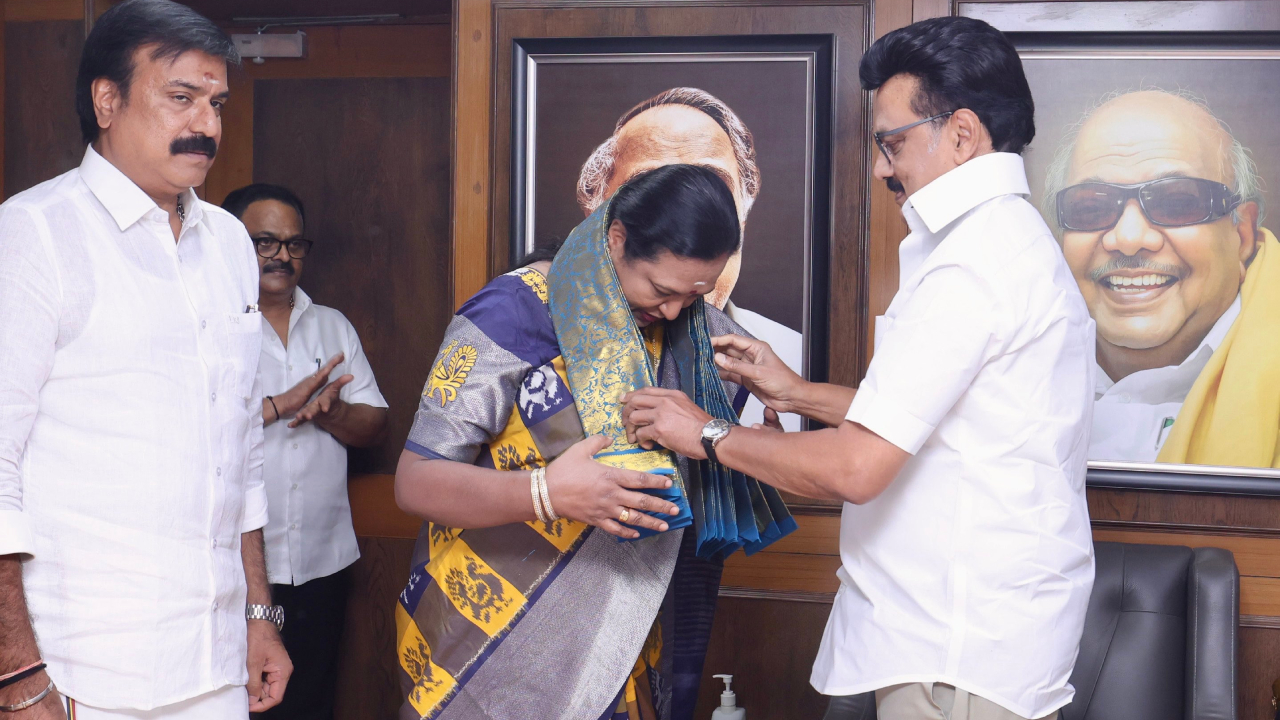
DMDK chief Premalatha Vijayakanth meeting Tamil Nadu CM MK Stalin. Credit: x.com/mkstalin
Synopsis: The Dravida Munnetra Kazhagam (DMK) has expanded its Secular Progressive Alliance by bringing in more than 20 parties, including Makkal Needhi Maiam (MNM), the Desiya Murpokku Dravida Kazhagam (DMDK) and several caste-based and community organisations ahead of the 2026 Tamil Nadu Assembly election. The move is aimed at consolidating votes in dozens of constituencies where the alliance won or lost by narrow margins in 2021, including several seats decided by fewer than 10,000 votes.
The ruling Dravida Munnetra Kazhagam (DMK) in Tamil Nadu is using several strategies as it seeks a second consecutive term in the 2026 Assembly election.
One of them is a steady expansion of its Secular Progressive Alliance (SPA). The coalition now includes a wider mix of parties, from national outfits to smaller regional and caste-based organisations, as well as individual leaders such as O Panneerselvam, a three-time Chief Minister and veteran All India Anna Dravida Munnetra Kazhagam (AIADMK) leader who was expelled from the party.
The move appears aimed at strengthening the alliance in constituencies where the margin of victory or defeat was extremely narrow in the 2021 Assembly election.
Smaller political parties and caste organisations often command influence within specific communities. Bringing them into the alliance could help the DMK consolidate those votes in closely contested seats.
In the 2021 Assembly election, the DMK alliance consisted of fewer than 10 parties and organisations.
It included the Congress, Marumalarchi Dravida Munnetra Kazhagam (MDMK), Communist Party of India (CPI), Communist Party of India (Marxist), Viduthalai Chiruthaigal Katchi (VCK), Indian Union Muslim League (IUML), Tamilaga Vazhvurimai Katchi (TVK) and Kongunadu Makkal Desiya Katchi.
Over the past few months, the DMK has brought more than 20 additional parties and organisations into the alliance.
These include actor Kamal Haasan’s Makkal Needhi Maiam (MNM), Manithaneya Jananayaga Katchi (MJK), Manithaneya Makkal Katchi (MMK), the Social Democratic Party of India (SDPI), Mukkulathor Pulipadai, Kongu Ilaignar Peravai, Adi Thamilar Peravai, Makkal Viduthalai Katchi, Puthiya Dravida Kazhagam, Samathuva Makkal Kazhagam, Moovendar Munnetra Kazhagam, Tamil Puligal Katchi, Adi Thamilar Katchi, Tamilar Desam Party, Akhila India Pasumpon Munnani, Dravida Tamilar Katchi and the Aam Aadmi Party.
Most notably, the Desiya Murpokku Dravida Kazhagam (DMDK) has aligned with the DMK for the first time since its formation.
Beyond political parties, the DMK has also secured the backing of several Christian and Islamic organisations that function as socio-political movements.
In the 2021 Assembly election, the DMK-led SPA won 159 constituencies, but nearly 43 of those victories came with margins of fewer than 10,000 votes, including several seats now held by ministers.
Three constituencies were won with margins below 1,000 votes. In 14 seats the margin ranged between 1,000 and 5,000 votes, and in 16 constituencies it was between 5,000 and 10,000 votes.
One example is Thirumayam, represented by S Ragupathi, Tamil Nadu’s Minister for Law, Courts, Prisons and Prevention of Corruption.
In the 2021 election, S Ragupathi secured 71,349 votes while AIADMK candidate PK Vairamuthu polled 69,967 votes, giving the DMK leader a narrow margin of 1,382 votes.
That election also saw K Selvakumar, leader of the Veera Mutharaiyar Munnetra Sangam and the Tamilar Desam Party, contest the seat and secure 15,144 votes, or 8.7 percent of the total vote share.
Selvakumar has now joined the DMK alliance. Makkal Needhi Maiam, which secured 1,356 votes in the constituency, is also now part of the alliance. Selvakumar’s organisation represents the Mutharaiyar community, which has a significant presence in Pudukkottai and neighbouring districts.
Meanwhile, the Amma Makkal Munnetra Kazhagam (AMMK), which secured 1,503 votes in the constituency, has joined the AIADMK alliance, though it is unclear whether this will significantly strengthen the party in the seat.
Katpadi offers another example. The constituency is represented by Durai Murugan, the DMK’s general secretary and Minister for Water Resources, who has held the seat since 1996.
In the 2021 election, Durai Murugan secured 85,140 votes while AIADMK candidate V Ramu polled 84,394 votes, leaving a razor-thin margin of 746 votes.
Questions remain over whether the veteran leader will contest again because of health concerns. That uncertainty has increased the DMK’s interest in strengthening its vote base in the constituency.
To consolidate support among intermediate caste groups and Muslim voters, the DMK has brought several Muslim organisations into its alliance, including MMK, SDPI, MJK and IUML.
The party has also aligned with organisations representing Dalit communities, including Adi Thamilar Peravai, Tamil Puligal Katchi and Adi Thamilar Katchi.
These groups operate across Tamil Nadu and can contribute between 1,000 and 10,000 votes in constituencies where they have influence.
The DMK also lost several constituencies by extremely small margins in 2021.
One of the most notable examples is Modakkurichi, now represented by BJP MLA C Saraswathi. Saraswathi secured 78,125 votes while DMK candidate Subbulakshmi Jagadeesan polled 77,844 votes, a difference of just 281 votes.
Coimbatore South offers another example. BJP leader Vanathi Srinivasan defeated actor Kamal Haasan, who contested under his Makkal Needhi Maiam (MNM) banner.
Vanathi Srinivasan secured 53,209 votes while Kamal Haasan polled 51,481 votes. Congress candidate Mayura S Jayakumar finished third with 42,383 votes.
MNM is now part of the DMK alliance. The combined vote base of the DMK, MNM and Congress could therefore pose a stronger challenge to the BJP in the constituency.
The Kongu region has a complex social composition, with communities such as Gounders, Dalits, Nadars and Mudaliars playing a significant role in electoral politics.
In the previous election, the region proved particularly challenging for the DMK and contributed significantly to the AIADMK’s victories. The party is therefore keen to regain ground in the Kongu belt ahead of the 2026 election.
To do this, the DMK has brought parties active in the region into its alliance, including U Thaniyarasu’s Kongu Ilaignar Peravai and the Puthiya Dravida Kazhagam, which are often identified with sections of the Gounder community.
Several constituencies in the southern districts also saw close contests in the previous election.
In Madurai South, the DMK won by 6,515 votes. In Madurai West, the party lost to former minister Sellur K Raju by 9,121 votes. In Usilampatti, the DMK lost by 7,477 votes, while in Andipatti it won by 8,538 votes.
To strengthen its prospects in the region, the DMK recently inducted former Chief Minister O Panneerselvam into the party. The move is aimed at attracting support from sections of the Mukkulathor community in the southern districts.
The DMK has also allied with organisations linked to the community, including actor Karunas’ Mukkulathor Pulipadai, Sridhar Vandaiyar’s Moovendar Munnetra Kazhagam and Moorthy Thevar’s Akhila India Pasumpon Munnani.
Like the DMK, the AIADMK alliance also won several constituencies by narrow margins in the 2021 election. Around 26 of its victories came with margins of fewer than 10,000 votes.
In Krishnagiri district in northern Tamil Nadu, AIADMK candidate K Ashok Kumar won the Krishnagiri constituency by just 794 votes. He secured 96,050 votes while DMK candidate T Senguttuvan polled 95,256 votes.
In the same constituency, Makkal Needhi Maiam (MNM) candidate KR Ravishankar secured 3,455 votes. MNM is now aligned with the DMK alliance, and those votes could influence the outcome if they shift to the alliance.
Veppanahalli in the same district offers another example. AIADMK leader KP Munusamy won the seat by 3,054 votes.
In that election, the DMDK candidate secured 3,601 votes while the MNM candidate secured 672 votes. Both parties are now aligned with the DMK, which could make the constituency more competitive for the AIADMK.
Some constituencies represented by alliance partners also saw close contests in the previous election.
In Vriddhachalam in Cuddalore district, Congress candidate Radhakrishnan won by just 862 votes. In that election, DMDK leader Premalatha Vijayakanth secured 25,908 votes. With the DMDK now aligned with the DMK, the alliance’s prospects in the constituency could improve.
Mettur in Salem district offers a similar example. PMK candidate S Sadasivam won by a margin of 656 votes.
In the same election, MNM secured 4,605 votes while DMDK secured 1,874 votes. With both parties now aligned with the DMK, the balance of votes in the constituency could shift.
The DMK’s decision to align with several caste-based organisations has drawn criticism from some quarters. Critics have argued that a party that claims to uphold social justice should not form alliances with caste-based outfits.
Senior journalist Nakkheeran Prakash, however, said similar electoral mechanisms have long been used by the BJP in several states, where the Rashtriya Swayamsevak Sangh (RSS) has built influence among different caste groups and communities.
“What the DMK is doing is using this electoral mechanism to establish a social justice government, rather than to deepen caste divisions,” he said.
Prakash also said the AIADMK has failed to use such electoral strategies effectively, which has weakened the party.
“With leaders such as Sasikala and O Panneerselvam, who represented the Mukkulathor community, moving away from the AIADMK, the party has increasingly shrunk into a formation representing a limited social base,” he said.
“Those who do not look at this through the lens of electoral strategy may see it as problematic. But from an electoral perspective, the DMK has used this mechanism effectively,” he added.


