

Published Dec 24, 2025 | 4:58 PM ⚊ Updated Dec 24, 2025 | 4:58 PM

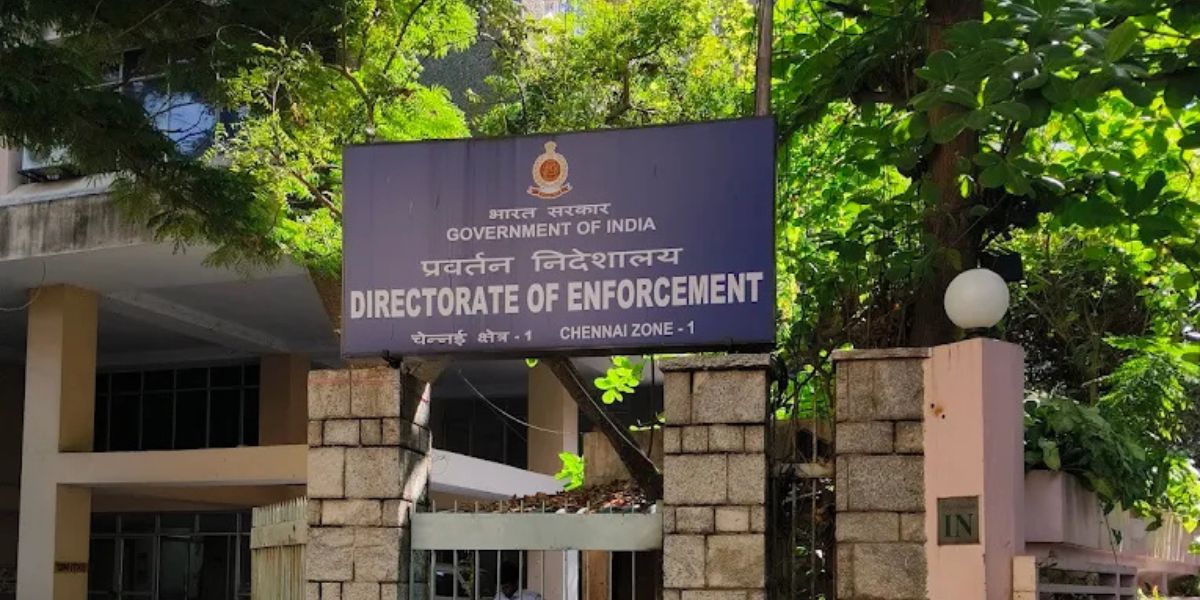
Enforcement Directorate (ED).
Synopsis: For years now, questions have been raised over the Enforcement Directorate’s increasing attempts to expand its jurisdiction. Confrontational overreach, such as raiding a corporation’s headquarters instead of individuals, and dispensing collective punishment irrespective of individual involvement, points to a version where process itself becomes punishment.
“Crossing all limits.” “Violating the federal structure of the country.” “Encroaching upon the state’s right to investigate.” “How can a corporation commit an offence?”
These were some of the remarks made by the Supreme Court of India while hearing a petition against the Enforcement Directorate (ED) over its handling of a probe into alleged irregularities involving the Tamil Nadu State Marketing Corporation (TASMAC).
The stern observations by the two-judge bench of the apex court, headed by then Chief Justice of India BR Gavai, highlighted a sample of a larger and concerning pattern in the central agency’s approach to investigations, particularly in opposition-ruled states.
In the TASMAC case, the allegations and contentions made by the ED, and their merit—or lack thereof—prompted the court, in October, to freeze the investigation pending a review of provisions of the Prevention of Money Laundering Act (PMLA).
Months earlier, in June, the Madras High Court had also ordered a stay on the ED’s probe in a case against film producer Akash Baskaran and businessman Vikram Ravindran.
Despite the court’s stay, the ED went on to issue fresh notices to Baskaran, inviting the court’s wrath. The episode culminated in the agency having to offer an unconditional apology.
A closer look at how the central agency has been functioning in opposition-ruled states reveals a growing tendency to prioritise headline management, calculated leaks, and narrative-building over clean and effective investigation.
Disregard for due process, confrontational overreach, procedural lapses and violations of the principles of natural justice, compromising investigations, have become the byproduct of prioritising agenda-setting over effective probes.
The ED’s abysmal track record of convictions in cases over the years has done little to shake off criticism that the central agency has become a tool of political intimidation, deployed by the BJP-led Union government against Opposition leaders, especially ahead of elections.
The latest flashpoint between the ED and Tamil Nadu has come in the form of a push by the central agency to file an FIR against KN Nehru, the Minister for Municipal Administration and Water Supply.
In two letters sent to the Tamil Nadu Director General of Police (DGP)—one in November and another in December this year—the ED alleged corruption and malpractice of over ₹1,000 crore in the recruitment process of the Department of Municipal Administration.
Curiously, the source of the ED’s allegation, as per its letter to the DGP, stems from the recovery of digital evidence such as WhatsApp chats during the investigation of a bank fraud case, which has since been quashed.
“The evidences were found by ED accidently when investigations were being done in a different case against a few individuals,” the letter to the DGP said.
The “accidentally” discovered leads, as per the ED, included digital evidence such as photos, WhatsApp chats and documents. The agency insisted that the evidence pointed to bribery for jobs and the routing of ill-gotten money via hawala routes.
The ED wanted the Tamil Nadu police to file an FIR, which would allow the agency to take over the probe. It may be noted that procedural lapses, such as filing a chargesheet in the National Herald case without an FIR, have previously invited judicial wrath against the agency.
Even before any action could be initiated, the ED’s letter to the DGP, along with hundreds of pages of “evidence”, which were supposed to be confidential documents, made their way into the public domain through selective leaks.
Several media houses reproduced the allegations and the vocabulary used by the ED verbatim from its “confidential” file.
The contents became so publicly available that they were attached to a PIL filed at the Madurai Bench of the Madras High Court by one K Athinarayanan, seeking directions to the police to act on the ED’s letter.
This prompted the Tamil Nadu police to launch an investigation into how confidential documents had reached non-official persons and to file an FIR against Athinarayanan.
The same modus operandi was on display during the ED’s investigation into the TASMAC row.
Leaked information through select platforms and individuals, narrative building even before the completion of probes, and procedural lapses such as collective punishment were evident, such as the violations of privacy of state government employees of TASMAC and the unauthorised seizure of personal gadgets.
The lapses in following due process and violations of constitutional mandates formed the foundation of Tamil Nadu’s arguments against the ED in the Supreme Court in the TASMAC case.
The court, finding merit in the arguments, froze the probe. The stay on the investigation, however, could not undo the damage caused by perception politics. One could even argue that the ED did not face a real setback despite its probe being suspended, if the intended target had already been achieved.
Confrontational overreach, such as raiding a corporation’s headquarters instead of individuals, and dispensing collective punishment irrespective of individual involvement, points to a version where process itself becomes punishment.
Violations of process have landed ED officials in trouble in the past, with state police filing FIRs against them, eventually leading to cases landing in court for disposal.
For years now, questions have been raised over the Enforcement Directorate’s increasing attempts to expand its jurisdiction.
Opposition parties insist that under the Narendra Modi government, the Central Bureau of Investigation, the Income Tax Department and the ED have become tools of political intimidation.
With low conviction rates but mounting criticism, the ED’s handling of cases in Opposition-ruled states has done little to change that perception.
(Edited by Dese Gowda)


