

Published Jan 24, 2026 | 9:00 AM ⚊ Updated Jan 26, 2026 | 8:44 AM

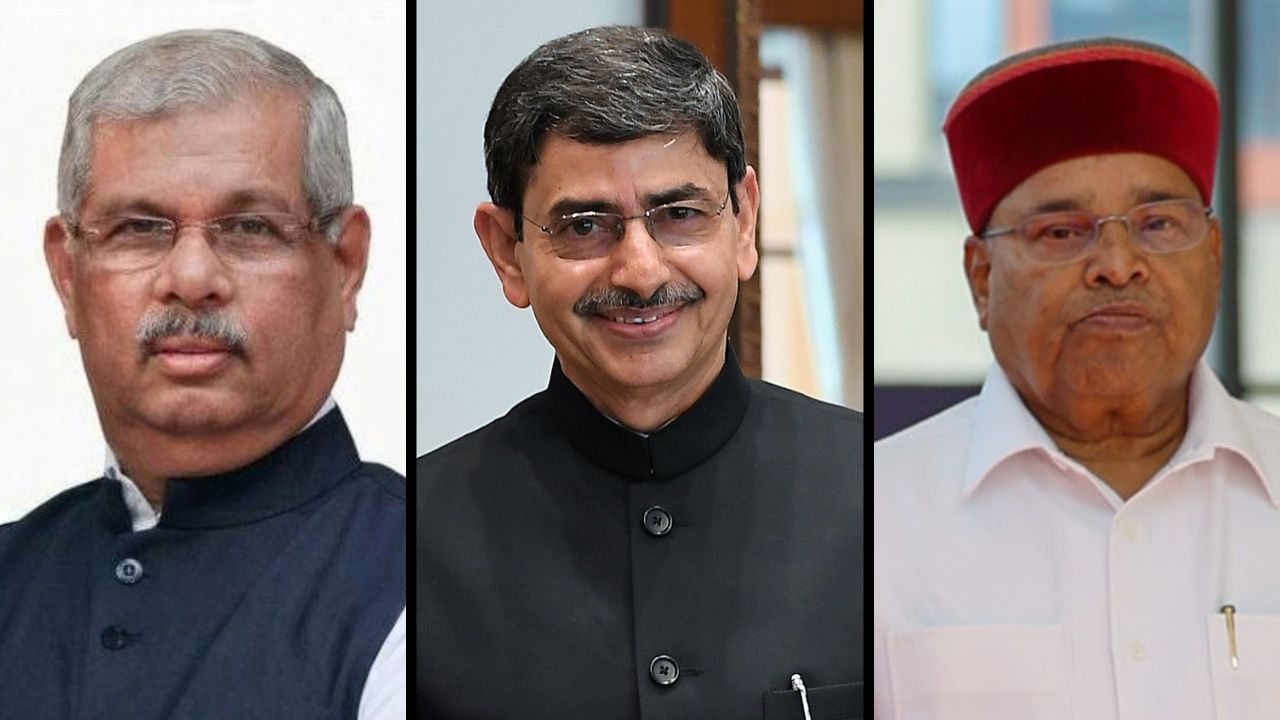
Kerala governor Rajendra Arlekar, Tamil Nadu governor RN Ravi, and Karnataka governor Thawarchand Gehlot.
Synopsis: Governors in Tamil Nadu, Kerala and Karnataka recently broke with constitutional convention by refusing, in different ways, to deliver the customary address prepared by elected state governments at the start of legislative sessions. The move drew sharp criticism from the state governments concerned. While the states have said they will explore legal avenues to hold Lok Bhavans accountable, the Constitution offers little direct recourse. More importantly, it gives governors little real authority in the first place.
This week, between 20 and 23 January, governors of three southern states, all with non-BJP governments, broke with constitutional convention. They refused to deliver their customary address, prepared and submitted by the elected state governments, that marks the start of the legislative session.
The Governor of Tamil Nadu refused to read the address in the Legislative Assembly. The Governor of Kerala skipped several key portions of the address. The Governor of Karnataka addressed the Assembly in just two lines in Hindi and then walked out.
The sequence of events is extraordinary, to say the least. In Tamil Nadu’s case, however, it has become something of a pattern. Since his arrival in the state, Governor RN Ravi has repeatedly avoided reading the Governor’s address in full, year after year.
Chief Minister MK Stalin condemned the Ravi’s refusal and called it unconstitutional. He also announced that, along with like-minded states, Tamil Nadu would explore legal measures to do away with the convention of the Governor’s address at the start of Assembly sessions.
Kerala and Karnataka have also said they will legally challenge the actions of their respective governors.
The controversy has raised several questions: what does the Constitution actually say? What is the governor’s role, and does he have the right to reject or refuse to deliver an address prepared by an elected government?
The Constitution of India clearly defines the role of a governor, and the scope of their powers and functions, through various articles. A key takeaway from these provisions is that the governor is a figurehead, bound to act on the advice of the elected Council of Ministers.
Most notably, Article 176 mandates that, at the start of the first session after each general election to the Legislative Assembly, and at the start of the first session of each year, the governor shall address the Legislative Assembly, or both Houses together in states with a Legislative Council, and inform the legislature of the causes of its summons.
It further requires the rules of procedure of the House or Houses to provide time for discussion of the matters referred to in the governor’s address.
The Supreme Court has, through multiple judgments interpreting these provisions, laid down clear limits on a governor’s powers.
One of the most significant cases in this regard is Nabam Rebia & Anr vs Deputy Speaker, Arunachal Pradesh Legislative Assembly (2016).
In this case, the apex court reaffirmed that under Article 163(1) of the Constitution, a governor is constitutionally bound to act on the aid and advice of the Council of Ministers headed by the Chief Minister, except in narrowly defined situations where the Constitution expressly grants discretion.
The court observed that, as a general rule, the governor “would ordinarily exercise his functions on the aid and advice of the Council of Ministers.”
The judgment makes this explicit: the governor is not an independent executive authority. Citing earlier Constitution Bench rulings, the court held that the governor is “only a formal or constitutional head”, while executive power is exercised by the elected government.
Since there is no general provision allowing the governor to act on “individual judgment”, the court ruled that the governor is bound by ministerial advice in the discharge of executive functions.
“…the Governor is only a formal or constitutional head. His executive functions are, therefore, dependent on the aid and advice given by the Council of Ministers. Since there is no provision enabling the Governor to act in ‘his individual judgment’, the Governor is bound by the advice of the Council of Ministers with whose aid he acts. This is completely in harmony and consonance with the views of the Constituent Assembly. Moreover, there is a recognition and acceptance that since the Council of Ministers enjoys a majority in the Legislature, it is in virtual control of both the executive and legislative functions of the Governor. Therefore, the Governor has little or no authority over the Executive or the Legislature, except to the extent specifically provided for in the Constitution,” the judgment reads.
In the same judgment, the Supreme Court cautioned against any interpretation that would allow a governor to function as a parallel power centre within a state. The Constitution, it said, does not allow a governor to routinely override or bypass an elected government.
Allowing such conduct would amount to creating a “parallel administration”, which is constitutionally impermissible.
Thus, the President and governors must exercise their formal constitutional powers only on, and in accordance with, ministerial advice, barring a few well-recognised exceptions. These exceptions are limited and cannot be expanded by implication or political convenience.
“…matters where the Governor acts in his discretion he will act in harmony with his Council of Ministers. The Constitution does not aim at providing a parallel administration within the State by allowing the Governor to go against the advice of the Council of Ministers,” the judgment reads.
The institution of the governor is a product of colonial rule.
“It was introduced during British rule. Earlier, governors were appointed from London; now they are appointed from Delhi. If there is talk of removing colonial vestiges, then the governor’s post should be the first to go,” retired Justice Hari Paranthaman told South First.
But whether at the state or Union level, power rests with elected governments.
“In India, as in England, the executive has to act subject to the control of the legislature. The President has thus been made a formal or constitutional head of the executive, and the real executive powers are vested in the ministers or the Cabinet,” he explained.
“The same provisions apply to the governments of states. The governor occupies the position of the head of the executive in the state, but it is virtually the Council of Ministers in each state that carries on executive government. The Council of Ministers is, like the British Cabinet, ‘a hyphen which joins, a buckle which fastens the legislative part of the state to the executive part.’”
Clashes between elected governments and governors appointed by the Centre are not new. In the 1960s, former Tamil Nadu Chief Minister CN Annadurai famously quipped: “Why does a goat need a beard, and why does a nation need a governor?”
Justice Paranthaman pointed to a notable case from his own career, when, as a lawyer, he argued for four people convicted in the assassination of former Prime Minister Rajiv Gandhi.
“In 1999, when the death sentences of all four had been confirmed, they submitted mercy petitions to the then Governor of Tamil Nadu, Fathima Beevi. She rejected them outright,” he said.
The four challenged this decision in the Madras High Court, where a legal team led by Advocate Chandru appeared on their behalf.
“We argued that the governor had rejected the mercy petitions without seeking the advice of the state Cabinet. Because of that, the rejection was invalid. The court accepted this argument and quashed the governor’s decision,” Justice Paranthaman said.
After this, the Cabinet led by then Chief Minister M Karunanidhi considered the petitions and recommended that one convict’s death sentence be commuted to life imprisonment. Governor Fathima Beevi then approved the recommendation.
While obstructions by governors in opposition-ruled states are not new, they have become far more frequent since the BJP came to power in 2014, according to Justice Paranthaman.
“Even earlier, governors in Tamil Nadu created problems, but this governor is doing it on a much larger scale. RN Ravi behaves like an opposition leader. And it’s not just him. Governors in Kerala, Karnataka and West Bengal are doing exactly the same thing in opposition-ruled states,” he said.
Notably, while the Constitution does not give governors the authority to reject the guidance of elected governments, it also offers only limited ways to hold them directly accountable when they do so.
Courts are often seen as the last hope. But Justice Paranthaman said many positions there are now occupied by people aligned with the Rashtriya Swayamsevak Sangh.
“Institutions like the Governor, the Comptroller and Auditor General and the Union Public Service Commission, all constitutional bodies, have been brought under control. In addition, investigative agencies like the Central Bureau of Investigation, and even bodies like the Central Board of Film Certification, are being weaponised. In my view, even the judiciary has been brought under their control. So wherever you go, the verdict is likely to favour them,” Justice Paranthaman said.
“The ruling establishment uses the courts as its biggest weapon. From the Tirupparankundram case to many other issues, the courts are central to how their machinery functions.”
Although Chief Minister MK Stalin has announced that the state would explore all legal avenues to do away with the colonial convention, this would be a difficult task, especially in the current political climate.
“To remove the Governor’s address from the start of Assembly sessions, Article 176 of the Constitution would have to be amended. Any constitutional amendment requires a two-thirds majority in Parliament,” JusticeParanthaman said.
“In the current political scenario, no party has those numbers. This should therefore be seen as part of a long, sustained struggle.”
(Edited by Dese Gowda)


