

Published Jan 08, 2026 | 8:00 AM ⚊ Updated Jan 08, 2026 | 8:39 AM

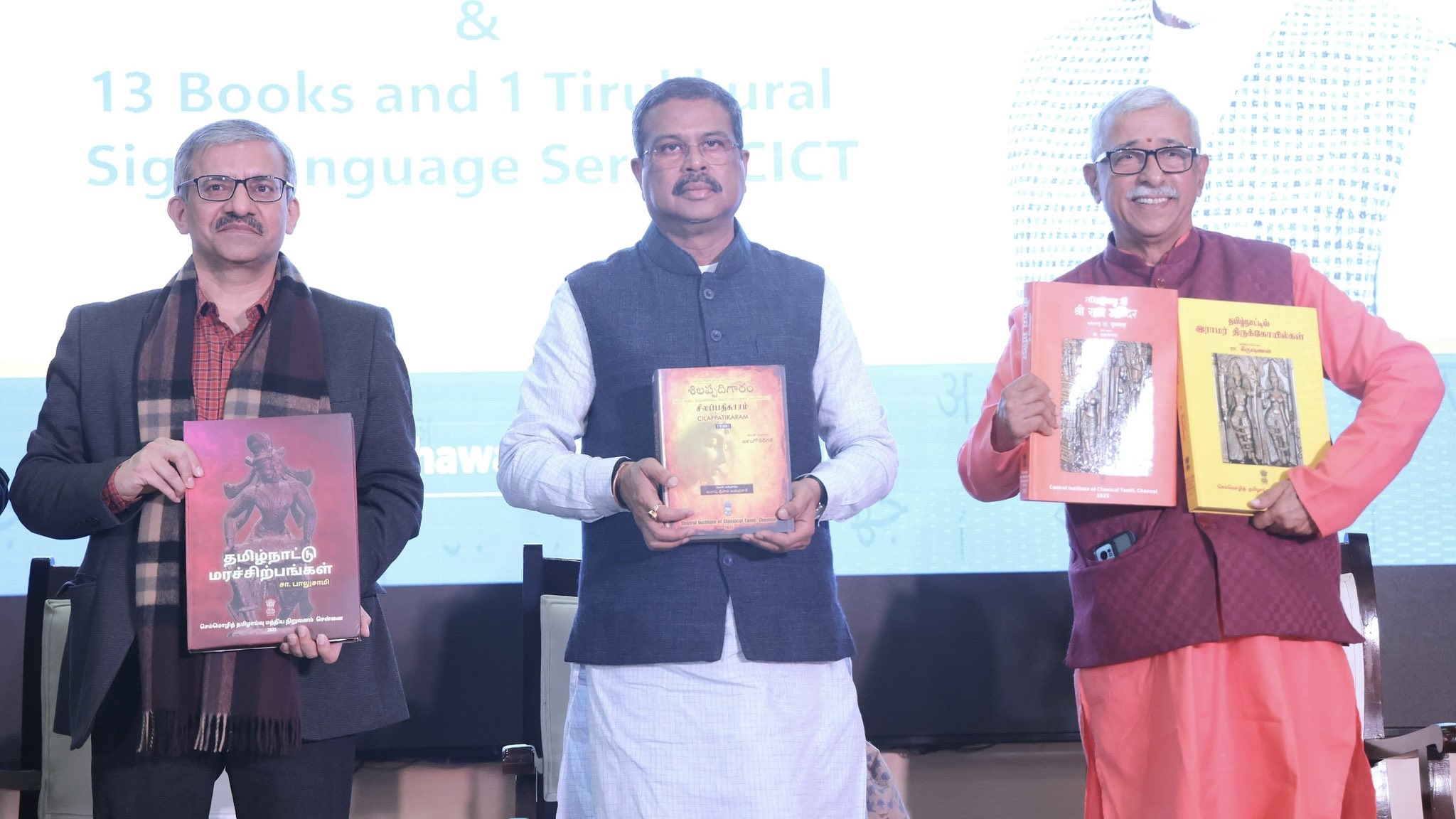
Of the 55 books released by Dharmendra Pradhan, 13 were produced by the Central Institute of Classical Tamil.
Synopsis: Union Education Minister Dharmendra Pradhan recently released 55 scholarly volumes in by the Central Institute of Classical Tamil classical Indian languages, including an interpretation of the Tirukkural in Sign Language. However, the inclusion of books on Ram temples and temple sculptures has sparked controversy, coming ahead of the Assembly elections in Tamil Nadu and Kerala. Critics argue that the BJP is using cultural institutions and language initiatives to advance a broader Hindutva agenda.
Union Education Minister Dharmendra Pradhan on Tuesday, 6 January, announced the release of 55 scholarly volumes in classical Indian languages, including an interpretation of the classic Tamil text Tirukkural in Sign Language. He described the initiative as part of a national effort to place India’s linguistic heritage at the heart of education, research and cultural pride.
The works, spanning Kannada, Telugu, Malayalam, Odia, Tamil and Sign Language, reflect the government’s commitment to strengthening Indian languages, Pradhan said in a post on X.
Emphasising that “all Indian languages are national languages”, he credited Prime Minister Narendra Modi for consistently advocating linguistic diversity and for promoting education and translation in Indian languages.
While the initiative has been projected as an academic and cultural milestone, its timing, just months ahead of the Assembly elections in Tamil Nadu and Kerala, has attracted political attention, particularly in the context of the BJP’s repeated attempts to foreground language and culture as instruments of national integration.
Of the 55 books released by Dharmendra Pradhan, 41 were produced by the Centres of Excellence for Classical Languages under the Central Institute of Indian Languages. The remaining 13 books, along with the Tirukkural edition in Sign Language, were produced by the Central Institute of Classical Tamil (CICT).
In general, publishing classical Tamil texts is the primary mandate of the institution. On that basis, it has continuously republished various Sangam-era Tamil literary works, grammatical texts and research volumes.
It is in this context that the Central Institute of Classical Tamil has now released these 13 books.
The list includes six Malayalam translations of Sangam-era works such as Purananuru, Pathitrupathu and Pattuppattu, as well as post-Sangam Keelkanakku texts including Nanmanikkadigai, Naanarpathu and Muthollayiram; a Telugu translation of Silappathikaram, one of the five great Tamil epics; Tamil Nadu Ramar Temples (Tamil and Hindi), which documents 64 Ram temples in Tamil Nadu; Tamil Nadu Wooden Sculptures, a research compilation on wooden sculptures found in temples; Sangam Literature Lexicon; Akananuru Lexicon – Verbs; and Akananuru Lexicon – Nouns. Along with these 13 books, Tirukkural videos in Sign Language for the hearing impaired were also released.
The list of Tamil books released at the event has also become contentious.
Among the 13 books, the publication of Tamil Nadu Ramar Temples, which documents 64 Ram temples in Tamil Nadu and has been brought out in Tamil and Hindi, and Tamil Nadu Wooden Sculptures, which studies wooden sculptures found in temples, has drawn particular attention.
Questions are now being raised within Tamil academic circles about what connection these two books have with the concept of a “classical language”.
As far as the Central Institute of Classical Tamil is concerned, its core objective is to highlight the antiquity, uniqueness, civilisation and culture of the Tamils based on 41 recognised classical Tamil texts.
To achieve this, the institute focuses on republishing classical texts, translating them into various languages, publishing research studies and reports produced by scholars on these texts, and examining the influence of the Tamil language on multiple disciplines and languages, as well as its antiquity and distinctiveness.
While institutions for other classical languages function under the Central Institute of Indian Languages, the CICT alone functions as an autonomous body, with Tamil Nadu Chief Minister M K Stalin as its chairperson.
In September 2024, Dr Sudha Seshayyan, former Registrar and Vice-Chancellor of MGR Medical University, was appointed Vice-Chairperson of the institute by the Union Ministry of Education. It is said that she has authored several books on spirituality.
However, her appointment was opposed at the time by Velmurugan, leader of the Tamilaga Vazhvurimai Katchi, and several Tamil scholars.
In this context, researchers believe that the two books released now have created confusion.
“When Tamil scholars earlier argued that there should be comprehensive research on Tamil tradition as a whole, they were told that this institute exists only for the study of classical literature. But today, moving away from that position, it is surprising to see books being published on wooden sculptures in temples and on the locations of Ram temples,” says Tamil Kamarasan, a scholar, editor and researcher known for his work on religion, philosophy and political thought in Tamil intellectual history.
Kamarasan points out that there are two objectives behind this for the Bharatiya Janata Party government: one, its long-term Hindutva project, and two, its electoral goals.
Referring to the appointment of Sudha Seshayyan, Kamarasan says, “Even then, many Tamil scholars questioned what connection she had with classical Tamil and why she was being appointed Vice-Chairperson.”
He continues: “The reason is that behind this lies the Bharatiya Janata Party’s Hindutva project.”
According to him, the BJP pursues such initiatives with two aims: a long-term Hindutva project that yields enduring benefits, and a short-term electoral objective that delivers immediate political gains. He argues that, for this, the party uses India’s official institutions. As an example, he cites the arguments presented in Modi’s India: Hindu Nationalism and the Rise of Ethnic Democracy by Christophe Jaffrelot.
In the book, Jaffrelot argues that the institutions of Indian democracy are being weakened and reshaped under the leadership of Prime Minister Narendra Modi.
By releasing books on Ram and on wooden sculptures found in Tamil Nadu temples, Kamarasan argues, the BJP is advancing a specific political narrative in cultural terms. This, he says, serves its long-term ideological objectives.
At the same time, by undertaking such initiatives during election periods, the party seeks to project an image that it is supportive of all languages and is working to promote all languages, he adds.
The Kashi Tamil Sangamam event, which has been held since 2022, has also attracted similar political criticism. Tamil activists and political leaders argue that such events are aimed at advancing a politics that seeks to link Tamil civilisation with North India and to present them as inherently unified, while also keeping electoral gains in mind.
“If they truly have equal respect for all languages, then why have they allocated more funds and resources to Hindi and Sanskrit, while failing to give due importance to languages such as Tamil and Prakrit, which have even greater antiquity?” Kamarasan asks.


