


Published Feb 18, 2026 | 10:09 AM ⚊ Updated Feb 18, 2026 | 11:53 AM

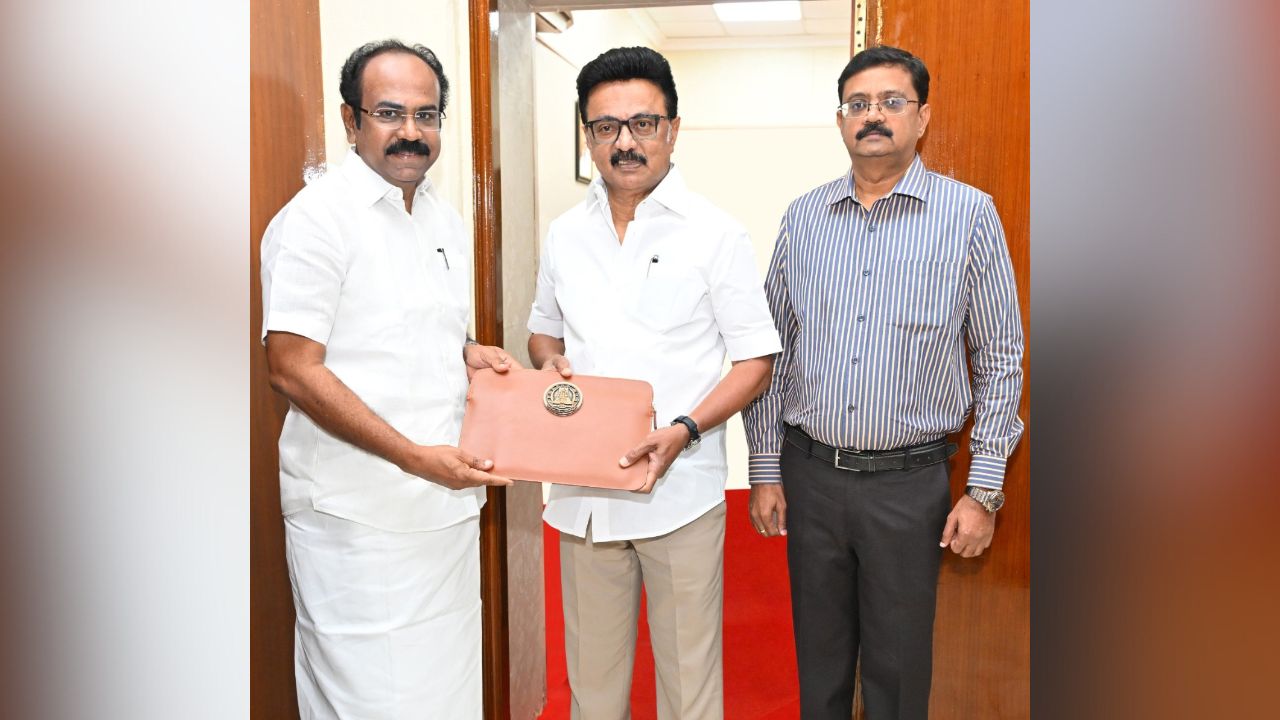
Tamil Nadu Finance Minister Thangam Thenarasu handing over the interim budget document to Chief Minister MK Stalin.
Synopsis: The Tamil Nadu Finance Minister presented the state’s interim Budget of 17 February. The budget attempts to defend expansive welfare spending, accelerate capital investment, and justify rising debt, all in the shadow of mounting federal tensions. The minister also criticised the Union government and the 16th Finance Commission over ‘unfair’ fund allocation for the state.
“பகுத்துண்டு பல்லுயிர் ஓம்புதல் நூலோர்
தொகுத்தவற்றுள் எல்லாம் தலை” (குறள் 322)
“To share one’s meal with others, and all life to save,
Is chief of all the lore that learned sages gave.”
When Thangam Thenarasu rose to present the 2026–27 Interim Budget in the Tamil Nadu Assembly on 17 February, he invoked this couplet from Thiruvalluvar. The choice was deliberate. The verse speaks of sharing, protection and collective welfare — themes that echo through the state’s fiscal philosophy.
However, once the poetry settled and the spreadsheets took over, the scale of what was being placed before the House became unmistakable. This was not a routine interim exercise. It was one of the largest fiscal frameworks Tamil Nadu has operated with — a budget that attempts to defend expansive welfare spending, accelerate capital investment, and justify rising debt, all in the shadow of mounting federal tensions.
For the financial year 2026–27, Tamil Nadu’s total revenue receipts are estimated at ₹3,44,575.31 crore. That marks a substantial rise from the Revised Estimates of ₹3,09,697.92 crore for 2025–26. On the expenditure side, total revenue expenditure is projected at ₹3,93,271.63 crore, compared to ₹3,78,917 crore in the previous year’s revised figures.
Even before capital spending is factored in, the state is operating at a large scale.
Capital expenditure for 2026–27 has been set at ₹59,561.72 crore, up from ₹51,442.93 crore in the 2025–26 Revised Estimates, a nearly 16 percent increase.
When net loans and advances are included, the total capital outlay climbs to ₹73,270 crore. The fiscal deficit is estimated at ₹1,21,949 crore, pegged at three percent of the Gross State Domestic Product (GSDP), while the revenue deficit is projected at ₹48,696 crore.
Since it was an interim budget, no major new announcements were made. However, in a significant political move ahead of the 2026 Assembly polls, four days before the interim Budget, Chief Minister MK Stalin allocated ₹6,500 crore for the Kalaignar Magalir Urimai Thogai scheme, crediting ₹5,000 for each beneficiary.
He also announced that the monthly assistance would be increased to ₹2,000 after the elections.
The budget stands out in its refusal to scale back welfare commitments, although revenue expenditure rises by over 3.79 percent compared to last year. Within that, subsidies and transfers alone account for ₹1,56,108.41 crore in 2026–27, a figure that captures the backbone of Tamil Nadu’s political economy.
The Kalaignar Mahalir Urimai Thittam, the ₹1,000 monthly assistance for women heads of households, continues without dilution. Free bus travel for women under the Vidiyal Payanam scheme remains funded, with ₹4,000 crore set aside under the broader Transport allocation. Student concessions and diesel subsidies are also protected, contributing to a total Transport outlay of ₹13,062 crore.
Social security pensions for 35.33 lakh beneficiaries amount to ₹5,463 crore this year. Education remains a major spending priority, with School Education allocated ₹48,534 crore and Higher Education ₹8,505 crore. Health and Family Welfare received ₹22,090 crore.
Even in sectors that typically see incremental growth, the expansion is visible. The allocation for the welfare of differently abled persons has grown from ₹814 crore in 2021–22 to ₹1,433 crore in 2025–26, and stands at ₹1,471 crore in 2026–27.
The upward trajectory mirrors the broader pattern: Welfare is not being trimmed; it is being normalised as structural expenditure.
While welfare continues, what distinguishes this interim budget is the sharper emphasis on capital expenditure. After a year of fiscal stress, when capital outlay stood at ₹51,443 crore in Revised Estimates, the government has restored momentum by raising it to ₹59,561.72 crore.
Highways (₹21,132 crore), municipal infrastructure and water resources (₹28,227 crore), rural development (₹28,687 crore), and energy projects (₹18,091 crore) witnessed strong allocations.
The total capital commitment, including loans and advances, reached ₹73,270 crore. The message is that long-term asset creation will not be sacrificed, even in a year marked by fiscal headwinds.
This dual approach of maintaining welfare and accelerating infrastructure defines the financial architecture of the year ahead.
No fiscal discussion in Tamil Nadu escapes the debt question. The numbers here are stark in absolute terms. Outstanding debt stood at ₹9,29,959 crore in the Budget Estimates of 2025–26, which rose to ₹9,52,374 crore in Revised Estimates, and is projected at ₹10,62,248 crore in the 2026–27 Interim Estimates.
By 31 March 2027, outstanding borrowings are expected to touch ₹10,71,770.34 crore.
Although crossing the ₹10 lakh crore mark is politically sensitive, the government’s defence rests on proportional indicators rather than nominal totals. The debt-to-GSDP ratio was 26.39 percent in 2024–25 and 26.43 percent in 2025–26 Revised Estimates. It is expected to ease slightly to 26.12 percent in 2026–27.
Similarly, while the fiscal deficit had risen to ₹1,24,007 crore in 2025–26 Revised Estimates, representing 3.48 percent of GSDP, it is projected to moderate to three percent this year.
In effect, the state acknowledges that debt is growing in absolute terms, but argues that growth and revenue expansion will keep it sustainable.
The sustainability of this model depends on revenue growth. The state’s own tax revenue is projected to increase from ₹2,06,540 crore in 2025–26 Revised Estimates to ₹2,29,579 crore in 2026–27. Total revenue receipts, as noted earlier, rise by nearly ₹35,000 crore year-on-year.
State’s own revenues now account for nearly three-fourths of total revenue receipts, underlining a degree of fiscal autonomy even amid tensions with the Centre.
A significant portion of the speech delivered by Thenarasu was devoted to Centre–State financial friction.
The government cited a ₹9,600 crore GST revenue shortfall following rate rationalisation, a ₹3,087 crore transfer mandated towards the Guarantee Redemption Fund, and ₹15,877 crore in additional loss funding to Tamil Nadu Power Distribution Corporation Limited (TNPDCL) imposed as a borrowing condition.
It also flagged the withholding of funds under centrally sponsored schemes, including allocations due under Samagra Shiksha, Jal Jeevan Mission and Finance Commission grants.
Beyond these operational pressures, Thenarasu sharply criticised the recommendations of the 16th Finance Commission. He described the Commission’s report as a “great disappointment” for Tamil Nadu, particularly noting that despite demands from several states for a higher share in the divisible pool of central taxes, the share had been retained at 41 percent.
He expressed concern that the growing use of cesses and surcharges, which are not shareable with states, had not been adequately addressed.
More pointedly, he argued that Tamil Nadu’s share in central tax devolution has steadily declined over successive Finance Commissions, from 7.931 percent during the 9th Finance Commission to 4.079 percent now, resulting in what he claimed was a cumulative loss of ₹3.17 lakh crore over time, an amount he said was equivalent to roughly one-third of the state’s outstanding debt.
He further observed that while neighbouring states such as Kerala and Karnataka had seen more substantial increases in their share under the 16th Finance Commission, Tamil Nadu’s increase was marginal at 0.44 percent, which he described as the lowest among comparable States.
The broader narrative emerging from this section of the speech was clear: The state government maintains that Tamil Nadu’s fiscal stress cannot be viewed in isolation. According to its position, borrowing levels and deficit pressures must also be understood in the context of what it characterises as reduced devolution, increased conditionalities, and delayed fund releases from the Union government.
In other words, the financial debate is not just about expenditure choices within Fort St. George, but about the evolving nature of fiscal federalism itself.
With this being the last budget before the 2026 Assembly elections, several sections of society had expected major announcements addressing their long-pending demands. Various stakeholders, including part-time teachers and anganwadi workers, have been staging protests seeking permanent appointments, equal pay and improved service conditions.
Many of them were hoping that this budget would bring concrete relief. However, no significant new announcements were made.
The state government clarified on 17 February that, as this is an interim budget, its primary purpose is to present the achievements of the present government and obtain legislative approval for interim expenditure. Traditionally, interim budgets do not introduce major new schemes or policy changes.
That said, two major developments ahead of both the interim budget and the 2026 Assembly polls have drawn widespread attention across the state.
One was the recent decision to credit ₹5,000 into the accounts of beneficiaries under the Kalaignar Magalir Urimai Thogai scheme. The other was the announcement of the Tamil Nadu Assured Pension Scheme (TAPS) for government employees, a long-standing demand from employee unions seeking restoration of pension security.
In the 2026–27 Interim Budget, ₹11,000 crore has been allocated towards TAPS, signalling the government’s attempt to address employee concerns even within the limitations of an interim financial statement.
Even before the budget session began, the principal Opposition party, the AIADMK, signalled that it was in no mood to offer the government any fiscal benefit of doubt. They even distributed printed cards mocking the event as a “kāthu kuthum vizha”, literally, an ear-piercing ceremony, implying that the budget was a hollow ritual rather than a serious financial exercise.
The AIADMK accused the DMK government of amassing debt on an unprecedented scale, alleging that in its 70 years of governance history, Tamil Nadu had never seen borrowing of this magnitude. Referring to the projected outstanding debt of ₹10.62 lakh crore in 2026–27
The Opposition claimed the “Stalin model” had achieved a dubious distinction, piling up record debt that would burden generations.
In a pointed political move, the AIADMK also addressed members of the State’s Economic Advisory Council, including economists such as Raghuram Rajan, Esther Duflo, Arvind Subramanian, Jean Drèze and S Narayanan. The party questioned what advice, if any, had been offered to the chief minister and whether borrowing at this scale had been part of their recommendations. It demanded that, in the interest of transparency and accountability, the advisory council publicly disclose the nature of its fiscal guidance.
The criticism did not stop there. AIADMK leaders also targeted Dr J. Jeyaranjan, Vice Chairman of the State Planning Commission, asking about structural reforms achieved over the past five years and whether he had effectively functioned as an “agent” encouraging higher borrowing.
In a rhetorical flourish, they questioned whether the debt, which they framed as roughly ₹1.32 lakh per capita, would be repaid from the chief minister’s “own household funds,” echoing a remark previously attributed to Deputy Chief Minister Udhayanidhi Stalin.
The Opposition further accused the ruling leadership of imposing a heavy debt burden on ordinary taxpayers while allegedly prioritising foreign travel and business outreach. According to the AIADMK, this contradiction lay at the heart of what it described as the government’s flawed economic model.
However, the ruling party maintains that debt must be viewed relative to GSDP rather than in absolute terms, and points to the projected decline in the debt-to-GSDP ratio to 26.12 percent in 2026–27 as evidence of fiscal sustainability.
The debate, therefore, is not merely about numbers, but about how those numbers are framed.
(Edited by Muhammed Fazil.)


