

Published Nov 09, 2026 | 1:47 PM ⚊ Updated Nov 09, 2026 | 1:47 PM

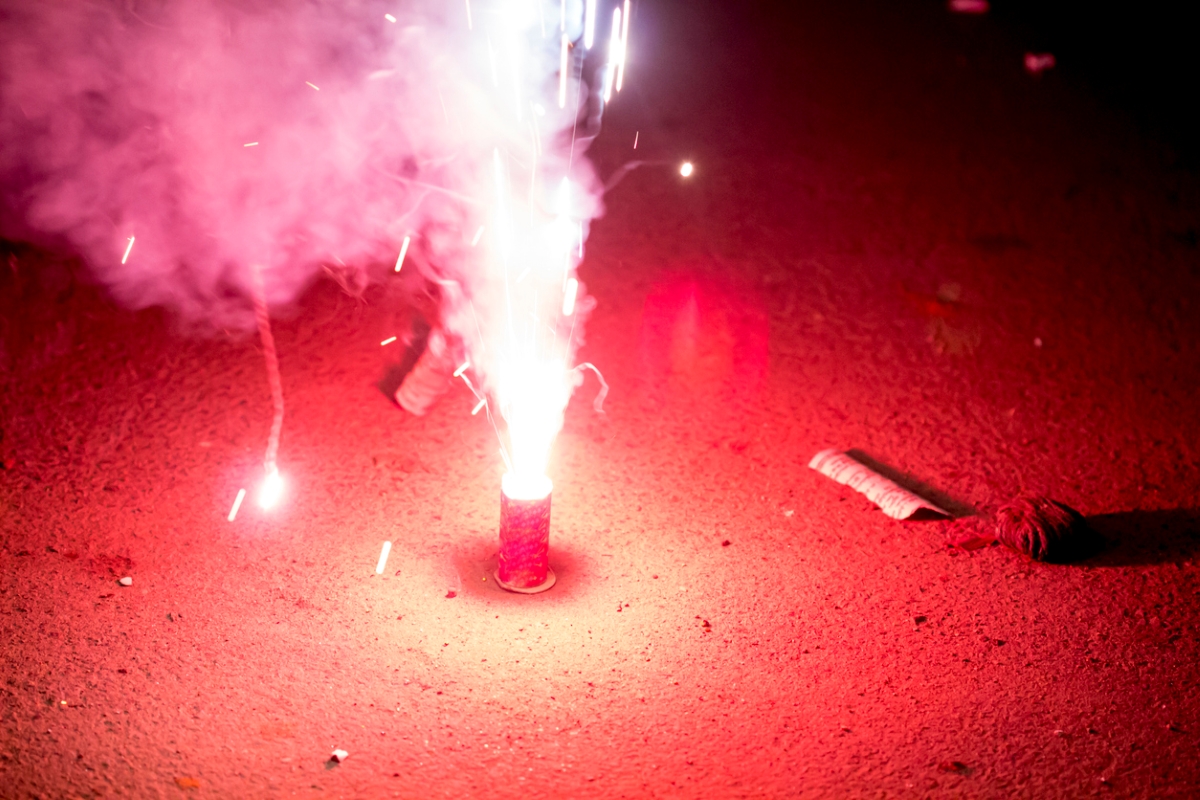
Chennai AQI crosses 1,200. (Representational image/ iStock)

Synopsis: In Chennai, the Air Quality Index (AQI) on Sunday, 8 November, crossed 1,200, placing the city in “Hazardous” category. Firecracker emissions blanketed residential neighbourhoods, affecting even those indoors; a six-month-old baby developed respiratory symptoms, while an asthma patient described the lasting impact of exposure to cracker smoke.
Amid the Deepavali celebrations across the country, the air quality has slipped to “severe” and “very poor” across many cities in India.
Chennai’s early winter stood little chance against the thick blanket of smoke unleashed by Deepavali fireworks. As firecrackers lit up the city on Sunday evening, smoke engulfed residential neighbourhoods, with some private real-time air quality monitoring platforms recording an AQI of over 1,200.
For many residents, the celebrations brought not just noise and spectacle but also coughing, eye irritation and breathing difficulties.
The deterioration in air quality was particularly concerning as several neighbourhoods reported heavy smoke and reduced visibility. Residents said the pollution had penetrated their homes despite keeping doors and windows closed, raising concerns over the exposure of children, elderly people and those with pre-existing respiratory conditions.
According to the official Central Pollution Control Board (CPCB) monitoring data, Chennai’s average AQI stood at 138 at 4 pm on November 8, in the moderate category. However, subsequent monitoring showed a significant deterioration in air quality as firecracker bursting intensified during the evening.
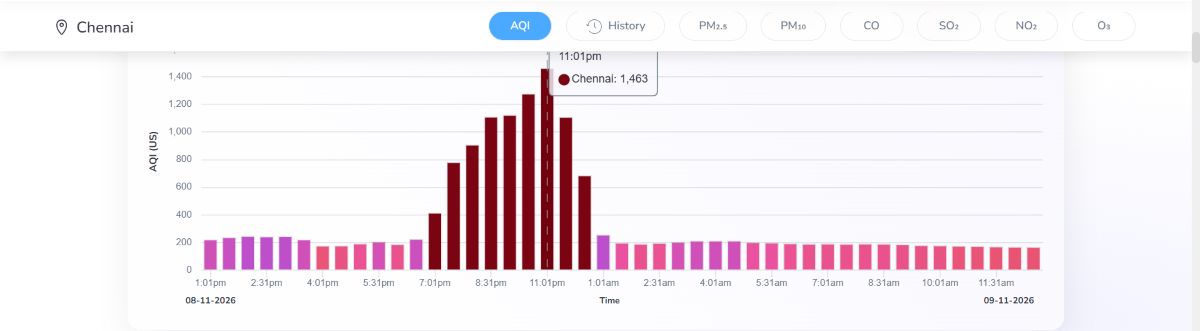
Highest AQI recorded at 11 PM in Chennai. (Screenshot/ AQI India)
An hourly assessment at around 7.30 pm reportedly recorded an AQI of 446. Some private monitoring platforms subsequently reported readings exceeding 1,200 around 10 pm.
Several citizens also took to social media to share the AQI readings on the night of Deepavali.
Environmental activist Sundarrajan, sharing the AQI reading of Sunday night, wrote on X, “People of Chennai, is this fair? If the air pollution level is this bad, it’s equivalent to smoking 60 cigarettes. This is outrageous!”
சென்னை மக்களே இது நியாயமா?
காற்று மாசின் அளவு இவ்வளவு மோசமாக இருந்தால் நீங்கள் 60 சிகரெட் பிடித்தற்கு் சமம்.
கொடுமை !
@Tnpcbofficial @TN_PCB
@IQAir https://t.co/Kh5KYQqPWA
— G. Sundarrajan (@SundarrajanG) November 8, 2026
According to CPCB, on Monday, 9 November, around noon, the AQI recorded was 221, placing the city in the “Poor” category.
The official monitoring data also showed variations across the city’s monitoring stations. On November 9, Chennai’s Manali recorded an AQI of 277, Arumbakkam 264, Kodungaiyur 220 and Velachery 202, indicating poor air quality in several parts of the city.
This came after Chennai recorded relatively better air quality a day before Deepavali. At 6.30 pm on November 7, the city’s average AQI was 72, falling under the satisfactory category. Seven of the nine monitoring stations were operational, with readings ranging from 54 at Perungudi to 92 at Velachery.
The impact of the pollution was also felt inside homes, with residents reporting eye irritation, coughing and breathing difficulties.
Janarthanan, a resident of Madipakkam in Chennai, said his six-month-old daughter developed health complications following exposure to the smoke and noise generated by firecrackers.
Despite keeping the infant indoors throughout the day and avoiding taking her outside, he said the heavy smoke during the evening affected her health.
“The baby developed eye irritation, cough and cold. She did not sleep throughout the night,” said Jana.
He also said several neighbourhoods, including Velachery, were covered in thick smoke, with visibility on roads severely affected.
Another Chennai resident, Kavitha, who has suffered from asthma since childhood, described how firecracker smoke entering their home during last year’s Deepavali triggered a severe asthma episode that significantly worsened their respiratory condition.
Kavitha, who lives on the third floor of an apartment building, said the building was relatively isolated and had good ventilation. However, during last year’s Deepavali, leaving a window open allowed smoke from firecrackers to enter the house.
“By evening, I was in my bedroom. When I eventually stepped out into the living room, I realised that the entire house had been engulfed in smoke. The living room, kitchen, and even the other bedroom were filled with smoke from the firecrackers being burst outside,” she said.
The exposure triggered a severe asthma episode, forcing the person to visit multiple hospitals over nearly a week. Despite receiving medication and injections, the breathing difficulties continued to worsen.
Eventually, repeated nebulisation helped stabilise the condition.
However, Kavitha said the episode had lasting consequences. Before the incident, they rarely needed an inhaler, with a single inhaler lasting several months. Since then, they have had to use it three to four times a day and finish an inhaler in less than a month.
“This Deepavali, I decided not to step out at all. I kept every window and every possible opening in the house closed. I even kept the kitchen and bathroom exhaust fans running throughout the day because the smoke was still finding its way into the house,” Kavitha said.
Despite these precautions, the person experienced breathing difficulties on Sunday night and had to use the inhaler again.
“I have now decided to avoid stepping out for at least the next 24 to 48 hours. Even if I have to go out, I will have to wear an N95 mask,” she said.
Questioning the lack of consideration for people with respiratory illnesses, Kavitha said firecracker pollution affected not just those bursting crackers but also everyone living in the surrounding neighbourhoods.
“What I find even more disturbing is the complete lack of consideration for other people’s health. When you burst crackers, you are not just exposing yourself to the pollution. You are forcing everyone around you to breathe it in as well,” Kavitha said.
“I don’t think a celebration should come at the cost of someone’s ability to breathe.”
The Tamil Nadu Pollution Control Board (TNPCB) had permitted firecracker bursting only between 6 am and 7 am and 7 pm and 8 pm on Deepavali, in accordance with the Supreme Court’s directions.
The board had also appealed to the public to use low-emission green crackers, avoid series crackers and burst fireworks in designated open spaces. It had cautioned that firecrackers contribute to air and noise pollution, affecting children, elderly people and those with existing health conditions.
Meanwhile, AQI India, a private real-time AQI tracker, noted that, out of the 100 most polluted cities in the country, 99 were from India on Sunday night.
99 out of 100 most polluted cities in the World are in India right now.
Keep yourself informed on your local air quality with https://t.co/mXIZvSRAaO. Stay safe, stay aware, and take necessary precautions.
Tell us in the comments what the air quality in your area is right now.
.
.
#India #AirPollution #DelhiPollution #Delhiair #AQI #AQIIN— AQI (@AQI_India) November 8, 2026
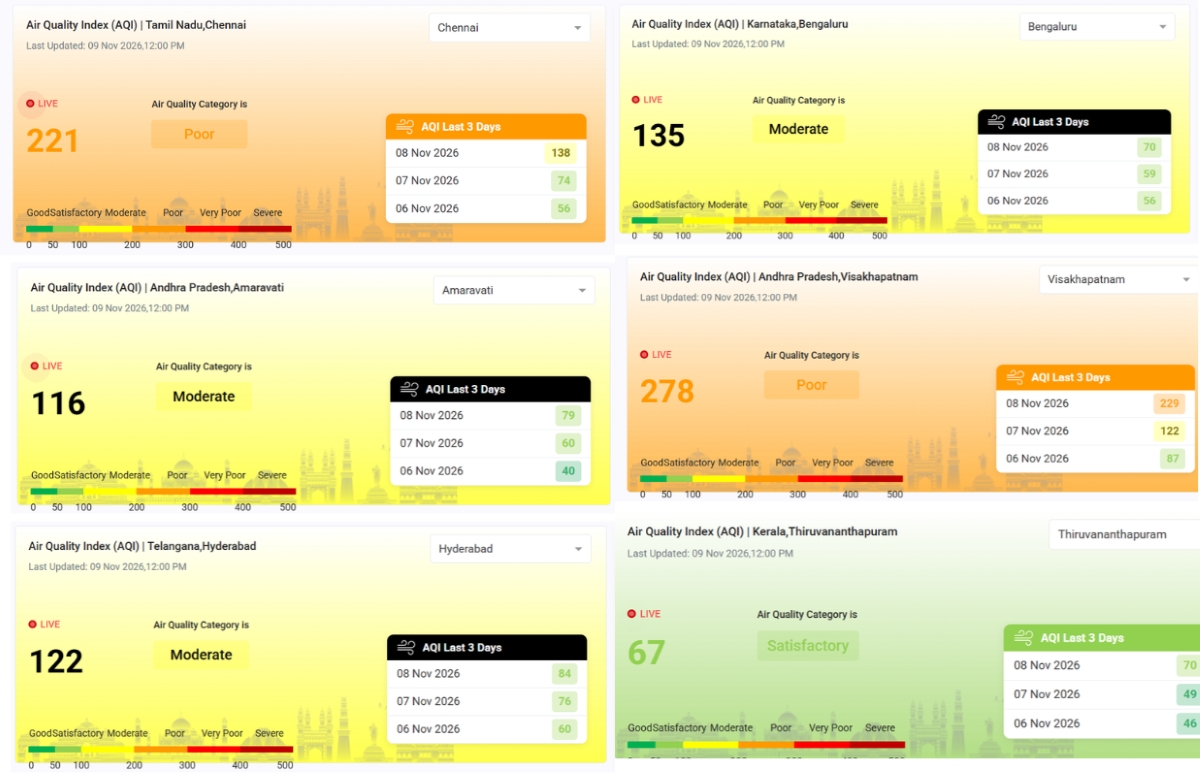
AQI recorded in Southern cities at 12 noon
The AQI recorded in Southern cities at 12 noon on Monday.
According to the Central Pollution Control Board (CPCB) dashboard, the national capital, Delhi NCR region, has recorded the AQI as 304 at 12 noon on Monday, 9 November, placing it in the “very poor” category.
However, according to ToI report, during the early hours of Monday, several monitoring stations across Delhi reported AQI readings above 400. Burari Crossing recorded the highest reading at 441, followed by Vivek Vihar at 437, Delhi Technological University (DTU) at 434, North Campus of Delhi University and Jahangirpuri at 433 each, and Rohini at 430, placing the city in the ‘severe’ category.
(Edited by Sumavarsha, with inputs from Subash Chandra Bose)



