

Published Apr 21, 2026 | 9:30 AM ⚊ Updated Apr 22, 2026 | 3:56 PM

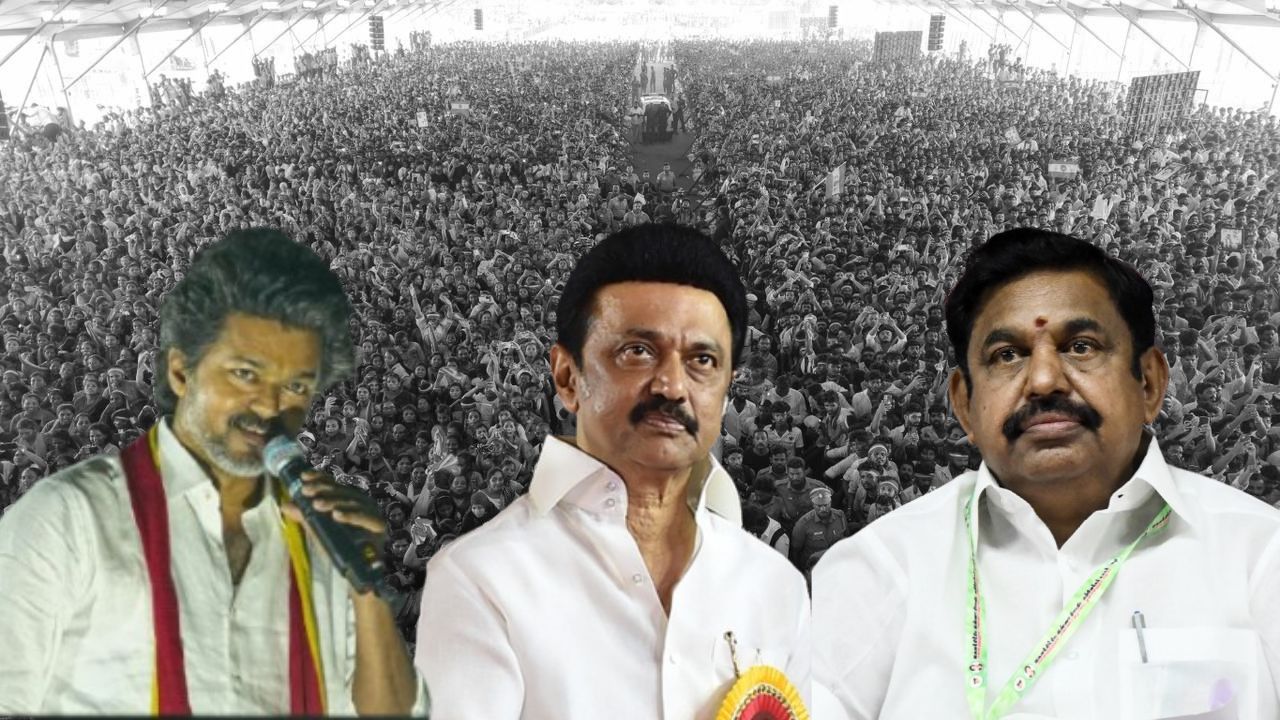
Vijay, MK Stalin and Edappadi K Palaniswami.

Synopsis: With the Assembly elections just hours away, the women voters in Tamil Nadu seem to be choosing the ruling DMK and Vijay’s TVK. Although the Opposition AIADMK seems to retain its generational voters, the youngsters are drifting away from the party. DMK’s welfare schemes and Vijay’s promise of change are attracting the women voters.
All political parties in Tamil Nadu are engaged in the last round of intense campaigning as the state heads to the polling booths on Thursday, 23 April, for the Assembly elections. According to pollsters, youngsters and women voters have emerged as decisive forces this time.
Opinions from the ground reveal that whichever party succeeds in attracting these two groups will secure victory.
According to Election Commission data dated 23 February 2026, Tamil Nadu has 2,89,60,838 women voters. From the ruling DMK to the new entrant, Tamilaga Vettri Kazhagam (TVK), all political players are focusing on appealing to women voters.
For instance, the DMK has promised an ₹8,000 coupon if voted back to power, while the Opposition AIADMK has promised ₹10,000 in cash. Actor Vijay’s newly formed TVK has pledged to increase the women’s entitlement assistance to ₹2,500.
Against this backdrop, South First spoke with several women in Tamil Nadu to understand which promises are resonating with them and where their support lies.
Also Read: Delta, Tiruchirappalli regions in TN weigh their options
Over the past five years, the ruling DMK introduced several women-centric schemes, including monthly financial assistance and free bus travel, which have left a deep impression on women.
Antonyammal, a 55-year-old fish vendor from Thoothukudi, who has voted for the DMK in the past three elections, said, “They help us in difficult times. We get ₹1,000 every month. Recently, they gave ₹5,000, which I used to pay rent. So I will vote for them again.”
Divya (30), also from Thoothukudi, said, “DMK provides breakfast schemes (for school children) and has promised to double women’s assistance. They have also said they will increase old-age benefits. Since they are already implementing such schemes, I support them.”
She added that even if other parties promise similar benefits, there is no certainty they will deliver, whereas the DMK has already proven that it can.
Manimekalai (65), from Coimbatore North, said, “AIADMK has done good work, but not like MK Stalin. He has introduced many welfare schemes for women, such as the entitlement scheme and free bus travel. So this time, I support DMK.”
Similarly, Deivaanai from Coimbatore, who has been voting for the last 30 years, said she supported AIADMK until 2016 but switched to DMK in 2021, “I got nothing from AIADMK. After voting for DMK, I received ₹1,000 monthly assistance, free bus travel, and even housing support. So I will vote for DMK again.”
Pattammal (50), from Kadayanallur, said, “My family supports AIADMK, but I will vote for DMK. The house I live in was given by Karunanidhi. Out of gratitude, I will vote for the Rising Sun.”
Kalyani, a 60-year-old agricultural labourer from Kuchipalayam, said, “I have voted for Kalaignar from the beginning. This time too, I will vote for the Rising Sun. Recently, they gave ₹5,000 and ₹3,000 for Pongal. So I will vote for them.”
Safheela, a first-year student and first-time voter from Tiruchirapalli, said, “Every party has issues, but comparatively, DMK seems like a better option.”
She explained, “I liked how the DMK handled governance during Covid. Compared to the AIADMK government after Jayalalithaa, the DMK government is much better.”
On Vijay, she asked, “How can we support a party without an ideology? You can’t vote just because someone is new.”
Danella Riya, a first-time voter from Thiruverumbur, said she would choose the DMK, pointing to Tamil Nadu’s broader trajectory in economic growth, women’s advancement and development as key reasons behind her decision.
“They are doing many good things, and I hope they will continue to do so. That’s why I will vote for DMK,” she said, reflecting a sense of cautious optimism rather than blind support.
Kalpana, a student from Tiruvarur, echoed a similar sentiment but positioned her choice more specifically in policy impact. She said her support for the DMK comes from its welfare-oriented approach and the tangible benefits for the people.
“I like the DMK’s policies. Schemes like the ₹1,000 monthly assistance under the Pudhumai Penn scheme genuinely benefit people,” she said, adding that such initiatives directly support women’s education and independence.
For her, the decision is less about political rhetoric and more about continuity of schemes that have already proven effective. “When something is already helping people, it makes sense to support it,” she added.
Meanwhile, from what several women told South First, it is clear that, contrary to the perception that only youth support Vijay, women across demographics back him.
Kalpana Devi (20), from Sivakasi, said, “There are many issues (in the state), including liquor, sexual crimes and drugs. But they are not addressed (by the government). Even welfare schemes haven’t fully reached everyone. A new change must come. If Vijay comes, change will happen.”
Thanga Pavithra (24), from Virudhunagar, pointed to poor safety conditions in the fireworks industry, “No MLA has visited us after elections. We believe things will change if TVK comes to power.”
Chellamma(60) from Virudhunagar said, “We have always voted for DMK. But now we will vote for Vijay. There should be a change.”
At the same time, some supporters expressed unusually high expectations, believing Vijay could even influence global gold prices.
Mahalakshmi (28), from Tiruppur, said, “If Vijay comes, good things will happen for women, even gold prices will reduce.”
Parameswari from Anupparpalayam said concerns over drug culture and women’s safety led her to shift support to Vijay.
Another voter, Parameswari, from Singanallur, who previously chose NOTA, said she would now vote for Vijay, hoping for change.
Also Read: Vijay’s TVK set to poll massively, but enough seats are a distant dream
Among women, only a handful said they would vote for the AIADMK, and almost all of them were older voters who have remained loyal to the party for decades.
Krishnaveni, a 55-year-old from Coimbatore North, was clear and unwavering, “Not just in this election, in any election, we will vote only for the ‘Two Leaves’ symbol,” she said.
Explaining her position, she added, “We have been voting for that party since childhood. We don’t want to change now. Our grandchildren ask us to vote for Vijay; they are educated, and they will choose what they like. But for us, it will always be AIADMK.”
A similar sentiment came from Anandavalli, a woman farmer from Kuchipalayam, who said, “We have always voted for the Two Leaves. We cannot change now.”
For some, this loyalty is deeply emotional and tied to the legacy of J Jayalalithaa. A farmer, Susedha, told South First, “Only Amma’s party took care of us. We have been voting for them since her time. She was taken away from us unjustly. From then on, we have stayed with that party. Whoever comes, we will vote only for the Two Leaves.”
At the same time, beneath this loyalty, there are clear signs of dissatisfaction.
Susedha pointed to the lack of consistent support, “We depend on agriculture, but for the past two years we haven’t received crop insurance. We will support whoever fulfils our demands,” she said.
However, beyond these pockets of loyalty, AIADMK finds little traction, especially among younger women. Not a single voter among the younger demographic voluntarily expressed support for the party, suggesting a visible generational disconnect.
While AIADMK retains a shrinking but loyal base, Naam Tamilar Katchi (NTK) struggles to convert interest into votes, particularly among women.
Among the hundreds of women South First spoke to, almost none said they would vote for NTK. There was no outright rejection; what emerged was a pattern of cautious appreciation followed by hesitation.
Safheela acknowledged, “I like NTK’s policies. The way they give equal representation to women candidates, and their focus on education and employment without relying on freebies, is something I respect.”
However, she was quick to add that admiration does not automatically translate into electoral support. “They have a lot of young people, but they are inexperienced,” she said, explaining why she ultimately leans towards the DMK.
Danella Riya echoed a similar view. While she recognised that NTK has a defined ideological framework, she felt the party lacked a clear roadmap for governance.
“They have policies, but they don’t yet have a proper formula for how to guide Tamil Nadu forward. If they figure that out, they could even come to power in the future,” she said.
For now, however, when it comes to choosing a party that can govern, both she and others prefer more established players, particularly the DMK.
Opinions of people indicate that the DMK’s welfare schemes have penetrated deeply across social and age groups, from college students to elderly women. For many, these are not just policy announcements but lived experiences that have shaped political preference.
Across districts, several women spoke of long-standing loyalty to the party, saying they have supported it for years and see no reason to shift, especially when they are direct beneficiaries of its schemes.
At the same time, an equally striking trend is visible. A significant number of women, cutting across age groups, are expressing a willingness to support Vijay’s TVK, driven not by a specific policy framework but by a broader desire for change.
When asked how they came to know about Vijay and his politics, many pointed not to structured campaigning but to informal networks, conversations within neighbours, peer discussions, and snippets of his speeches circulating in the media.
Chellamma from Virudhunagar explained the process in simple terms, “We keep talking among ourselves in the neighbourhood. That’s how we came to know. Also, when that ‘thambi’ (younger brother) speaks in the news, we like the way he talks.”
For some, this appeal translates into a deeper sense of trust and expectation.
Abirami, a 33-year-old differently-abled auto driver from Tiruvarur, said she does not align with either DMK or AIADMK, but sees hope in Vijay’s entry, “He is leaving behind huge wealth to come for us. If he wanted, he could stay at home with that money. If he is entering politics, it is to do good for people like us. Only if we give him a chance will we know,” she said.
Her words reflect a sentiment heard repeatedly in different forms, that Vijay’s decision to step away from a successful film career lends him credibility as someone entering politics with intent rather than compulsion.
His repeated line, “I am leaving the peak of my career to come for you,” appears to have resonated strongly, especially among women who view it as a gesture of personal sacrifice.
Amid these shifts, AIADMK’s support base appears to be caught between two competing narratives, the DMK’s welfare-driven governance and Vijay’s promise of change.
While a large section of women continues to favour the DMK, particularly for its schemes, a noticeable portion of younger voters is gravitating towards TVK.
What stands out is that Vijay’s entry is not merely eating into one side of the political spectrum. Instead, it is creating small but visible shifts across both Dravidian majors.
Marikkani, a 45-year-old from Sivakasi who has consistently voted for the DMK until now, represents this shift: “No one has done anything for our area so far. This time, I support Vijay,” she said, indicating a break from long-held voting patterns.
Such responses suggest that while the DMK retains a strong base, it is not entirely insulated from voter fatigue or local dissatisfaction.
Taken together, these voices point to an evolving electoral landscape. The DMK continues to benefit from welfare-driven trust, but Vijay’s emergence has introduced an element of unpredictability, drawing support not only from undecided voters but also from those who have previously backed established parties.
His entry has, in effect, disrupted the traditional DMK–AIADMK binary. But whether this disruption is deep enough to translate into electoral victory remains an open question.
That answer will only emerge when the votes are counted on 4 May.
(Edited by Muhammed Fazil.)



