

Published Feb 06, 2026 | 9:04 PM ⚊ Updated Feb 06, 2026 | 9:05 PM

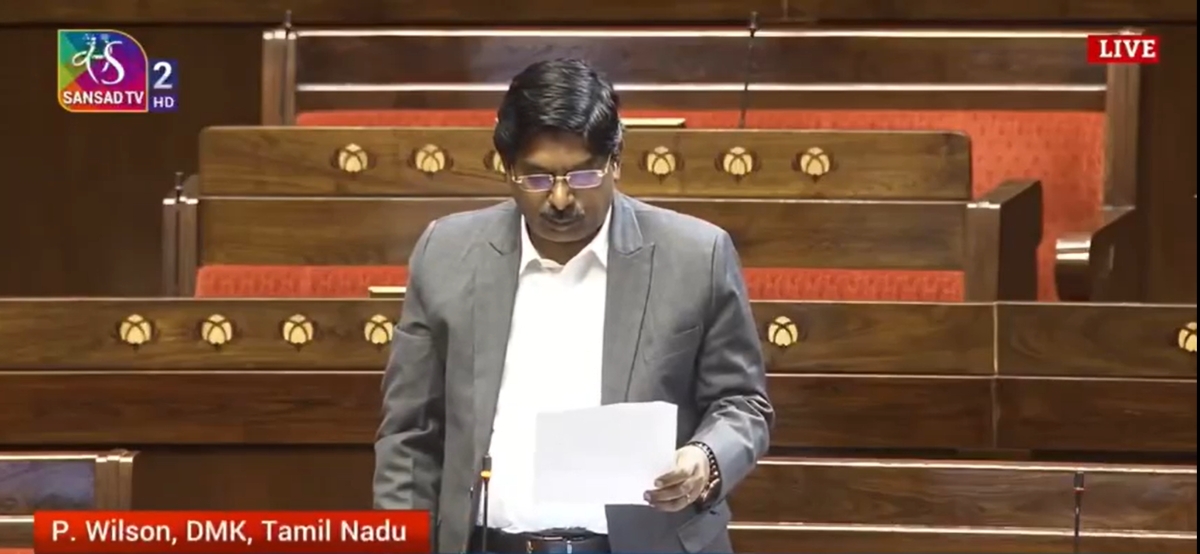
DMK MP P Wilson. (Screengrab)
Synopsis: The Bill seeks amendments to the Constitution of India to ensure social diversity in the appointment of judges to the Supreme Court and High Courts, with representation for Scheduled Castes (SCs), Scheduled Tribes (STs), and Other Backward Classes (OBCs) in proportion to their population. It also proposes measures to bring greater transparency to appointments in the higher judiciary.
DMK Rajya Sabha MP P Wilson on Friday, 6 February, introduced a Constitution Amendment Bill in Parliament proposing a series of changes aimed at judicial appointments, reservation policy, and caste enumeration.
The Bill seeks amendments to the Constitution of India to ensure social diversity in the appointment of judges to the Supreme Court and High Courts, with representation for Scheduled Castes (SCs), Scheduled Tribes (STs), and Other Backward Classes (OBCs) in proportion to their population. It also proposes measures to bring greater transparency to appointments in the higher judiciary.
Among its key provisions, the Bill calls for the establishment of permanent regional benches of the Supreme Court at Chennai, New Delhi, Mumbai, and Kolkata. It also seeks to increase the retirement age of High Court judges from the present 62 years to 75 years.
The proposed amendments further aim to enhance the quantum of reservation for Socially and Educationally Backward Classes in proportion to their population, as determined through a caste census. The Bill also seeks to provide reservation in promotions with consequential seniority for Backward Classes.
While introducing the Bill, he said it seeks to amend Article 7 of the Seventh Schedule to the Constitution to empower State governments to conduct caste census exercises.
Wilson’s legislative push follows concerns he has repeatedly raised in Parliament over what he describes as a “diversity deficit” in the higher judiciary. In an earlier statement, he cited data provided by Union Law Minister Arjun Ram Meghwal in response to an unstarred question in Parliament.
According to the data, between 1 January 2021 and 30 January 2026, a total of 593 judges were appointed to various High Courts. Of these, 26 judges (4.38 percent) belonged to the SC category, 14 (2.36 percent) to STs, and 80 (13.49 percent) to OBCs, while 473 judges, or 79.76 percent, were from forward castes.
Wilson also referred to earlier figures covering the period from 2018 to 30 October, 2024, during which 684 High Court judges were appointed. The data showed that 21 judges (3.07 percent) were from the SC category, 14 (2.05 percent) from STs, and 82 (11.99 percent) from OBCs, while 567 judges, or 82.89 percent, fell under other categories.
He has argued that the continued underrepresentation of historically oppressed communities in the higher judiciary raises concerns about whether the institution adequately reflects India’s social diversity. Wilson has questioned the functioning of the existing collegium system, stating that the skewed composition of the judiciary cannot be attributed to a lack of qualified candidates but points instead to structural exclusion.
In his remarks, Wilson has also urged Prime Minister Narendra Modi to consider constitutional changes to ensure proportionate representation of OBC, SC, and ST communities in the appointment of judges to the Supreme Court and High Courts.
Alongside the Constitution Amendment Bill, DMK Rajya Sabha MP P. Wilson has also introduced a Private Member’s Bill seeking comprehensive legislation to mandate virtual court proceedings alongside physical hearings across courts and tribunals.
In the Statement of Objects and Reasons, Wilson noted that the COVID-19 pandemic had compelled courts to adopt virtual hearings, which significantly improved access to justice by allowing participation from remote locations and reducing the financial burden on litigants. He pointed out that despite substantial public investment in virtual court infrastructure, several tribunals and courts have gradually moved away from online hearings even where there is clear demand.
The Bill argues that virtual courts are essential to realising the constitutional promise of access to justice by reducing delays, cutting litigation costs, and improving convenience for litigants, lawyers, and judges. Wilson highlighted that many adjournments in the Supreme Court, High Courts, and appellate tribunals occur because lawyers from different parts of the country are unable to attend hearings in person, with the financial burden ultimately falling on litigants.
The proposed legislation seeks to make virtual hearings mandatory, particularly to ease access for litigants from outside Delhi, where the Supreme Court and most tribunals are located. It also aims to streamline judicial processes by reducing paperwork and encouraging automation of administrative tasks.
(Edited by Sumavarsha)


