

Published Dec 08, 2025 | 11:51 AM ⚊ Updated Dec 08, 2025 | 11:51 AM

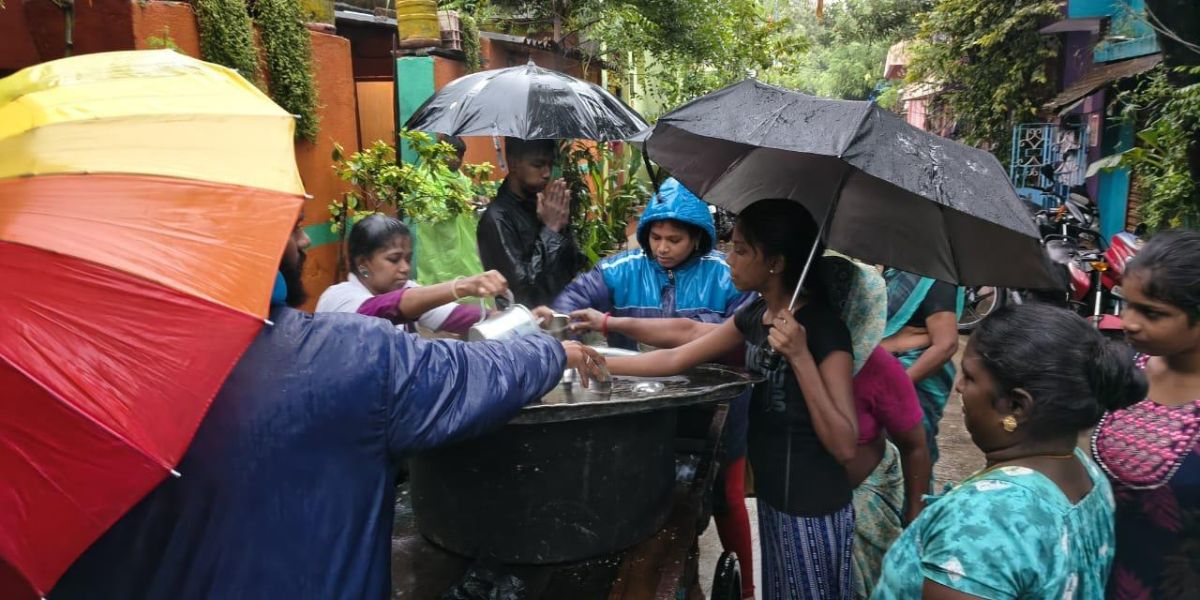
Chennai residents with volunteers during the flooding. (Vyasai Thozhargal)
Synopsis: Common people have been suffering due to the flood and its aftermath following heavy rains that accompanied Cyclone Ditwah in Chennai. The first stories to emerge were not about numbers, forecasts, or official bulletins — but about people navigating yet another relentless monsoon.
“This morning, two stray dogs came running at me,” said S Rashmi, a flower vendor, clutching the edge of her basket. “People nearby helped, but every monsoon it becomes like this. The dogs get restless when there’s water everywhere,” she told South First.
By the time the rain finally loosened its grip on Chennai, the first stories to emerge were not about numbers, forecasts, or official bulletins — but about people navigating yet another relentless monsoon.
South First visited the city as the floodwaters slowly began to drain.
Ahead of Cyclone Ditwah, the Greater Chennai Corporation (GCC) began monitoring flood levels in real time across 40 roads in the city’s most vulnerable areas.
Using flood meters installed at these locations, the Integrated Command and Control Centre (ICCC) received updates when water levels rose beyond two inches, allowing officials to alert residents and deploy boats in areas experiencing waterlogging.
Flood meters had been installed in historically flood-prone zones, including Sai Nagar near the Perungudi dump yard, Pandiyan Nagar in Sholinganallur, and Kumaraswamy Nagar Main Road, among others.
Other areas covered by the monitoring system include Teynampet, Tiruvottiyur, Manali, Madhavaram, Tondiarpet, Royapuram, Thiru.Vi.Ka. Nagar, Kodambakkam, Valasaravakkam, Alandur, Adyar, and Perungudi.
However, these steps were not just enough to protect the vulnerable from the aftermath of the heavy rains.
At a small temple corner in Adyar, Rashmi sat on a plastic stool, guarding her basket from stray dogs unsettled by the water.
Rashmi had already made her early-morning trip to the Koyambedu market, wading through slush to collect small bundles of jasmine and other fresh flowers.
However, the business had collapsed after the rain and its aftermath. “Even if I bring flowers, nobody wants to buy,” she said, adjusting the tarpaulin above her head. “Outside the temple, I get a few customers.”
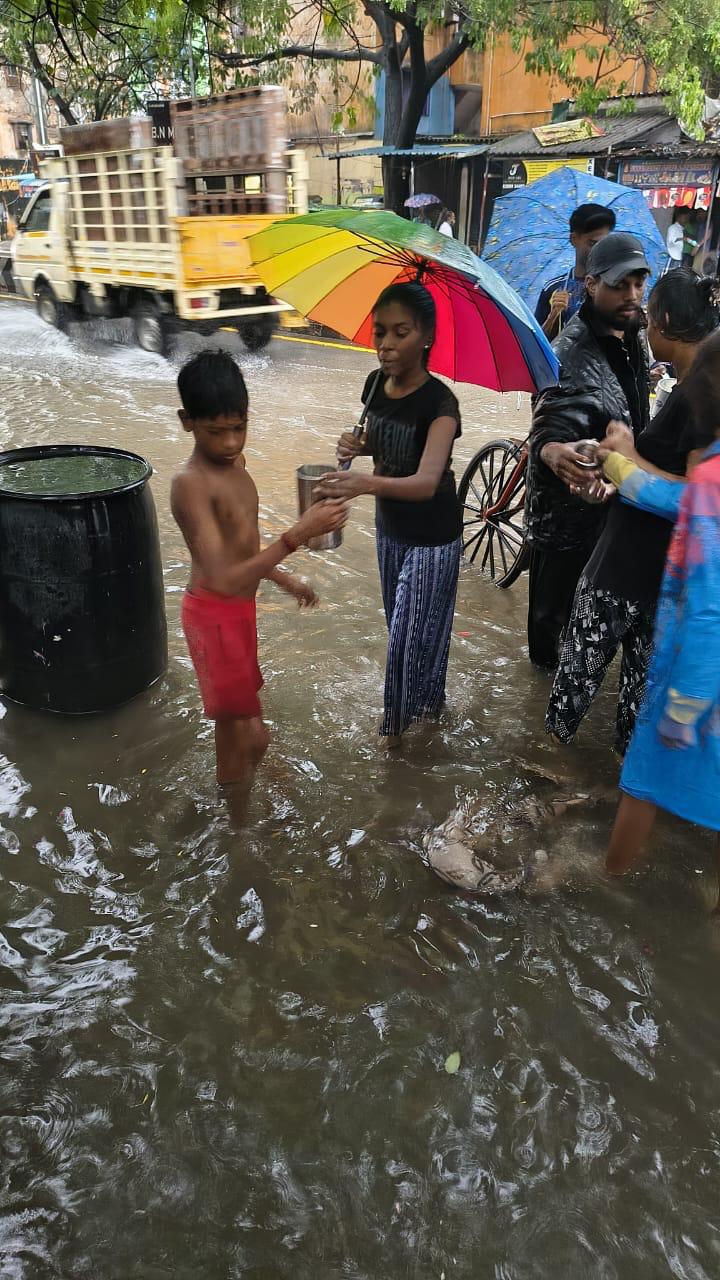
Flooding in Chennai. (Vyasai Thozhargal)
Earlier, senior officials, following inspections from the chief minister and deputy chief minister, had held meetings to strengthen emergency preparedness. The GCC instructed call centre personnel to respond promptly to helpline 1913 calls from residents in affected areas.
Additionally, automatic boom barriers have been installed at 17 subways to manage traffic during floods, and a mobile app has been launched to provide early warnings and flood alerts to residents.
However, when South First visited neighbourhoods across the city, the scenes reflected a strain similar to that of Adyar.
Along the flooded streets of Mylapore, Chitra Kala went from doorway to doorway in search of domestic work after losing her job during the rains.
She told South First that she lives in a rented single-room house near the Modern Bridge in Tidel Park, where floodwater had filled the space for days, leaving her family trapped.
“The children couldn’t go to school, and we had no work and no food, and I lost my job itself,” she said. “We don’t have another house to run to. Cyclone names change every year,” she added. “But for people like us, the floods, the water, the struggle — nothing ever changes.”
At the MRTS stations, the problems took another shape. At Kotturpuram, commuters climbed stairs in semi-darkness, using mobile phone flashes since the lights had failed. At Tiruvallikeni and Lighthouse, water had seeped into the concourse and pooled under ticket counters.
“The train is running, but the station isn’t. That’s the problem,” said R Murugan, a daily commuter. “Rain didn’t break the station; neglect did. We walk with phone flashlights because the lights inside don’t work. It’s like entering a tunnel with no guarantee of safety.”
The India Meteorological Department (IMD) and the Indian National Centre for Ocean Information Services (INCOIS) issued fresh warnings for the Tamil Nadu coast on Sunday, 7 December.
Squally weather with wind speeds of 35 kmph to 45 kmph, gusting up to 55 kmph, is likely to prevail over the South Tamil Nadu coast, the Gulf of Mannar and the Comorin area on Sunday
On 9 December, similar squally conditions are expected over the North Tamil Nadu coast, while on 10 December, the warning extends to the entire Tamil Nadu coast, including the Gulf of Mannar and the Comorin area.
On 11 December, squally weather is again forecast over the South Tamil Nadu coast, the Gulf of Mannar and the Comorin region. Fishermen have been advised not to venture into the sea in the above areas during the warning periods.
In addition, INCOIS has issued ocean current alerts for several coastal districts, including Chennai, Cuddalore, Kancheepuram, Nagapattinam (North and South), Thiruvallur and Viluppuram.
Surface current speeds have been expected to range between 1.1 and 1.3 metres per second from 4 pm on 6 December to 7 pm on 8 December, and harbour and marine operations have been advised to remain extremely cautious.
Vijayalakshmi, coordinator of Vyasai Thozhargal, a youth-led social initiative from Vyasarpadi, told South First that communities in low-lying neighbourhoods of North Chennai continue to bear the brunt of flooding despite repeated preparedness efforts.
She said areas such as Sathyamoorthy Nagar often remain waterlogged for up to two days after heavy rainfall due to their low-lying nature.
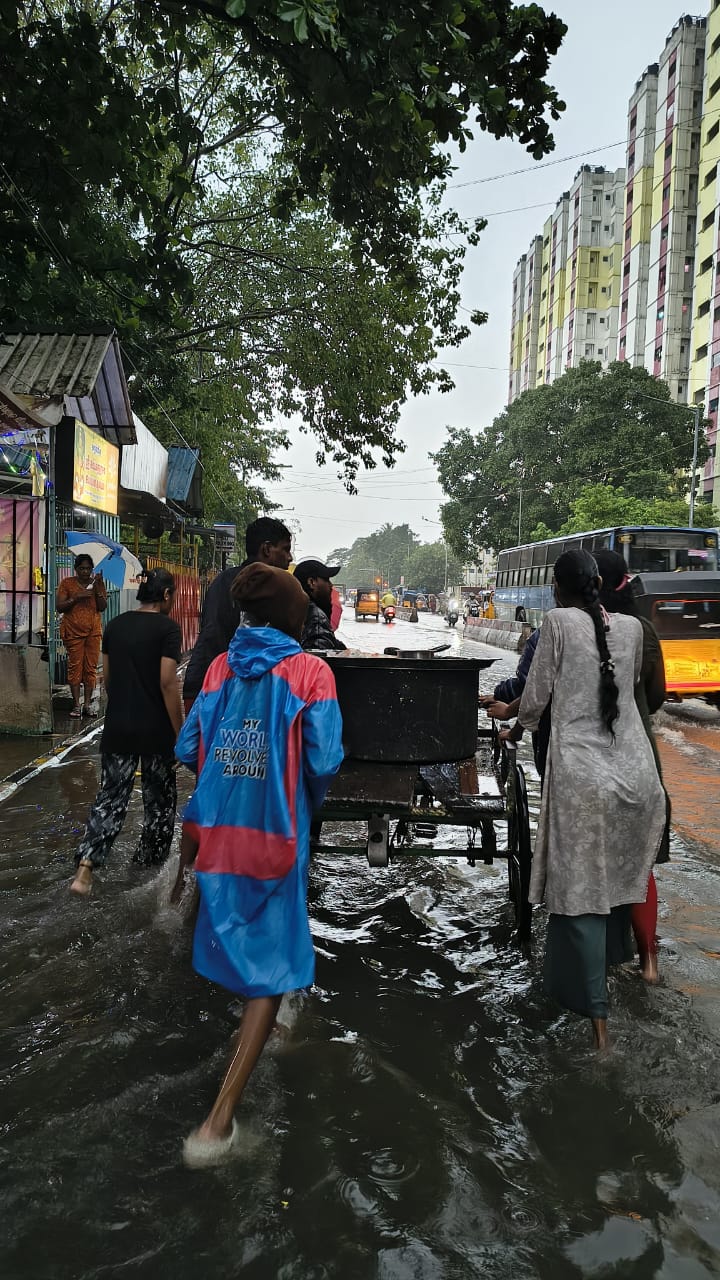
Flooding in Chennai.
“Every December, we stay on high alert because this is typically the rainy period. Before the rains begin, we identify which areas are likely to flood and assess the low-lying zones,” she said.
She explained that officials and volunteers relocate people from vulnerable areas and prepare relief centres with food and shelter arrangements.
“Last year, we provided essentials such as food, milk, biscuits, bread, napkins and emergency supplies. These are everyday needs, so we make sure everything is ready in advance.”
Recalling last year’s situation, she said water levels had reached nearly three feet in several places, damaging vehicles and preventing people from going to work.
“Many residents depend on daily wages, and even a week without work completely disrupts their household,” she said, adding that families usually take around ten days to recover after heavy flooding and can manage only when they receive additional support.
She also spoke about the disproportionate impact on women and children. “Children, infants and women face severe difficulties. Even during heavy rain, they have to walk long distances to fetch water and other essentials,” she said.
She noted that during flood seasons, grocery and essential commodity prices rise automatically, making survival harder for vulnerable families. Speaking about this year, she said heavy rains on 1 and 2 December caused waterlogging in several low-lying areas, though the city escaped major flooding.
She acknowledged the government’s recent measures, including the installation of motors to pump out stagnant water and the introduction of multiple helpline numbers, calling the response “positive overall.” However, she pointed out a persistent gap in implementation.
“There remains a gap between the government’s schemes and the people. While measures are being implemented, residents of North Chennai are not fully receiving the benefits,” she said.
Ending with an appeal, she said, “The government has identified the issues, and we believe that proper solutions will be provided. But support is still not reaching people in our area. This gap needs to be urgently addressed. This is our request to the government.”
(Edited by Muhammed Fazil.)


