

Published Jul 09, 2026 | 9:29 PM ⚊ Updated Jul 09, 2026 | 9:46 PM

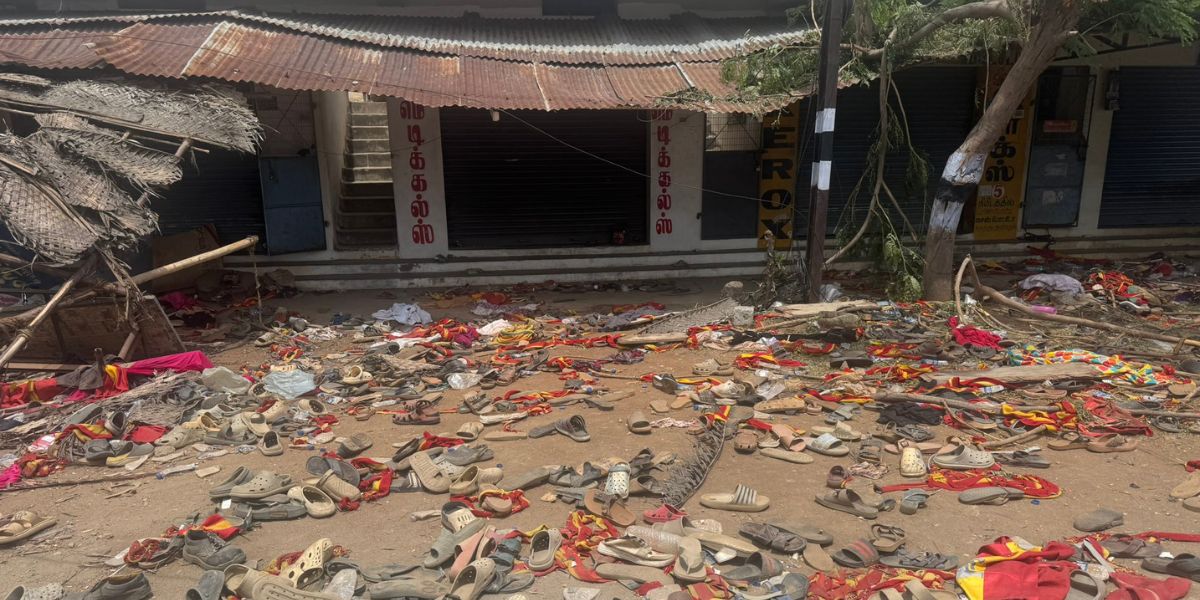
The stampede left 41 people dead and injured more than 100 others on 27 September 2025.

Synopsis: Chief Minister C Joseph Vijay’s proposed Karur visit has triggered political and legal objections amid the ongoing CBI probe into the 2025 crowd crush. But does the law actually prevent him from travelling to the district or meeting the victims’ families?
Nine months after a stampede at a TVK election campaign rally in Karur killed 41 people, Tamil Nadu Chief Minister C. Joseph Vijay is set to return to the district on Friday, 10 July, for a series of official government programmes, including laying the foundation stone for a new industrial project.
During the visit, he is also scheduled to hand over compassionate appointment orders to 32 members of the families of those killed in the tragedy on 27 September 2025.
The decision has triggered a political controversy, with the opposition DMK, the ruling alliance’s Left partners and even TNPSC aspirants questioning the government’s move while the CBI investigation into the tragedy is underway.
The key legal question, however, is whether Vijay can be prevented from visiting Karur or interacting with the victims’ families while the investigation is pending.
Also Read: DMK withdraws plea seeking curbs on CM Vijay’s remarks
Speaking to South First, human rights and civil liberties lawyer Advocate BB Mohan said the issue must be viewed separately from the political debate.
Responding to demands that Vijay should not visit Karur until the investigation is completed, Mohan said the law imposes no such restriction.
Under Section 180 of the Bharatiya Nagarik Suraksha Sanhita (BNSS), an investigating officer can summon any person acquainted with the facts of a case—not merely witnesses.
“It is incorrect to say that only witnesses can be summoned. Anyone who knows the facts surrounding the incident can be called for questioning. That, by itself, does not make the person an accused,” Mohan said.
He explained that under the old Section 41A CrPC, now Section 35(1)(a) of the BNSS, in offences punishable with imprisonment of up to seven years, police ordinarily issue a notice requiring a person to appear for questioning. Only after examining the evidence does the investigating officer determine whether that person should be treated as an accused.
“For instance, a person who witnesses a stabbing can be summoned because he knows what happened. His role is to provide information. It alone does not make him the offender,” he said.
Referring to the Karur crowd crush investigation, Mohan said Vijay’s movements before and after the incident—including his arrival at the venue and his departure after the tragedy—are matters that investigators are entitled to examine.
“I had earlier said Vijay should be among the first persons questioned because he left the venue immediately after the incident. It makes him an important person to be examined. But questioning someone and holding them criminally liable are two entirely different things,” he said.
Mohan opined that only a fair, impartial and evidence-based investigation can determine whether Vijay’s conduct, or that of any other individual, contributed to the tragedy.
He said criminal liability ultimately depends on what the evidence establishes.
“The real legal question is not whether 41 people died. It is whether anyone intended that they should die, or whether anyone acted with the knowledge that death was a likely consequence.”
He explained that offences such as murder and culpable homicide depend upon proving intention or knowledge, while negligence requires a separate legal assessment.
Drawing an analogy with road accident investigations, Mohan said investigators rely on tyre marks and other forensic evidence to determine whether a driver exercised due care.
Similarly, in the Karur case, investigators must examine scientific and documentary evidence to determine whether negligence occurred, who was responsible and whether any criminal liability arises.
On Vijay’s proposed visit, Mohan reiterated that there is no legal bar preventing the chief minister from travelling to Karur or meeting the victims’ families merely because the investigation is pending.
“Ordinarily, no one, including the courts, interferes with an ongoing criminal investigation unless it is a court-monitored probe. The investigation is the exclusive responsibility of the investigating officer. Whether Vijay bears criminal liability can only be determined through the investigation and, thereafter, by the court based on evidence. Allegations alone cannot establish guilt.”
The controversy stems from Vijay’s decision to distribute compassionate appointment orders to 32 members of the victims’ families during his visit.
The CBI is investigating the stampede case under the supervision of a committee headed by retired Supreme Court judge Justice Ajay Rastogi.
While several TVK functionaries and ministers have been named as accused, Vijay has only been questioned during the investigation. The Supreme Court has specifically noted that he was not named as an accused in the FIR.
Also Read: Karur stampede: Punal study points to deadly role of extreme heat
The controversy intensified after Minister Aadhav Arjuna remarked at a 2 July party meeting that “there is an account to be settled in Karur.”
The DMK argued that such remarks, along with the government’s decision to distribute compassionate appointments, could influence witnesses in the ongoing CBI investigation.
DMK organising secretary RS Bharathi approached the Supreme Court seeking safeguards to prevent interactions between accused persons and material witnesses.
However, when the matter came up on 7 July, the Bench questioned the maintainability of the plea and objected when the DMK described Vijay as an accused, pointing out that even the FIR registered under the previous DMK government did not name him as one.
The petition was subsequently withdrawn, though Bharathi later approached the Supreme Court-appointed supervisory committee headed by Justice Ajay Rastogi, reiterating his concerns.
Also Read: Stampede victim’s kin alleges ₹30 lakh bribe offer by local DMK leader
Interestingly, criticism has not come only from the opposition.
The CPI(M) and CPI, both allies of the ruling TVK government, have questioned the decision to offer government jobs before the investigation concludes.
CPI(M) state secretary P Shanmugam said the government should first frame a uniform policy governing compassionate appointments in such cases.
CPI state secretary M Veerapandian, who spoke to South First, echoed the demand, saying the party had no objection to humanitarian assistance but believed government employment should be granted only under a transparent policy applicable to all.
Also Read: Tamil Nadu TRB’s clarification skirts Part-2 evaluation issue
The announcement has also drawn criticism from TNPSC aspirants and contract government employees.
Several aspirants told South First that government jobs should ordinarily be filled through competitive recruitment and warned that the appointments could create a precedent that many candidates waiting in the recruitment system would consider unfair.
Writer and political activist Kavin Malar accused Vijay of misusing executive authority.
“If Vijay had not come to power, would these appointments have been possible? The fact that this decision is being taken only after assuming office raises questions about whether executive power is being used appropriately,” she said.
She also questioned the timing of the announcement, noting that government jobs had not been promised during the election campaign or in the TVK’s 2026 election manifesto.
Malar also questioned the use of the term ‘compassionate appointment.’
“Thousands of people have been waiting for years for compassionate appointments after fulfilling all the prescribed criteria. Likewise, lakhs of TNPSC aspirants are preparing through the established recruitment process. Any deviation without a transparent policy risks creating injustice for those waiting within the system,” she said.
(Edited by Majnu Babu).



