

Published May 14, 2026 | 2:40 PM ⚊ Updated May 14, 2026 | 2:40 PM

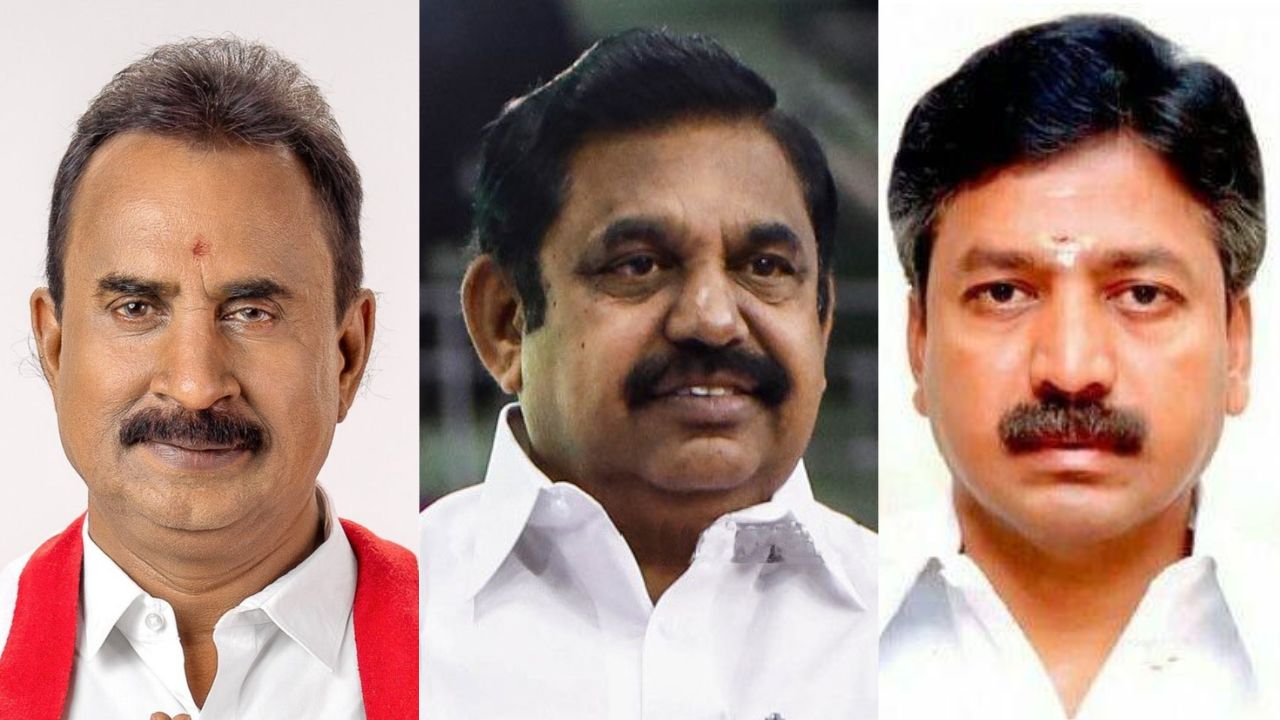
The Shanmugam-Velumani camp believes that remaining out of power for another five years would severely damage its political and business interests.

Synopsis: The AIADMK is facing its biggest internal crisis since Jayalalithaa’s death, with rival EPS and Velumani-Shanmugam factions battling over legislative control, party legitimacy and support for the TVK government. As the EPS camp seeks anti-defection action against 25 rebel MLAs and removes them from party posts, the conflict is increasingly resembling the faction wars that once dragged the AIADMK to the Election Commission, High Courts and Supreme Court.
The latest revolt inside the AIADMK in Tamil Nadu is increasingly drawing comparisons with the turbulent years that followed the death of former chief minister J Jayalalithaa in 2016, a period marked by bitter factional wars, rival claims over the party leadership, legal battles, and a prolonged fight for control of the iconic “Two Leaves” symbol.
With the party now split between the faction led by Edappadi K Palaniswami (EPS) and another led by SP Velumani and CV Shanmugam, many within Tamil Nadu political circles believe the crisis is beginning to resemble earlier AIADMK power struggles, where the key question eventually moved beyond ideology or alliances to a more fundamental one: Who is the real AIADMK?
The EPS faction has now formally approached the Assembly Secretary seeking action against 25 MLAs under the anti-defection law after they voted in favour of the Tamilaga Vettri Kazhagam (TVK) government during the Assembly floor test.
Also Read: CM Vijay demands to scrap NEET two years after TN resolution under DMK
During the floor test in the Tamil Nadu Assembly, Palaniswami was invited to speak on behalf of the AIADMK. He categorically declared that the party was not extending support to the TVK government.
“The 47 AIADMK MLAs were elected by the people to restore the rule of MGR and Jayalalithaa. They were elected for the AIADMK alone. Therefore, we are not supporting the Tamilaga Vettri Kazhagam,” EPS stated.
However, shortly afterwards, SP Velumani was also invited to speak on behalf of the party.
This became controversial because rival letters had already been submitted regarding the leadership of the AIADMK legislature party, with 17 MLAs backing EPS and over 25 MLAs backing Velumani.
MLAs from the EPS camp objected strongly when Velumani was allowed to speak, citing Assembly Rule 99 and questioning the legality of the move. Despite the protests, Velumani addressed the House.
The confrontation escalated further when 25 MLAs aligned with the Velumani faction voted in favour of the resolution moved by Chief Minister C Joseph Vijay, supporting the TVK government.
Speaking to reporters later, Palaniswami rejected allegations from the rival faction that he had attempted to negotiate an arrangement with the DMK.
He accused the opposing faction of making false allegations to secure positions in the TVK government and misleading party cadres and the public.
However, Velumani insisted the faction had no intention of breaking the party.
While speaking to the media, he said, “The party is our lifeblood. We only asked for a review of the electoral defeats. We are not trying to destroy the AIADMK.”
He also called for the reunification of all expelled and estranged leaders, including VK Sasikala, O Panneerselvam (OPS) and TTV Dhinakaran, arguing that the party’s primary objective should remain opposing the DMK.
Shanmugam, meanwhile, defended the support extended to the TVK government, arguing that a majority of AIADMK MLAs had taken the decision collectively.
He also rejected the legitimacy of the party whip cited by the EPS camp and claimed that only the legislature party, not the General Secretary alone, could appoint the whip.
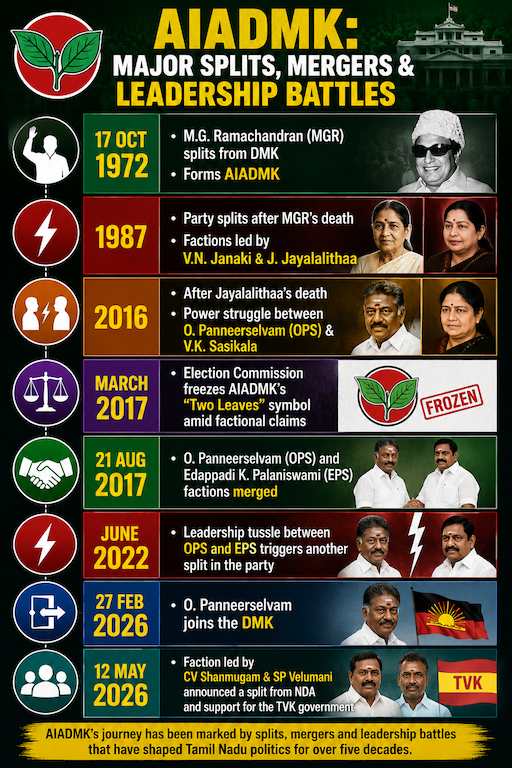 The current crisis within the AIADMK is drawing strong comparisons with the party’s earlier factional battles that repeatedly reached the Election Commission, the Madras High Court, the Delhi High Court and the Supreme Court over a central question: Who is the “real” AIADMK?
After the death of party founder MG Ramachandran in 1987, the AIADMK split into two factions, led by his wife, VN Janaki and J Jayalalithaa. Both factions approached the Election Commission, claiming ownership of the party and its iconic “Two Leaves” symbol.
The EC froze the symbol ahead of the 1989 Assembly election after concluding that both factions had substantial support. The two groups contested separately before later reuniting under Jayalalithaa.
A similar crisis erupted after Jayalalithaa died in 2016. Rival camps led by O Panneerselvam and VK Sasikala approached the Election Commission over control of the AIADMK name and symbol. In March 2017, ahead of the RK Nagar bypoll, the EC again froze the “Two Leaves” symbol after both factions staked claim to it.
Later, the EPS and OPS factions merged and jointly approached the Election Commission seeking recognition as the “real” AIADMK. In November 2017, the EC restored the “Two Leaves” symbol to the merged EPS-OPS faction after applying the “majority test,” citing support from most MLAs, MPs and party office-bearers.
Dhinakaran challenged the Election Commission’s decision before the Delhi High Court, and later the Supreme Court, but the courts largely upheld the Election Commission’s powers in deciding party disputes.
The Madras High Court and Supreme Court also heard multiple cases filed by OPS and Sasikala challenging EPS’s leadership, General Council resolutions and control over the party structure between 2022 and 2024.
The present conflict, involving rival legislature party claims, competing whips and possible anti-defection proceedings, is increasingly resembling those earlier AIADMK civil wars that eventually moved from the Assembly floor to constitutional institutions and courts.
Also Read: DMK walkout, AIADMK split helps TN CM Joseph Vijay win vote of confidence
Political observers said the present crisis appears to be moving along a familiar trajectory, competing claims over the legislature party, rival whips, questions over who commands the support of MLAs, and a growing possibility of legal intervention.
The Velumani-Shanmugam camp has already argued that “majority support among MLAs” should determine legitimacy within the legislature party, while the EPS faction insists organisational authority rests with the General Secretary and the officially appointed whip.
That debate closely mirrors the arguments repeatedly made before the Election Commission and courts during previous AIADMK splits.
Meanwhile, AIADMK advocate and Rajya Sabha MP IS Inbathurai confirmed that the EPS camp has now formally sought anti-defection proceedings against the 25 MLAs.
“If MLAs vote against the direction issued by the party whip appointed by the General Secretary, it falls under the anti-defection law. We have now submitted the complaint before the Assembly Secretary,” he said.
He further alleged that the Speaker ignored objections raised by the EPS faction during the voting process and violated Assembly procedure by allowing the voting to continue without recording their protest.
At the same time, AIADMK General Secretary Edappadi K Palaniswami has removed 25 MLAs, including Shanmugam and Velumani, from their party posts after they rebelled against his leadership and voted in favour of the TVK. EPS has also appointed new district secretaries and office-bearers to replace them.
The AIADMK has historically survived intense internal conflicts through temporary compromises, mergers, or charismatic central leadership.
However, political analysts noted that, unlike earlier crises, the party today lacks a universally accepted figure like MGR or Jayalalithaa capable of reunifying rival factions.
With demands now emerging to bring back Sasikala, OPS and other expelled leaders, and with rival camps openly questioning each other’s legitimacy, many believe the party may once again be heading toward prolonged legal and political battles over organisational control, legislative authority, and ultimately the ownership of the AIADMK identity itself.
(Edited by Muhammed Fazil.)



