

Published Mar 06, 2026 | 7:00 AM ⚊ Updated Mar 06, 2026 | 7:00 AM

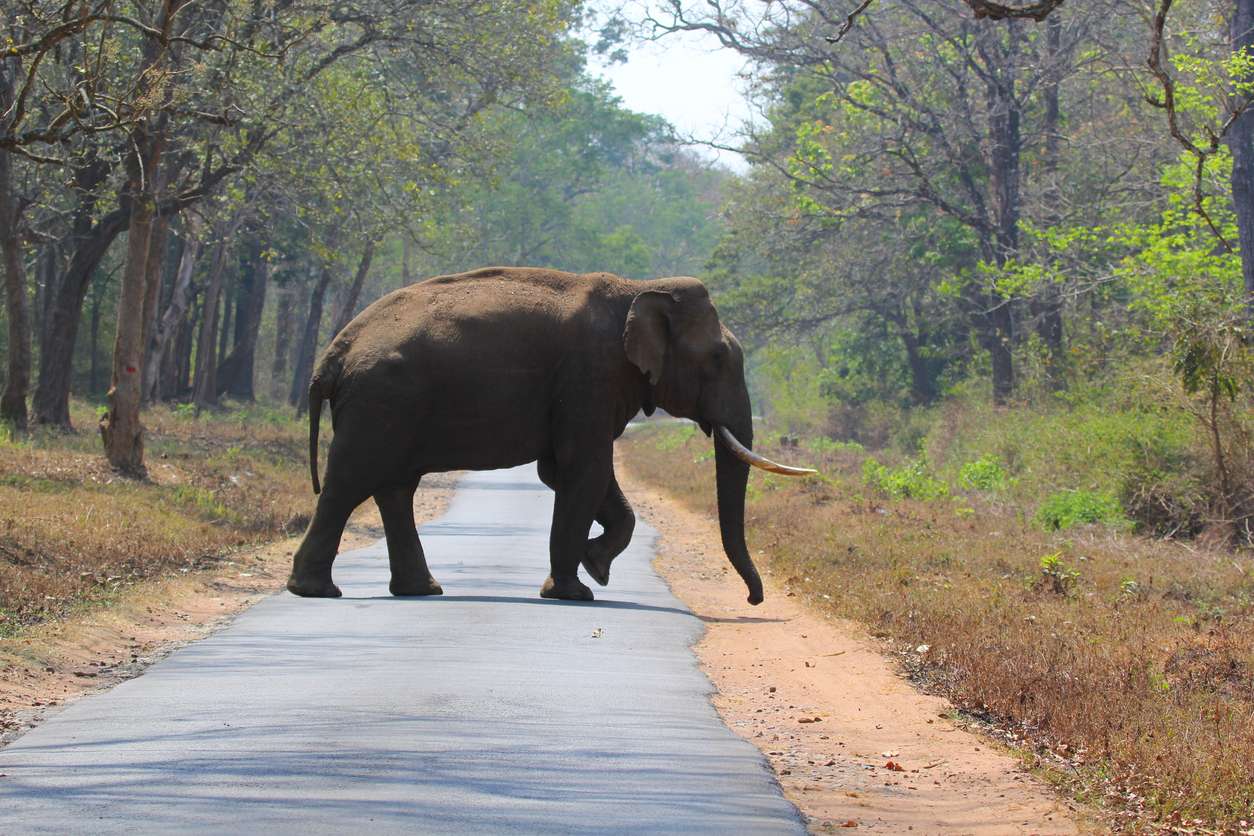
Representational image. Credit: iStock
Synopsis: Tamil Nadu recorded 685 human deaths from wild animal attacks between 2015 and July 2025, with elephants responsible for 522 fatalities, making them the state’s biggest wildlife threat. Experts cite fragmented habitats, crop raiding, and risky human responses as key drivers. Despite AI surveillance and barriers, conflict persists, highlighting the need for locally tailored, community-driven mitigation strategies.
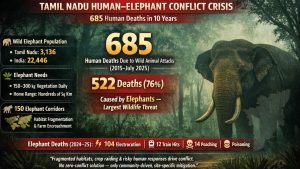
Tamil Nadu has recorded 685 human deaths due to wild animal attacks between 2015 and July 2025. Of these, 522 — nearly 76 percent — were caused by elephants, making man-animal conflict the single largest wildlife-related threat to human life in the state over the past decade.
The figures were presented by D Venkatesh, Chief Conservator of Forests and Field Director of the Anamalai Tiger Reserve, at a human–animal conflict mitigation workshop held at CASFOS in Coimbatore earlier this year.
The data indicate that elephant-related incidents account for a larger share of human fatalities in Tamil Nadu than those involving gaur, wild boar, sloth bear, tiger, leopard and deer combined.
The concern gains further weight from recent replies in the Rajya Sabha. According to the Ministry of Environment, Forest and Climate Change, India currently has an estimated 22,446 wild elephants under the latest DNA-based synchronous population estimation.
Tamil Nadu alone accounts for 3,136 elephants — one of the highest populations in the country.
The Centre has acknowledged that technologies such as GPS collaring, AI-enabled camera traps, thermal cameras, early warning systems and drone surveillance are being deployed in conflict-prone areas, including in Tamil Nadu.
Yet, on the ground, fatalities and conflict incidents continue.
Biologists say the answer lies not merely in numbers, but in ecology.
“Elephants are large, free-ranging animals that require enormous quantities of food and water every day. An adult may consume 150–300 kg of vegetation and require substantial water. To meet these needs, they travel long distances annually,” said Abinesh Anbazhagan, Wildlife biologist to South First.
Unlike predators such as leopards, which can adapt to smaller patches of vegetation, elephants move in herds and require expansive landscapes, he added.
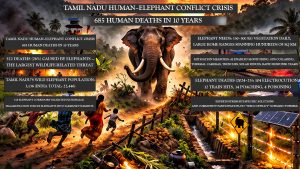
Their annual home ranges can extend hundreds of square kilometres. “In Tamil Nadu’s fragmented forest–agriculture mosaic, such movement inevitably intersects with human settlements,” he noted.
While 150 elephant corridors across 15 States have been ground-validated nationally, as informed in Parliament, Abinesh said fragmentation at the landscape level has narrowed traditional movement routes in parts of Tamil Nadu, pushing elephants to take alternative paths through farms and settlements.
“They are not entering villages by choice. In many cases, these areas were once part of their range. When routes are blocked, they deviate. Crops and fruit trees offer easy food, increasing the likelihood of encounters,” he explained.
Abinesh also cautioned against viewing wildlife conflict solely through the lens of elephants.
“Elephants attract attention because of their size and visibility. But nationally, snakebite deaths are far higher than fatalities caused by large mammals,” he pointed out, referring to estimates that place annual snakebite deaths in India in the tens of thousands.
According to him, public fear often amplifies elephant-related incidents. “Fear psychosis plays a role. When elephants are seen near settlements, panic spreads quickly. That can lead to risky behaviour — crowding, chasing, or attempting to drive them away — which sometimes escalates situations.”
He stressed that understanding risk perception is as important as understanding ecology. “We must look at wildlife interactions scientifically. Not every sighting is a crisis.”
Centre has stated that AI-based surveillance and early warning systems are being implemented in select conflict-prone regions.
Tamil Nadu has deployed AI-enabled monitoring systems in divisions such as Coimbatore and has established command-and-control centres in high-conflict areas like Gudalur and Hosur.
However, experts caution against viewing technology as a standalone solution.
“Early warning systems have worked well in places like Valparai, where settlements are clustered and alerts can be effectively disseminated. But what works in one terrain may not work elsewhere,” said Dr PS Easa, Chairman of Care Earth Trust to South First.
According to him, mitigation must be site-specific.
“Soil type, terrain, type of crops, settlement patterns, and even community attitudes matter. A trench may work in one location but fail in another. Hanging solar fences may be cost-effective in some places, while stone walls may be prohibitively expensive and environmentally disruptive,” he noted.
Tamil Nadu has installed elephant-proof trenches, hanging solar fences, steel wire rope fencing, and deployed Rapid Response Teams to drive elephants back into forests. But the effectiveness of each intervention varies by location.
“There is no zero-conflict situation possible where humans and wildlife share space. The goal should be reduction, not elimination,” Dr Easa said.
While human fatalities draw attention, elephants too face mortality risks. According to the Rajya Sabha reply, 2024–25 saw 104 elephant deaths due to electrocution nationwide, 12 due to train hits, 14 due to poaching and four due to poisoning.
Electrocution, in particular, remains a major concern.
Illegal tapping of high-voltage lines to deter crop raiding is often responsible. “This is not solar fencing. This involves direct electricity connections, which are illegal and can kill both animals and humans,” Dr Easa said. Preventing such incidents requires coordination between forest, police, electricity and revenue departments.
Railway collisions present another structural challenge. Though mitigation measures exist — including surveillance and coordination mechanisms — they require constant monitoring and cross-departmental collaboration.
Experts emphasise that human–elephant conflict is no longer solely a forest department issue. It is ecological, economic and social.
Stakeholder participation, particularly involving local farmers, is critical. “A farmer who has lived there for decades understands elephant movement patterns. Ignoring community knowledge weakens mitigation,” Dr Easa said.
He also points to the importance of concentrated investment in conflict hotspots rather than thinly distributing funds across multiple regions.
Tamil Nadu has begun identifying such hotspots and is working with scientific institutions to assess drivers such as food availability, water stress and linear infrastructure disturbance.
Ultimately, experts argue that coexistence requires balance — neither romanticising elephants nor dismissing human distress.
“With Tamil Nadu holding over 3,000 elephants and a decade of high human fatalities, the challenge is not about choosing between people and wildlife. It is about designing smarter, locally grounded strategies that recognise the ecological needs of elephants and the safety concerns of communities,” he noted.
Dr. Easa cautioned that not every wildlife presence amounts to conflict. “Interaction turns into conflict only when it leads to injury, loss of life or economic damage both for human and wildlife. The mere movement of elephants through landscapes is natural behaviour,” he said.
As both State data and Parliament replies indicate, technology, policy and funding are in place. The question now is whether these tools can be tailored sharply enough to the landscapes where conflict continues to unfold.


