

Published Jan 31, 2026 | 4:23 PM ⚊ Updated Jan 31, 2026 | 4:23 PM

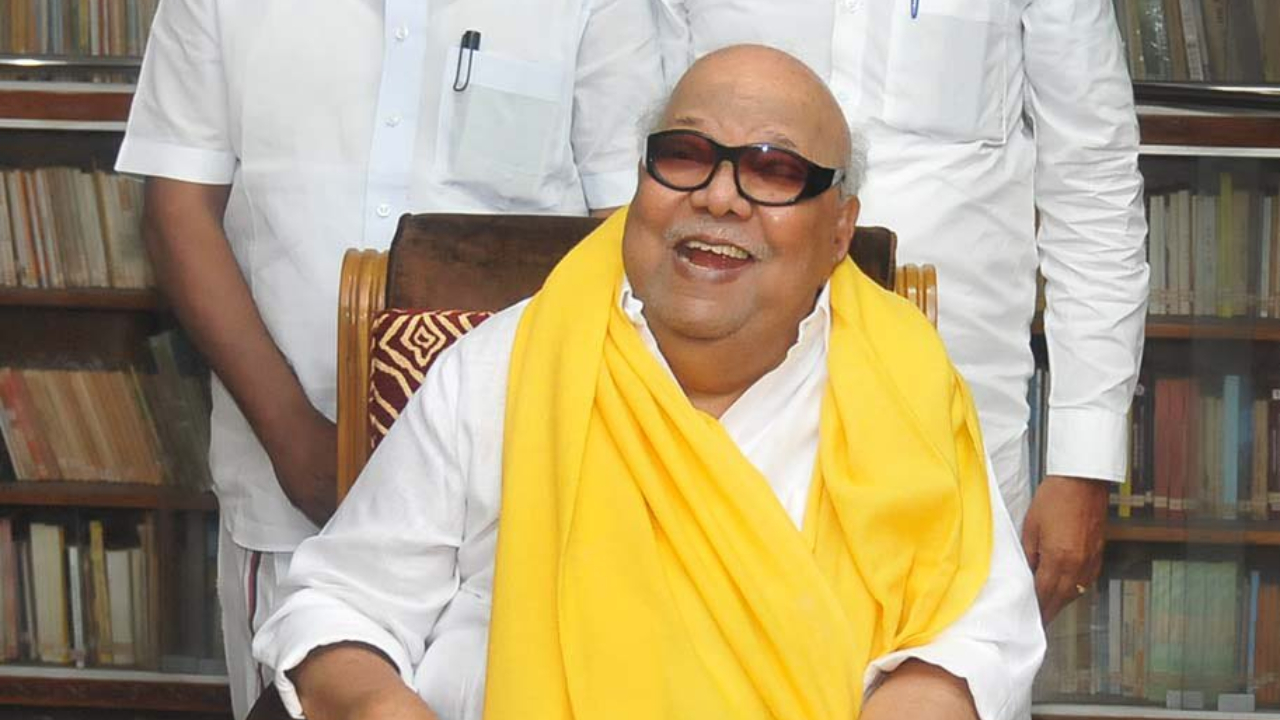
M Karunanidhi. Credit: x.com/kalaignar89
Synopsis: On 31 January 1976, the democratically elected DMK government in Tamil Nadu, led by Chief Minister M Karunanidhi, was dismissed under Article 356 during the Emergency. Governor KK Shah’s report paved the way for President’s Rule, triggering mass arrests of DMK leaders under MISA. The dismissal, widely linked to AIADMK and Congress’ coterie, reshaped Tamil Nadu’s political landscape.
“This might be my last speech as chief minister of Tamil Nadu” said then Tamil Nadu CM M Karunanidhi in his speech at the annual day function of Don Bosco School in Chennai at 5 pm on this day in 1976.
Although he would go on to deliver many speeches later as chief minister, the words he spoke that day turned out to be true within the next one and a half hours.
The government led by the Dravida Munnetra Kazhagam (DMK), democratically elected in Tamil Nadu, was dismissed by the then Indira Gandhi–led Union government. After receiving the news via newspapers, Karunanidhi returned home, sighed in relief saying, “Ah, the suspense is finally over,” and sent back his official government car to the Secretariat.
This was because, for a day or two earlier, rumour mills were buzzing that DMK government in Tamil Nadu could be dismissed any moment.
Thus, for the first time, DMK government headed by M Karunanidhi in Tamil Nadu was dismissed. Today marks the 50th anniversary of that event, remembered by many as a significant political moment.
This article revisits the developments that unfolded in Tamil Nadu in the days following that day.
On 30 January, the day before Karunanidhi’s government was dismissed on 31 January, a Gandhi memorial event was held at the Guindy Gandhi Mandapam under the leadership of then Tamil Nadu Governor KK Shah. The event was held till the morning of 31 January.
Speaking at the event, Governor Shah said, “DMK government follows the footsteps of Mahatma Gandhi.”
Karunanidhi later criticised that on the morning of 31 January, when Governor spoke at the Gandhi memorial function, he had not yet sent his recommendation to dismiss the government, and that hurriedly, in line with the wishes of the Centre, a report was prepared and sent, and the Governor’s signature was obtained only after 31st evening.
In confirmation of this, on the evening of 31 January, 1976, the Union Cabinet met and recommended to then President Fakhruddin Ali Ahmed that the Tamil Nadu Council of Ministers be dismissed and President’s Rule be imposed in Tamil Nadu under Article 356 of the Constitution.
That very night, President issued the order.
According to a report published in The Hindu, “Shah, in his report, said he was satisfied that a situation had arisen in which the government of the State could no longer be carried on in accordance with the provisions of the Constitution. The government was headed by Chief Minister M Karunanidhi.”
It was based on this recommendation that the Union Cabinet sent its recommendation to the President to dismiss Karunanidhi’s government.
Once the news of the dismissal came out, several DMK leaders were arrested. However, many were surprised that M Karunanidhi, who was both party leader and Chief Minister, was not apprehended.
However, within an hour of announcement, police came to Karunanidhi’s residence claiming they had come to arrest his son, MK Stalin – current Tamil Nadu CM.
Since Stalin was out of town at that time, Karunanidhi in his book Nenjuku Neethi writes that when Stalin returned the next day, he personally handed him over to the police.
That night, the police also came looking for Murasoli Maran, a senior DMK leader known as the party’s face in Delhi. Karunanidhi similarly handed him over to the police the next day.
Along with them, hundreds of DMK leaders and cadres across Tamil Nadu, members of the Communist movement, and even former Congress members were arrested, Karunanidhi notes in his book.
Those arrested from January 1976 were not released until January 1977.
“On 18 January 1977, she announced that elections to the Lok Sabha would be held in March. While many political prisoners were released with the relaxation of MISA, in Tamil Nadu, which was under the president’s rule, DMK cadres were still held in jail. After repeated meetings with Governor Mohan Lal Sukhadia, DMK cadres were released in batches between 23 January and 2 February” (Panneerselvan, AS, Karunanidhi: A Life)
The news of the government’s dismissal spread like wildfire across Chennai on the 31st itself. Hundreds of cadres began gathering in front of Karunanidhi’s residence.
Karunanidhi records in Nenjuku Neethi that even government officials came to him in tears to convey the news. But the DMK veteran, who was expecting this, felt a strange sense of relief that the suspense had finally ended.
According to The Hindu, “Immediately after the dismissal of the government, Commissioner of Police issued prohibitory orders in Chennai, banning for 14 days any meetings, protests, demonstrations, and even Assembly.”
As Emergency was in force at the time, strict censorship was imposed on the press as well.
Even so, Karunanidhi published in Murasoli a list of those arrested under MISA under the headline “Those who did not come for CN Annadurai’s memorial day.”
The implication was that all those who did not attend had likely been arrested under MISA.
Although it has been said that Karunanidhi’s government was dismissed in 1976 based on a dossier prepared by the Intelligence Bureau under the then Tamil Nadu officer-in-charge MK Narayanan, the roots of this go back to 1972.
In November 1972, MG Ramachandran, then leader of AIADMK, submitted to the Centre a list of complaints against DMK ministry. The list contained 54 complaints in total: 27 against CM Karunanidhi, 13 against other ministers, and the rest against alleged irregularities committed by DMK district secretaries.
On 3 February, 1976, speaking in Parliament, then MoS for Home Affairs Om Mehta said that a judicial inquiry would be conducted into these complaints. On that very day, the Sarkaria Commission was constituted under the chairmanship of then Supreme Court judge Justice Sarkaria.
Former Chief Minister MG Ramachandran welcomed the dismissal of DMK government as an action taken to protect democracy.
In this context, it was widely rumoured at the time that Congress and AIADMK had jointly planned and brought down the DMK government.
In confirmation of this, in the Lok Sabha elections held in March 1977, AIADMK and Congress contested together as an alliance. CPI and IUML were also part of this alliance. They won all 34 seats. DMK-led alliance won only five seats.
(All the views in this article are drawn from Karunanidhi’s Nenjuku Neethi and Panneerselvan, A.S., Karunanidhi: A Life)
(Edited by Amit Vasudev)


