

Published Jun 09, 2023 | 3:06 PM ⚊ Updated Jun 09, 2023 | 3:06 PM

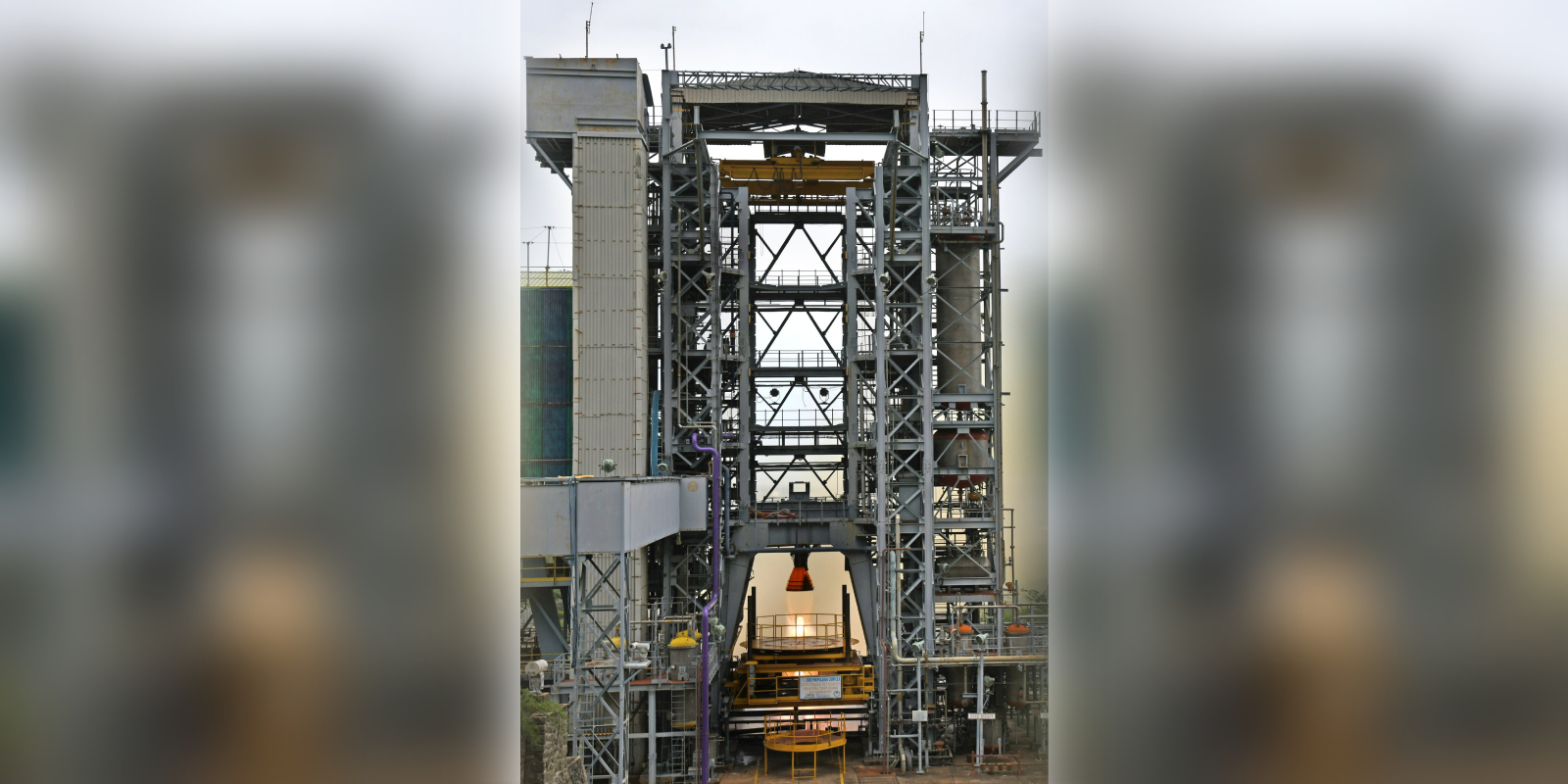
ISRO's Gaganyaan under testing. (Gaganyaan Isro/ Twitter)

Indian Space Research Organisation (ISRO) chief S Somanath on Thursday, 8 June, spoke about the manned space mission, Gaganyaan, the air-breathing vehicle “Hava” and other projects of ISRO.
Somanath said ISRO has decided not to rush its Gaganyaan project as it wants to ensure that the country’s first human space flight is a “sure shot safe mission.”
Gaganyaan was set to launch in 2022, but due to Covid-19 there was an inordinate delay, Somanath told reporters during the international conference on Spacecraft Mission Operations (SMOPS-2023).
“We have a different thinking now. Our thinking is like this that we don’t want to rush. That decision we have taken. The primary objective of the human space flight is a sure shot safe mission,” the ISRO chief said.
The space agency has redefined the mission in such a way that it will achieve success on the very first attempt. For this, it has enhanced the testing and demonstration mission substantially in recent times. He explained that these exercises involve additional abort missions to ensure the crew’s safety.
According to Somanath, the first exercise will probably happen in August, which was earlier planned in July.
“So, two abort missions have to take place this year followed by an unmanned mission possibly by the beginning of next year,” the ISRO chairman said.
The space scientist said all the engine test programmes have been completed within ISRO.
Stating that hectic activities are taking place, Somanath said every week at least some major tests are happening.
“For me, eight major tests are there and if all the tests successfully happen without any glitches, the launch will be between 2024 and 2025 time frame. But if I face problems and challenges, which are natural in this process, I have to discount for the schedule,” he added.
What is Gaganyaan
Gaganyaan (Orbital Vehicle) is an Indian crewed orbital spacecraft intended to be the basis of the Indian Human Spaceflight Programme.
PM Modi : “We have decided that by 2022, when India completes 75 years of independence.#ISRO#gaganyaan#astronomy pic.twitter.com/hpIWHggLcy— Gaganyaan (@Gaganyaan_Isro) September 21, 2019
About India’s first solar mission, Aditya-L1, Somanath said the launch window is August this year to January next year.
“If we cannot launch it in August then we will go to next year January,” he added.
Regarding Chandrayaan-3, ISRO’s third moon mission, Somanath said it is due to be launched in mid-July. ISRO will follow the same process that was adopted during the Chandrayaan-2 mission, he said.
“We are going in the same path as Chandrayaan-2 because we have already done that. We have the experience to do it in that manner but it all depends on various other factors whether there are any other contingency conditions,” Somanath said, adding, “The landing flight is just the same as previously. No change.”
To a query on how indigenous Chandrayaan-3 is, the ISRO chairman said, “What we are doing in ISRO is 100 percent indigenous. We are not buying anything from anybody to do it but of course, we buy some components such as electronic chips, processors, some high-end devices, but we don’t buy Chandrayaan lander from anybody.”
“HAVA” stands for Hypersonic Air Breathing Vehicle with Air Integration System.
ISRO chairman S Somanath said there will be an announcement soon about the space agency’s testing facility for the hypersonic air-breathing vehicle “Hava”.
The space scientist, however, emphasises that ISRO was not focused on air-breathing technology because it wants to deal more with space. Air-breathing engines are those that take in air from their surroundings to burn fuel, such as jet engines. It is therefore not suitable for space travel as there is no air/atmosphere in space.
“We are also developing a new rocket ‘Hava’ to fly at a hypersonic speed for 200-plus seconds. You will also hear some announcements soon about our testing plant with the new fuel for air-breathing,” Somanath told reporters here.
Replying to a query on the progress made on air-breathing technology, Somanath said ISRO is looking at it not as an immediate input for any rocket but as a technology capability.
“If air is there, that is not space,” Somanath explained. “ISRO is not much into air-breathing technology primarily because we don’t want to dwell in air, we want to go to space. But we develop the technology because it is a very high-end technology in terms of capabilities that we have— in terms of combustion etc. So we are testing the engine. We are testing in our Mahendragiri facility where we have established a hypersonic test facility,” he added.
Regarding new generation launch vehicles (NGLV), Somanath said ISRO is building an architectural rocket, and a big team from various centres is working on it.
“The team has come out with a preliminary report on how this rocket should look like, what are the technical inputs, what are the approaches that we have to do, where we should do, what manufacturing —everything is addressed. We want it to be partially reusable. We should use the new generation propulsion and engine.”
To a question, Somanath ruled out any Russian dependence on cryogenic engines.
“There is no Russian dependence in our cryogenic engines. It is 100 percent Indian by now. It was there for maybe 15 years. We are not dependent on Russia for any inputs including components. Whatever we had purchased from Russia has all been replaced by Indian equivalent components. It is already done,” he said.
The ISRO chairman said that after the Russian collaboration, a new indigenously developed engine called C-25 was developed in ISRO, which he, as Director of the Liquid Propulsion Systems Centre (LPSC), qualified and launched multiple times.
About the semi-cryogenic engine, Somanath said ISRO is developing one to replace the LVM-3 or Launch Vehicle Mark-III, previously known as the Geosynchronous Satellite Launch Vehicle Mark III or GSLV Mk III.
According to him, it is a 200-tonne engine, which ISRO has been developing for the past 15 years.
“This engine has now reached the first powerhead. The assembly has already been done. We have built a huge test facility. It was commissioned just last month and we have installed it and done the first-ever propellant feed into it. So it’s successful now,” the ISRO chief said.
He added that in another few days, the first firing of the engine will take place, followed by six to seven tests, which will take place every two weeks under different conditions.
If the tests are successful, the next phase will be to work on the hardware, Somanath said.
He also explained that ISRO had initially planned to conduct the tests in Russia and Ukraine because they had the facilities to conduct the tests, but now due to war those locations are not accessible.
“Now the geopolitical situation does not allow us to go there,” Somanath said, explaining that it made the space agency accelerate the construction of such a facility in India.
“I am happy that the industry is supporting us so much to build a huge facility, which has just been commissioned,” he added.
(Disclaimer: The headline, subheads, and intro of this report along with the photos may have been reworked by South First. The rest of the content is from a syndicated feed, and has been edited for style.)



