


Published Feb 01, 2026 | 1:48 PM ⚊ Updated Feb 01, 2026 | 2:33 PM

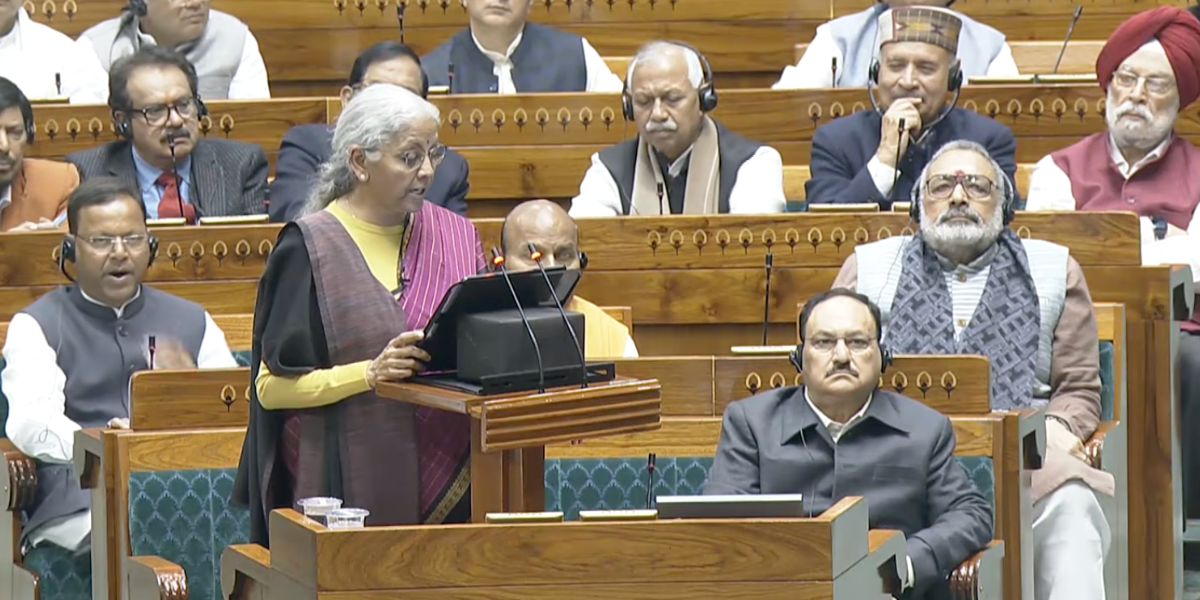
Finance Minister Nirmala Sitharaman presenting the Union Budget 2026.
Synopsis: Presenting the Union Budget 2026, Finance Minister Nirmala Sitharaman announced a series of initiatives aimed at boosting farmers’ incomes, strengthening rural livelihoods and promoting technology-driven agriculture. In a push towards diversification and higher-value farming, support was announced for crops such as coconut, cocoa, cashew and sandalwood in coastal regions.
Presenting the Union Budget 2026 in Parliament on Sunday, 1 February, Finance Minister Nirmala Sitharaman announced a series of initiatives aimed at boosting farmers’ incomes, strengthening rural livelihoods and promoting technology-driven agriculture.
Outlining the government’s third “Kartavya” aligned with its vision of Sabka Saath, Sabka Vikas, Sitharaman said the focus would be on empowering youth, enhancing farm productivity and encouraging entrepreneurship, with special attention to small and marginal farmers.
In the fisheries sector, the government proposed an integrated development programme for 500 reservoirs and Amrit Sarovars to strengthen inland fisheries.
The Budget also seeks to reinforce the fisheries value chain in coastal areas by enabling market linkages involving startups, women-led groups and Fish Farmer Producer Organisations (FFPOs), aimed at improving value addition and income security.
To generate quality employment in rural and peri-urban areas, the Budget announced support for entrepreneurship in the animal husbandry sector through a credit-linked subsidy programme.
The government will back the scaling up and modernisation of livestock enterprises, enhance integrated livestock, dairy and poultry value chains, and encourage the formation of Livestock Farmer Producer Organisations to strengthen supply chains and improve returns for producers.
In a push towards diversification and higher-value farming, support was announced for crops such as coconut, cocoa, cashew and sandalwood in coastal regions.
In the northeastern states, other tree crops will be promoted, while walnuts, almonds and pine nuts will be encouraged in hilly regions through expanded high-density cultivation.
Highlighting sandalwood’s deep link to India’s social and cultural heritage, Sitharaman said the Union government would partner with state governments to promote focused cultivation and post-harvest processing to restore the Indian sandalwood ecosystem.
The initiative will include rejuvenation of old and low-yield orchards and expansion of high-density plantations of nuts such as walnuts, almonds and pine nuts. A dedicated programme will also be launched to enhance farmers’ incomes through value addition by engaging youngsters.
Noting that India is the world’s largest producer of coconuts and that nearly 30 million people, including about 10 million farmers, depend on coconut-based livelihoods, Sitharaman announced a Coconut Promotion Scheme.
The scheme aims to raise production and productivity by replacing senile and non-productive trees with improved saplings in major coconut-growing states.
A dedicated programme for cashew and cocoa will be implemented to make southern India self-reliant in raw cashew and cocoa production and processing. The government aims to improve export competitiveness and transform Indian cashew and cocoa into premium global brands by 2030.
The finance minister also announced the launch of Bharat Vista, a multilingual artificial intelligence-based digital platform for agriculture. The tool will integrate Agri Stack portals and the Indian Council of Agricultural Research (ICAR) package of agricultural practices with AI systems.
According to Sitharaman, Bharat Vista will help farmers improve productivity, make better cropping and input decisions, and reduce risks by providing customised advisory support based on local conditions.
(Edited by Muhammed Fazil.)


