

Published Mar 29, 2026 | 3:49 PM ⚊ Updated Mar 29, 2026 | 3:49 PM

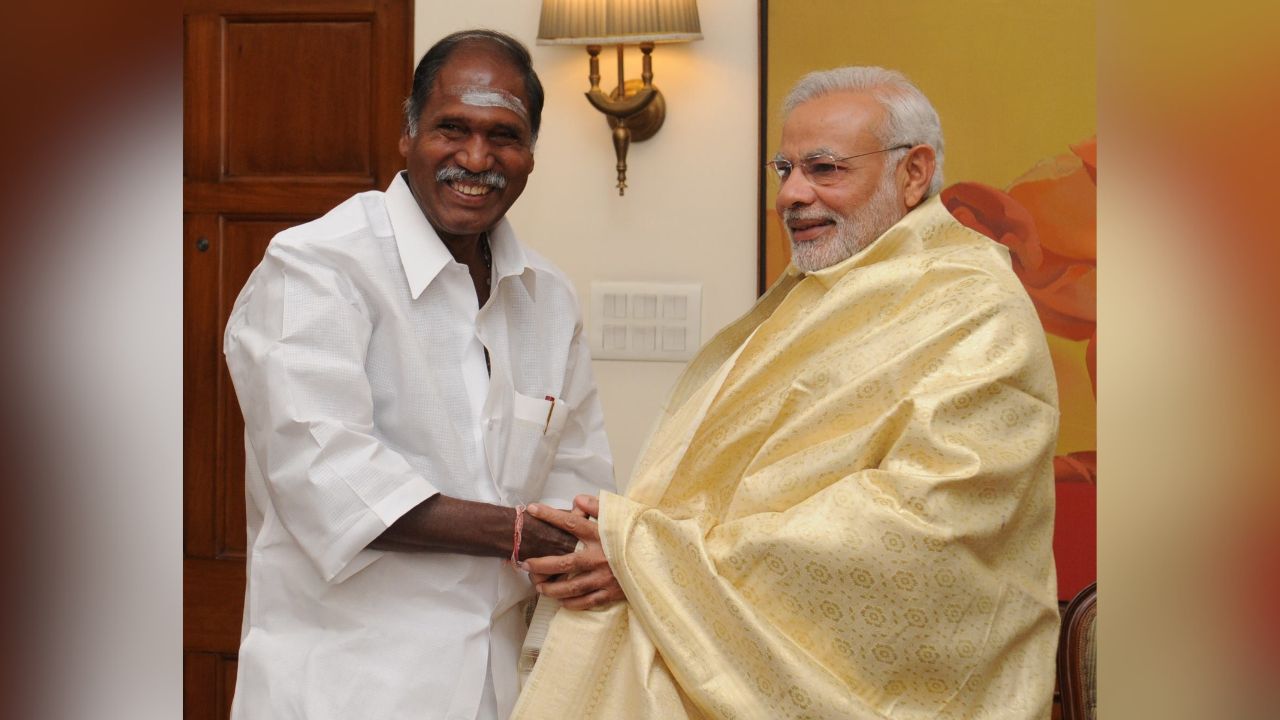
N Rangasamy with Prime Minister Narendra Modi. (File picture)
Synopsis: A pre-poll survey by People’s Pulse predicts an NDA victory in the Union Territory of Puducherry, enabling Chief Minister N Rangasamy to return for a fourth term. The pre-poll survey projects the NDA winning 14–17 seats, the Secular Progressive Alliance (SPA) 9–11, the Tamilaga Vetri Kazhagam (TVK) of actor Vijay winning 2–4, and others 1–2.
As Puducherry braces for the Assembly polls on 9 April, a clear but measured verdict appears to be emerging from the ground. Far from any sweeping wave, the contest is shaping up as a hard-fought, constituency-by-constituency battle in the 30-member elected Assembly (within the 33-seat house), where micro-level factors and local dynamics in at least 8–10 marginal seats could prove decisive.
A fresh pre-poll survey conducted by Peoples Pulse suggests the formation of an NDA-led government, enabling Chief Minister N Rangasamy to return for a fourth term. Barring a dramatic last-minute shift in voter sentiment — which currently appears improbable — the ruling alliance is well positioned to secure a narrow but workable majority, predicted the survey.
The pre-poll survey projects the NDA winning 14–17 seats, the Secular Progressive Alliance (SPA) 9–11, the Tamilaga Vetri Kazhagam (TVK) of actor Vijay winning 2–4, and others 1–2.
The survey, conducted between 16 and 23 March 2026, selected three polling stations in each of the 30 Assembly segments and collected 20-25 samples per station, yielding a total of 2,000 respondents. The sample was carefully stratified to reflect the ground reality in terms of caste, religion and age, with equal representation for gender.
The organisation said that the remaining days before polling could still influence the final outcome and that a post-poll survey, to be released on 29 April, will provide further clarity after voting concludes.
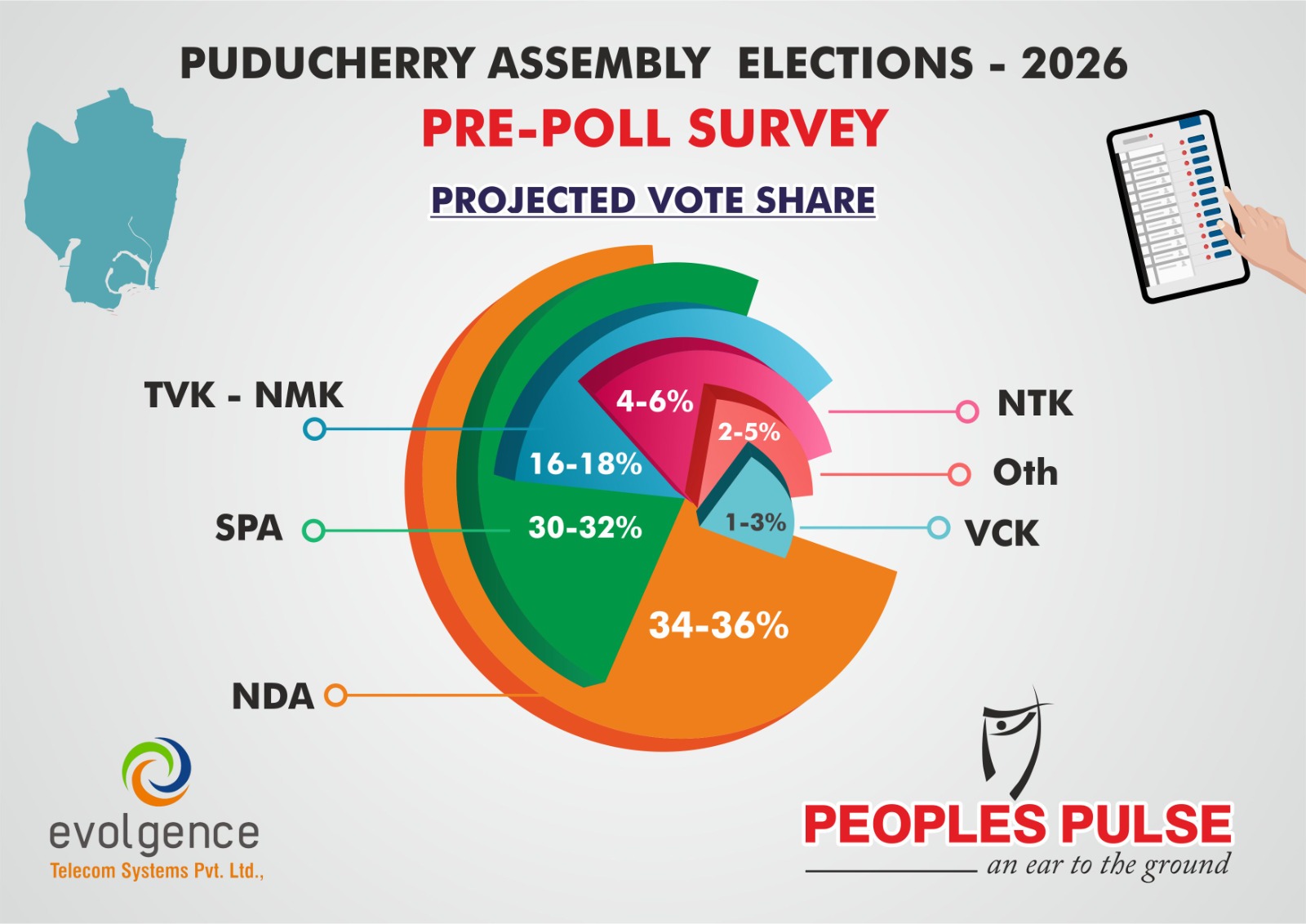
Projected vote share
According to the survey, the NDA is expected to command 34–36 percent of the total vote share, the SPA 30–32 percent, TVK, along with its ally NMK, 16–18 percent, NTK 4–6 percent, VCK 1–3 percent, and smaller parties collectively 2–5 percent.
Within the NDA, the All India NR Congress (AINRC) is set to emerge as the single largest party with 9–11 seats, followed by the BJP with 5–7. The SPA’s Congress may secure 3–5 seats and the DMK 6–8. These numbers point to a grinding contest rather than a landslide, yet they also underscore the NDA’s consistent edge.
Pre-election dynamics have tilted the scales in the NDA’s favour.
The SPA is grappling with multiple setbacks — public perception of disarray, challenges in ticket allocation, and visible internal discord. Coordination challenges persist at both leadership and cadre levels between Congress and DMK, placing both parties at a potential electoral disadvantage.
These internal conflicts, compounded by the entry of TVK and the resulting fragmentation of Opposition votes, have created a favourable environment for the NDA. Should these trends hold, a tally exceeding 20 seats for the alliance would not be surprising.
By contrast, the NDA has resolved initial seat-sharing frictions between its key partners, the AINRC and the BJP, and now displays strong coordination that is proving to be a significant electoral asset.
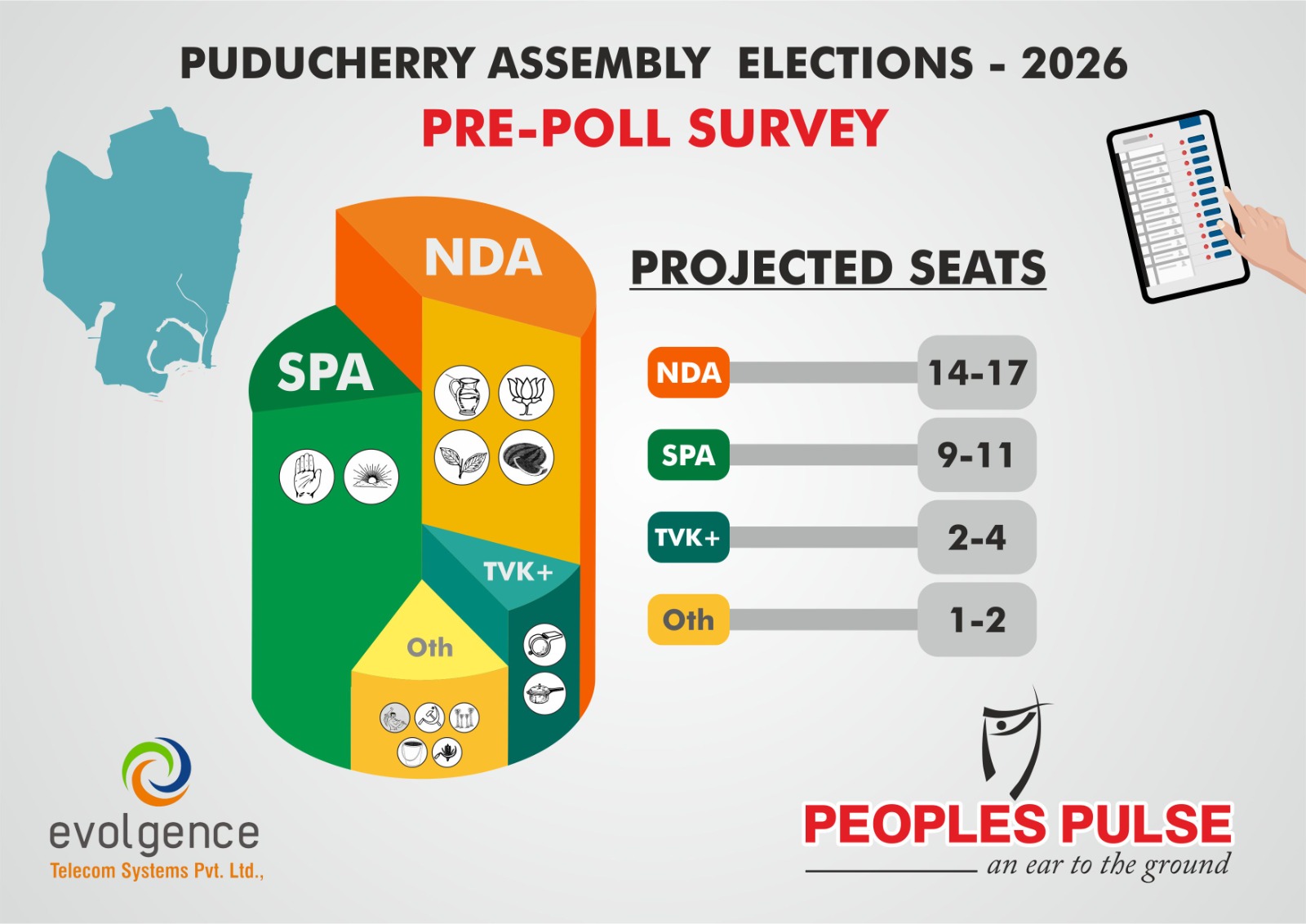
Projected seats.
When respondents were asked about their preferred chief minister, Rangasamy commanded a dominant 62 percent support. On the question of which party is better placed to deliver development for Puducherry, 46 percent favoured the AINRC and 34 percent chose Congress.
Crucially, 55 percent of voters felt the NDA government deserved another chance, while 41 percent said no and four percent remained undecided.
Approximately 60 percent of respondents also believe that, as a Union Territory, Puducherry cannot achieve significant development without support from the Union government — a perception that translates into a tangible advantage for the NDA, which is in power at the Centre.
Voter priorities while casting ballots reflect a pragmatic mix: 40 percent prioritise the candidate, 30 percent the party, 10 percent caste and religion, 10 percent are influenced by money, and the remaining consider other factors.
The key electoral issues identified include unemployment, rising cost of living, lack of development, corruption within the administrative system, and the unchecked sale of liquor. There is also widespread demand for statehood and palpable resentment over perceived interference by the Lieutenant Governor.
Educated youth unemployment, recurrent flooding, poor road conditions, water scarcity, and the prolonged delay in holding local body elections have added to the discontent.
Three major shifts have made the 2026 election markedly different from the 2021 verdict. First, TVK is making a strong impression by contesting all 30 seats independently (with two seats for ally NMK).
The TVK party has fielded seasoned local leaders such as V Saminathan, KAU Assana, G Nehru, J Prakash Kumar, and C Dhanavelu, each bringing personal vote banks of 5,000 to 10,000 votes. It is attracting nearly 40 percent of first-time voters and those in the 18–25 age bracket.
In around 14 constituencies, TVK’s anticipated vote share exceeds the 2021 winning margin, positioning it as a potent spoiler. With multiple players in the fray, winning thresholds in urban seats are likely to dip to just 33–36 percent — a scenario that generally benefits the NDA’s superior booth-level organisation.
TVK has further strengthened its prospects by inducting heavyweight defectors from the BJP, Congress, and AIADMK.
Second, the VCK has walked out of the SPA after being allotted only one seat and is now contesting independently in Oussudu (SC), Thirubhuvanai (SC), Ozhukarai, and influencing Nettapakkam (SC). This move is splitting Dalit votes and is expected to directly aid BJP candidates in reserved constituencies.
Third, the PMK remains divided. While one faction backs the NDA, the Ramadoss faction — allied with Sasikala’s AIPTMMK — is contesting separately. This split is eroding AINRC’s support among Vanniyars by 5–12 per cent in several northern seats and weakening AIADMK’s traditional Thevar base by 5-9 percent.
Unlike 2021, when anti-incumbency was largely consolidated against the ruling dispensation, the opposition vote this time stands fragmented among the SPA, TVK, and NTK. This division enables the NDA to clinch many seats even with a relatively modest vote share, particularly in urban areas.
The NDA alliance also demonstrates better vote efficiency in rural belts. Within the SPA, the DMK appears more effective than Congress at converting votes into seats, giving the alliance a 4–5 percent higher share in constituencies it contests.
The NDA, for its part, draws strength from Central schemes — notably the ₹2,000 monthly cash transfer to women and gas subsidies — which provide a reliable floor of around 35 percent votes.
Candidate selection across alliances reflects careful attention to local religious demographics, particularly Muslim influence in parts of Karaikal and Christian presence in coastal areas. Caste equations continue to matter, though they remain fluid. Both the NDA and SPA have allotted nearly 45 percent of their seats to Vanniyar candidates, underscoring the community’s pivotal role in deciding outcomes in about 14 seats.
In these Vanniyar-dominated areas, the NDA maintains an advantage as the Ramadoss faction has refrained from mounting a strong attack on Chief Minister Rangasamy.
Mudaliars and Vellalars (18–22 percent), concentrated in urban pockets, display divided loyalties, with the younger cohort tilting towards TVK. Vanniyars (14–25 per cent) constitute the largest group in northern seats and function as kingmakers.
Dalits (16–18 per cent) hold sway in five reserved seats, where VCK’s independent run is creating divisions. Thevars (10–12 per cent) have traditionally supported the AIADMK but now face fragmentation. Muslims and Christians largely lean towards the SPA.
In Mahe and Yanam, local communities — Thiyya in Mahe and Kapu, Fishermen and Settibalija in Yanam — take precedence over broader Tamil-centric patterns.
The NDA remains largely Hindu-oriented but has made strategic accommodations for Christians, besides fielding notable Muslim candidates in the Karaikal district. The SPA retains a robust traditional base among both Christians and Muslims. NTK, in line with its 2026 policy shift, has fielded Brahmin and minority candidates even in general seats to project a broader “Tamil identity” beyond narrow caste considerations.
The party stands out for achieving a perfect 50 percent gender split in ticket distribution, fielding 14 women candidates compared to four by the NDA and three by the SPA.
It has chosen not to contest in Mahe and Yanam to concentrate its organisational strength in Tamil-speaking regions and finds stronger traction in SC-reserved and rural areas, drawing votes primarily from the SPA.


