
Published Jan 13, 2026 | 3:57 PM ⚊ Updated Jan 13, 2026 | 6:06 PM

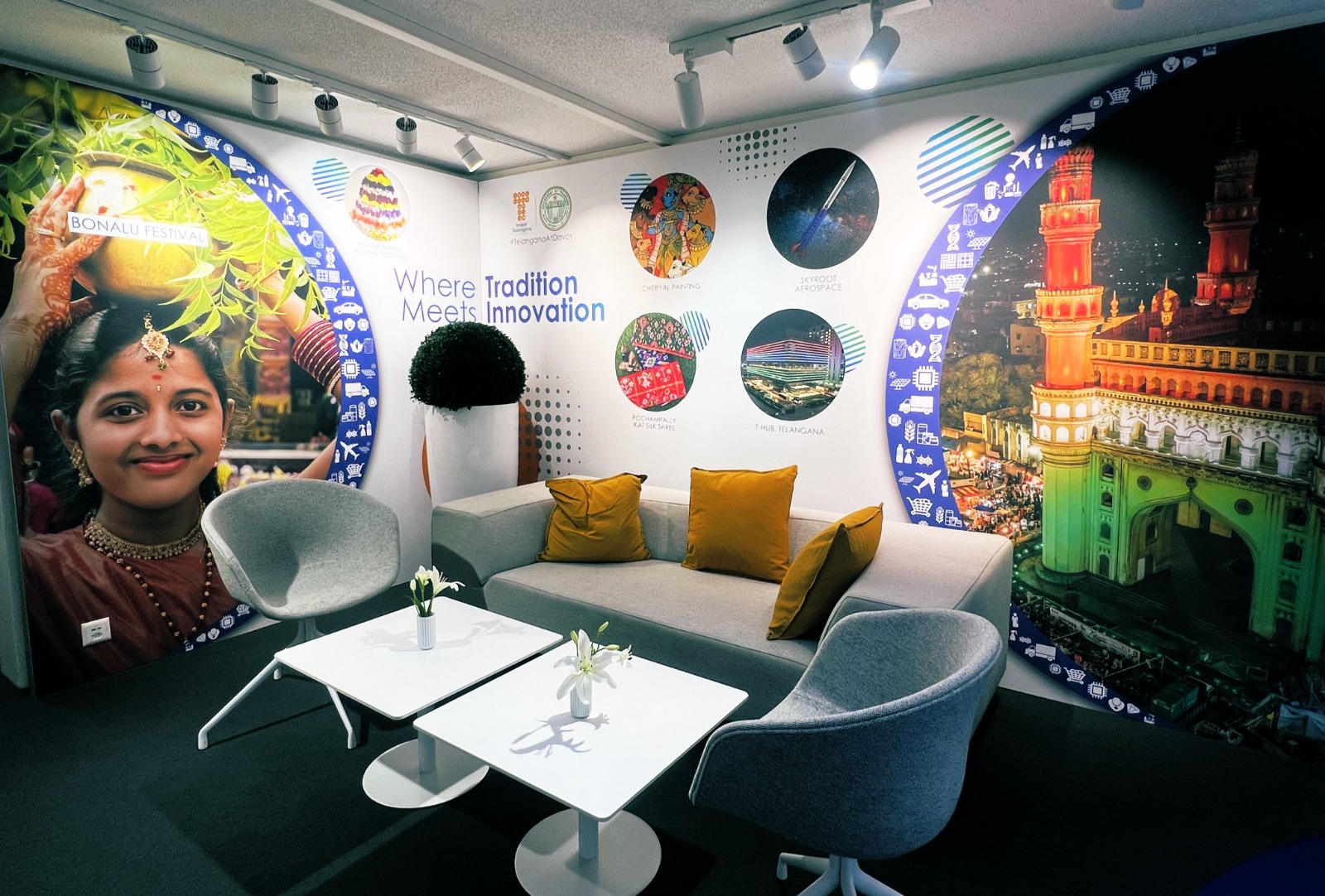
An inside view of the Telangana pavilion, exhibiting a blend of culture, tradition and technology at the World Economic Forum (WEF) in Davos, Switzerland. (Supplied)
Synopsis: Telangana’s information technology exports have crossed ₹3 lakh crore annually. While the figure is impressive, it is the human reality behind it that deserves closer attention. Every crore in exports translates into thousands of pay slips, housing rentals, school admissions and small businesses that thrive around technology hubs. Over the past two years, the state’s IT surge has been as much about social mobility as it has been about balance sheets.
In today’s India, the most consequential battles over prosperity are no longer fought in fields or factory floors, but in data centres, design studios and lines of code. States that succeed in this new economy will determine not only their growth rates but also their social futures — who gets jobs, who builds wealth and who enters the middle class.
Telangana’s recent technology-led expansion offers a revealing case of how public policy, private capital and human talent can converge to reshape a region’s destiny.
Telangana’s information technology exports have crossed ₹3 lakh crore annually. While the figure is impressive, it is the human reality behind it that deserves closer attention. Every crore in exports translates into thousands of pay slips, housing rentals, school admissions and small businesses that thrive around technology hubs. Over the past two years, the state’s IT surge has been as much about social mobility as it has been about balance sheets.
Since the Congress government took office in 2023, it has made a deliberate choice to place technology at the centre of economic strategy. Under Chief Minister A Revanth Reddy and IT and Industries Minister D Sridhar Babu, the state has sought to reorient its governance from merely attracting companies to enabling them to grow and innovate.
Regular engagement with global firms, industry bodies and technology leaders has informed a series of policy refinements, signalling that Telangana is not content to rest on its past reputation as an IT destination but is determined to remain competitive in a rapidly evolving global market.
The numbers suggest that this approach is working. Telangana has set itself a target of achieving ₹3.6 lakh crore in IT exports and creating 11 lakh direct technology jobs by 2025–26. Employment in the sector has already risen from 9.5 lakh in 2023 to more than 10.2 lakh in 2024–25 and is expected to cross 11 lakh this year. The significance of this growth extends far beyond office campuses. Each technology job typically supports several others in transport, housing, retail, food services and logistics, creating an estimated 25 lakh indirect livelihoods across the State.
Hyderabad’s growing prominence in the global technology ecosystem is central to this story. The government’s push to promote the city as a hub for Global Capability Centres (GCCs) reflects a realistic understanding of how multinational corporations are restructuring their operations. With more than 300 GCCs already operating in Hyderabad — placing it among the top three such destinations globally — the city has moved well beyond its earlier role as a back-office location.
These centres now handle core functions such as product design, engineering, analytics and research, embedding Telangana deeper into global value chains.
International outreach has become an important part of this strategy. Engagements at global platforms such as the World Economic Forum are not mere symbolism; they provide opportunities for direct dialogue with decision-makers who are reassessing their investment footprints in a world of shifting geopolitics and supply chains. By projecting Hyderabad as a stable, skilled and cost-competitive base, the State is positioning itself to capture a larger share of this global rebalancing.
The rapid expansion of digital infrastructure further underlines this ambition. Large data centre investments announced at the Telangana Global Rising Summit — including commitments from InfraKey DC Park, JCK Infra and the AGP Group — could make the state a critical data and cloud hub for South Asia.
In an era where artificial intelligence, e-commerce and financial technology depend on secure and high-capacity data infrastructure, such projects are not peripheral; they are foundational to future growth.
Parallel investments planned for the Bharat Future City, including proposals for deep-tech research hubs and digital media technology centres, point to a longer-term vision that goes beyond today’s IT services. The objective is to create an ecosystem where research, innovation and advanced manufacturing can coexist, allowing Telangana to move up the technology value chain rather than remaining confined to service delivery.
Artificial intelligence has emerged as a particularly important frontier. The expansion of global AI engineering centres in Hyderabad, bringing in thousands of highly skilled professionals, signals a shift in how global firms view the city. Telangana is no longer seen merely as a location for cost-effective manpower but as a site for innovation, experimentation and product development. This transition is crucial if India is to claim a meaningful role in the next phase of the digital revolution.
The life sciences and biotechnology sectors are following a similar trajectory. Initiatives such as the BioAsia conference, which focuses on the convergence of biology, automation and digital technology, seek to place Telangana at the cutting edge of biomedical innovation. By actively courting global investors and research institutions, the State is attempting to replicate in biotechnology what it achieved in IT two decades ago.
Importantly, the government has also recognised the economic potential of the creative industries. Through policies such as IMAGE 2.0, it is encouraging growth in animation, gaming, multimedia and digital entertainment — sectors that blend technology with artistic talent and have the capacity to generate both employment and global visibility. Improved digital connectivity and support for remote working are helping spread these opportunities beyond Hyderabad into smaller towns, making growth more geographically balanced.
What gives this entire effort credibility is the consistency of investor confidence. Domestic and international institutions continue to commit capital across technology, data infrastructure, life sciences and creative industries. In a country where policy uncertainty has often deterred long-term investment, Telangana has managed to project stability, continuity and a willingness to engage constructively with business.
Ultimately, however, the true measure of Telangana’s technology-led growth will not lie in export figures or investment announcements, but in its social impact. For a young graduate entering the workforce, a woman launching a start-up, or a family migrating from a rural district in search of better prospects, the IT and innovation economy offers a pathway to security and dignity. If the State can sustain its present momentum while ensuring that the benefits of growth remain widely shared, Telangana’s technology moment could become one of the most durable and inclusive development stories in contemporary India.
(Edited by Majnu Babu).


