

Published Mar 25, 2026 | 6:31 PM ⚊ Updated Mar 25, 2026 | 6:31 PM

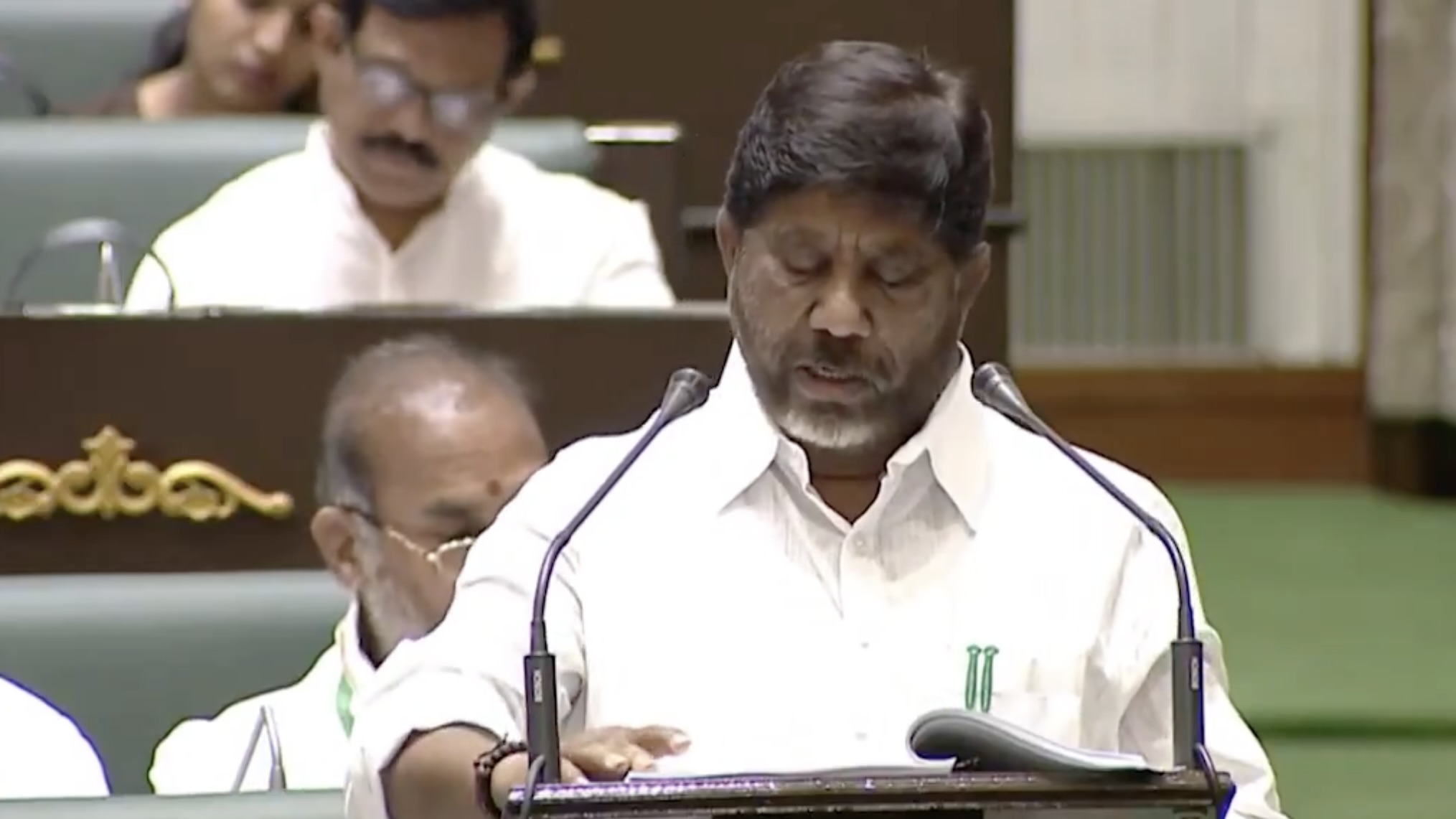
Telangana Finance Minister Bhatti Vikramarka Mallu presents the state budget.
Synopsis: The Telangana budget 2026–27 and the Socio-Economic Outlook 2026 present contrasting accounts of the state, though both were tabled in the same legislature. The budget does not address global disruptions, rising input costs or tighter borrowing conditions, while allocations to agriculture have declined and a large share of the workforce remains dependent on a slowing rural economy.
The Telangana Socio-Economic Outlook 2026, tabled in the legislature alongside the budget, opens with a vision: a $3 trillion GSDP economy by 2047, a net-zero metropolis within the Outer Ring Road, a state at the forefront of global capability centres, fintech and the silver economy. The language is of trajectory and transformation. It is, in the precise sense of the word, aspirational.
The budget presented on 20 March 2026 is written in the same register. Its features include a 29 percent jump in capital expenditure; a GSDP growth rate of 10.7 percent, against a national average of 8 percent; infrastructure sanctions totalling ₹43,592 crore across Hyderabad; the Musi Riverfront, Bharat Future City, seventeen new medical colleges, Metro Phase II. The Finance Minister presented this as a state in decisive motion.
What neither document does—and what makes reading them together so revealing—is acknowledge the conditions under which they were prepared. Three weeks before budget day, West Asia had escalated to open conflict. Crude oil had crossed $100 a barrel. The rupee had hit a record low of ₹93.2. State Development Loan spreads had widened to their highest since the COVID shock of 2020. Goldman Sachs had cut India’s growth forecast. Urea—the input on which Telangana’s paddy economy depends—had risen 41 percent, from $425 to $600 per tonne, as Qatar, which supplies most of India’s LNG used in its production, halted shipments. Kharif sowing, Telangana’s major cropping season, was six weeks away.
The budget 2026–27 mentions none of this.
This is not a minor omission. Telangana has over 10 lakh workers in Gulf states whose remittances are a critical income source for rural households. Its pharmaceutical sector—the engine of Hyderabad’s industrial identity—earns roughly 15 percent of export revenues from West Asia.
The ₹5.75 lakh crore in investment commitments announced at the Rising Summit included significant Gulf and Singapore capital now subject to war-induced risk aversion. Further, the State Development Loan market through which Telangana must borrow an estimated ₹65,000–80,000 crore to fund this budget had tightened before the war and tightened further after it.
The budget’s investment ambitions and its borrowing behaviour are in direct contradiction: heavy SDL issuance crowds out precisely the private capital the budget claims to attract.
None of this is reflected in a single line of the budget speech. It was written, as the budget article accompanying this piece notes, as though it were still January.
But the deeper disconnection is not between the budget and the war. It is between the budget and the economy that most Telangana citizens actually inhabit.
The Socio-Economic Outlook 2026 records, quietly and without comment, that 41.5 percent of Telangana’s combined workforce is employed in agriculture. Agriculture contributes 15.1 percent of State Gross Value Added – growing at just 1.4 percent, against the services sector’s 13.5 percent.
The primary sector GSVA grew at 1.4 percent in a year when rainfall was 37 percent above normal, irrigation coverage was cited as expanded, and paddy procurement reached record volumes. One-sixth of the state’s output grew at 1.4 percent in what should have been a good year. This is not a success story. It is a structural signal about the condition of the rural economy.
The budget’s response to this signal is to reduce agriculture’s share of total spending. Agricultural allocations in 2026–27 stand at ₹15,703 crore – 4.8 percent of the total budget. Two years ago, in 2024–25, the allocation was ₹32,268 crore, or 11.1 percent. In nominal rupees, agriculture has lost more than ₹16,500 crore in two budget cycles.
The cut coincides precisely with the most severe agricultural input cost shock in years. The government has reduced support to farmers at the moment when their input costs have risen most sharply. Rythu Bharosa, providing ₹6,000 per acre in investment support, was designed for a world of $425 per tonne urea. On budget day, urea was $600 per tonne. The scheme was announced unchanged.
This is not the only number that the SEO and the budget together illuminate without comment. The Outlook records that Telangana’s non-tax revenue includes ₹2,100 crore budgeted from royalties on minor minerals and ₹1,320 crore from sale of sand in 2024–25.
These are conservative estimates for an extraction regime whose actual scale—particularly in river sand—far exceeds what appears in official accounts. The revenue model that underlies Telangana’s fiscal ambitions depends, in a portion that is structurally invisible, on the depletion of the natural resource base—rivers, aquifers, minerals—that the rural economy depends upon for its survival. The SEO’s chapter on environment notes, with admirable frankness, that “pressures on natural resources have emerged as major concerns affecting public health and ecological balance in the state.”
The budget is silent on this connection.
The rural economy that 41.5 percent of Telangana’s workforce inhabits is also distinguished by a structural dependence on external inputs that no policy document in this legislature session examines honestly.
Paddy, the state’s dominant crop occupying 132 lakh acres, is irrigated by tubewells extracting from a declining water table, fertilised by urea and DAP whose prices are determined in international markets, protected by pesticides manufactured from naphtha whose price has risen 20–25 percent with the war.
The farmer at the end of this chain is a price-taker at every step: in inputs, in water and in output. The ₹500 per quintal Sannarakam incentive and the Rythu Bharosa transfer are calibrated to normal-year economics. They were not designed for, and cannot absorb, an input shock of the magnitude now underway. The SEO’s agriculture chapter concludes, cautiously, that the sectoral outlook is “cautiously optimistic.”
It notes, briefly, that crop performance remains “vulnerable to uncertainties arising from erratic weather patterns, uneven rainfall, rising input costs, and volatile international commodity prices.” This is a precise description of the situation as of budget day. The budget does not address it.
The structural pattern across Telangana’s budgets since 2014 is consistent and worth stating plainly. The budget estimates have grown from ₹1,00,637 crore in 2014–15 to ₹3,24,234 crore in 2026–27 – a threefold increase in twelve years.
In the same period, every year’s revised estimate has been lower than the budget estimate—in most years by 7–20 percent—and actual expenditure has in several years fallen still further below even the revised estimate. The 2025–26 budget of ₹3,04,965 crore was revised down to ₹2,81,338 crore, a shortfall of ₹23,627 crore, or 7.7 percent, that was presented without explanation before a still larger budget for the following year was announced.
The Musi Riverfront project, with ₹43,592 crore in sanctioned works and ₹24,752 crore already commenced, has a budget allocation of ₹1,500 crore in 2026–27 – 3.4 percent of the sanctioned cost. At the current allocation rate, the project would take 29 years to complete from MAUD funds alone. The budget presents the sanction as the achievement. The funding gap is not mentioned.
This is the pattern: high announcements, lower revisions, lower actual spending, growing contingent liabilities parked off-budget, and an escalating debt stock—estimated at ₹7.5 lakh crore total, with annual servicing costs of roughly ₹55,000 crore—whose trajectory is acknowledged in the SEO’s public finance chapter and absent from the budget speech.
The interest payments to revenue receipts ratio for Telangana stands at 14.4 percent, the fifth highest among general category states, above Maharashtra, Gujarat and Karnataka. This is not a position from which a 29 percent increase in capital expenditure, funded primarily by fresh borrowings, is straightforwardly sustainable. The SEO knows this. The budget does not say it.
The CURE-PURE-RARE spatial framework—which divides Telangana into a net-zero urban core, a manufacturing peri-urban ring, and a Rural Agri Region Economy beyond the Regional Ring Road—is the SEO’s organising vision for 2047.
The rural agri region, the RARE zone, is where 41.5 percent of the workforce lives, where groundwater is declining, where input costs are rising, where agricultural allocation has been nearly halved in two years, and where the structural linkage to external—international—input markets makes household income increasingly volatile. The framework names this zone. It does not fund it.
The budget’s MAUD allocation of ₹17,907 crore overwhelmingly serves the CURE zone – the Hyderabad urban core. The RARE zone receives the declining agriculture allocation, the stagnant Rythu Bharosa, and the MGNREGA programme, which itself, as the SEO records, achieved only 77–94 percent of person-day targets across districts in 2025–26. MGNREGA is the last-resort employment guarantee for households when the farm economy fails. Its underperformance is not a minor administrative shortfall. It is a measure of the gap in the rural safety net at the moment of maximum stress.
Two documents presented in the legislature in one budget session tell us different things. The Socio-Economic Outlook 2026 describes, in measured official language, an economy in which agricultural growth is 1.4 percent, rural employment depends heavily on a global input chain now disrupted by war, natural resource extraction underpins fiscal revenue, and the debt trajectory constrains future flexibility.
The budget 2026–27 announces a $3 trillion vision, a 29 percent capital expenditure increase, and a Musi Riverfront that will take, at current funding rates, three decades to complete.
The people of Telangana who live between these two documents—in the RARE zone, on a paddy acre, with a borewell falling, with urea at $600 a tonne, with a Rythu Bharosa transfer designed for a world that no longer exists—will encounter the distance between them in the kharif season, at the fertiliser depot, and in the revised estimates that will accompany next year’s budget.
At that point, the gap between what was promised and what was possible will need to be explained in the legislature assembled to discuss these two documents – the annual budget 2026–27 and the Socio-Economic Outlook.


