
Published Mar 14, 2026 | 3:01 PM ⚊ Updated Mar 14, 2026 | 3:01 PM

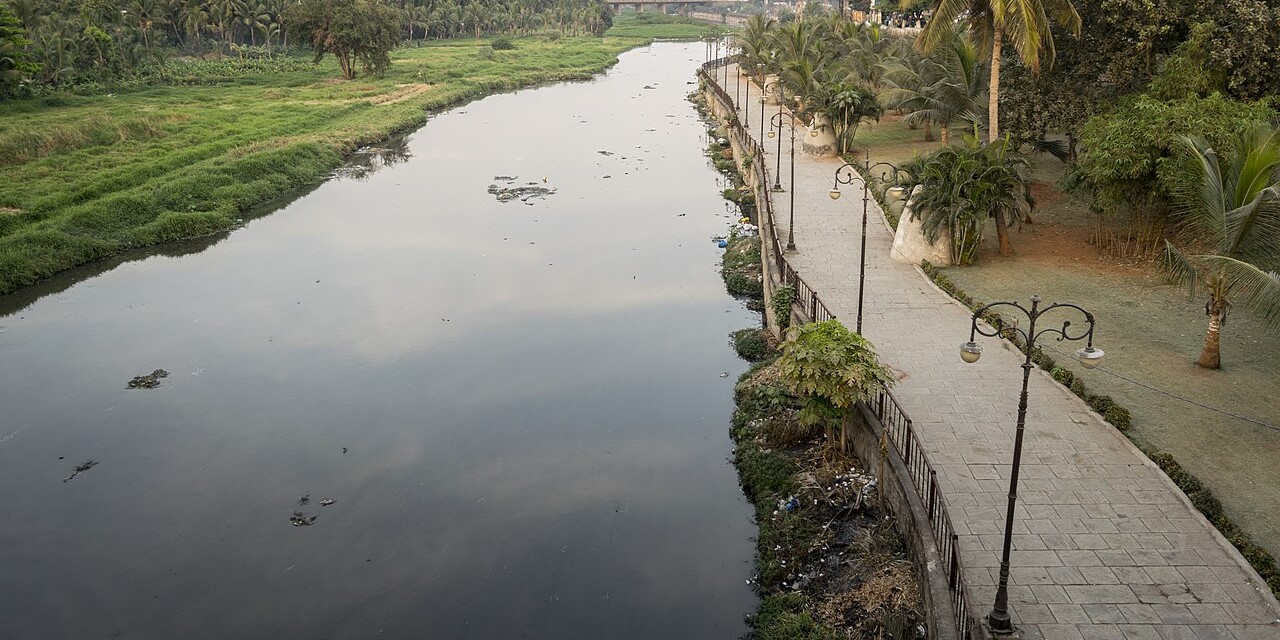
File image of Musi river. (Creative Commons)
Synopsis: These riverfronts exist in cities that had already built functional sewerage systems, institutional governance, and transit infrastructure over decades before the riverfront was developed. The riverfront was the last layer, not the first.
The Telangana Congress government’s ambitious multi-crore Musi Riverfront Development Project, aimed at rejuvenating the Musi River, has run into controversy over the displacement of those living along its basin and allegations of inflated costs.
The proposals in the (Musi Riverfront Development Corporation Ltd) MRDCL presentation are substantively similar to what successive governments have been floating since 1998 — the Gandipet-to-Langarhouse corridor, the east-west road, the Gandhi Sarovar concept, and the riverfront beautification. This is not a new project — and that matters.
What has changed is the price tag and the consultant. The presentation itself reportedly cost ₹160 crore to produce. The question is whether ₹160 crore of consultant fees has produced genuinely new thinking, or a more expensively packaged version of the same plan that has been shelved repeatedly for the same unresolved reasons.
“Cities Around the World Are Turning Riverfronts into Economic Powerhouses” — an unsubstantiated claim is the rhetorical foundation of the entire presentation, and it does not survive scrutiny.
Land use conversion and concretisation of riverbeds are not economic transformations. Real economic transition requires land value capture mechanisms, transit integration, employment decentralisation, affordable commercial space policies, and deliberate social inclusion frameworks. None of these appears in what has been presented.
The international examples are also being deployed selectively. Seoul’s Cheonggyecheon — the most-cited model globally — is a concrete channel with pumped water, maintained at enormous annual cost and criticised by Korean environmental organisations as ecologically hollow.
More importantly, these riverfronts exist in cities that had already built functional sewerage systems, institutional governance, and transit infrastructure over decades before the riverfront was developed. The riverfront was the last layer, not the first.
However, Hyderabad is attempting to do it in reverse order. The presentation showcases the finished products while remaining entirely silent on the Operational and maintenance costs that sustain them and the institutional structures that manage them.
The presentation asks: “What could 55 kilometres of fully realised riverfront unlock for Hyderabad?” The honest corollary question is: What is locked away — and for whose benefit is it being unlocked? The answer is not hidden.
A state strained by debt is seeking to clear encroachments along 46 colonies — exempted from Social Impact Assessment (SIA) through G.O. Rt. No. 921 — to release high-value riparian land.
This is not necessarily illegitimate. But it should be stated plainly, not dressed in the language of ecological restoration and economic transformation. The land is the real asset being unlocked. The river is the justification.
The MRDCL MD acknowledged plainly: “Unless we treat the entire sewage across the city and stop it from directly entering the Musi without treatment, again the Musi cleaning is not happening.” That is an honest statement. What follows from it is not.
There are 54 major nalas in the 675 sq km GHMC area alone, with 94 percent of sewage water flowing into the Musi through them. On just the 30 km stretch of the Musi running through Greater Hyderabad, 51 nalas emit sewage directly into the river.
These nalas span the entire Musi stretch — they are not confined to the Phase 1 corridor from Gandipet to Langarhouse.
The DPR lists “sewage interception before it enters the river” as one of seven integrated components of Phase 1. But no assessment has been presented — or apparently conducted — on three basic questions that any credible sewage engineer would ask first:
Despite operating 55 STPs generating over 2,031 MLD of treated water daily, HMWSSB has found almost no takers for its non-potable water — currently, only 0.1 percent is sold.
The proposed Singapore-style tertiary treatment model, supplying industries at ₹70–80 per kilolitre, is therefore not a revenue certainty — it is an aspiration that has already failed to materialise with existing treated capacity.
HMWSSB’s own sewerage master plan recommends 62 STPs across the city to meet needs up to 2051 — a programme that is ongoing and nowhere near complete. The Musi Phase 1 DPR plugs into this broader sewerage gap as if it were solved. It is not.
The presentation, in short, says “prevention of sewage joining this stretch” without answering the only question that matters: where does it go instead, through what infrastructure, at what cost, built by whom, and on what timeline relative to the civil works? Without answers to these questions, the sewage component of Phase 1 is not a plan. It is a promise — and one that every previous version of this project, going back to 1998, has also made.
Bringing Godavari water through Mallanna Sagar into Osmansagar to simulate perennial flow in the Musi is the most technically dubious element of the project. Flushing a channel that continues to receive sewage from nalas not yet intercepted does not create a river — it creates a diluted drain.
This is an inter-basin water transfer on the Deccan Plateau, where water is already a deeply contested resource, proposed to manufacture the visual appearance of a healthy river without addressing its actual condition. Decades of toxic discharge by pharmaceutical, bulk-drug, and chemical industries along the Musi continue largely unchecked — a problem no amount of Godavari water can flush away.
Phase 1 alone is estimated at ₹6,500–7,000 crore. At standard infrastructure O&M benchmarks, sustaining this at build-out would require thousands of crores annually — for the STPs, the underground STP (the first of its kind in Hyderabad), the public spaces, the barrages, the perennial flow maintenance, the cycling tracks, and the promenade.
There is no published O&M financial model. No dedicated revenue stream has been identified. No institutional budget allocation has been proposed. International riverfront projects that succeeded did so because O&M was designed into the financial architecture from day one. A capital cost estimate without an O&M framework is not a plan — it is an announcement.
MRDCL is a project delivery corporation. It has no authority over what happens upstream of Gandipet, no jurisdiction over industries discharging into nalas, no mandate for watershed reforestation, and no accountability for long-term river health across Rangareddy and Nalgonda districts, where Musi’s downstream impacts are felt by farmers and communities.
Dr Donthi Narasimha Reddy has consistently argued that Musi rejuvenation requires, above all else, a Musi River Basin Authority — a statutory body with authority over the entire catchment: upstream land use, watershed management, industrial effluent enforcement, reforestation, and encroachment prevention.
Without a basin authority, every rupee spent on the riverfront is perpetually hostage to what continues to happen upstream and throughout the catchment. No riverfront project anywhere in the world has succeeded as a standalone intervention disconnected from basin governance. The Musi is not an exception.
Telangana still does not have a Relief and Rehabilitation law or policy. The project displaces residents of 46 colonies under an (Social Impact Assessment) SIA exemption invoked through a regressive 2017 BRS-era amendment — an amendment the current Congress government is perpetuating rather than repealing, in contradiction of its own stated commitments to social justice.
A project that displaces tens of thousands of people needs a single, published, legally binding Resettlement and Rehabilitation policy — not case-by-case political assurances, and certainly not an exemption from the very assessment that would establish what those people need.
The ambition is not wrong. The Musi is in crisis and has been for decades. But the sequence and substance matter enormously. Genuine rejuvenation begins with:
1. A Musi River Basin Authority with statutory powers over the full catchment, not a project delivery corporation with a 21 km mandate.
2. A binding R&R policy covering all affected colonies before a single household is displaced, not G.O.-based SIA exemptions.
3. A resolved and publicly available sewage demand assessment for the Gandipet-to-Langarhouse catchment, with infrastructure routing and costs, and clear sequencing relative to civil works.
4. An honest O&M financial model with dedicated revenue streams.
5. An end to the rhetorical conflation of concretised riverfronts with ecological restoration.
What is being proposed is a very expensive riverfront. What the Musi needs is a basin.
(Views expressed here are personal.)


