


Published Mar 08, 2026 | 2:00 PM ⚊ Updated Mar 12, 2026 | 9:43 AM

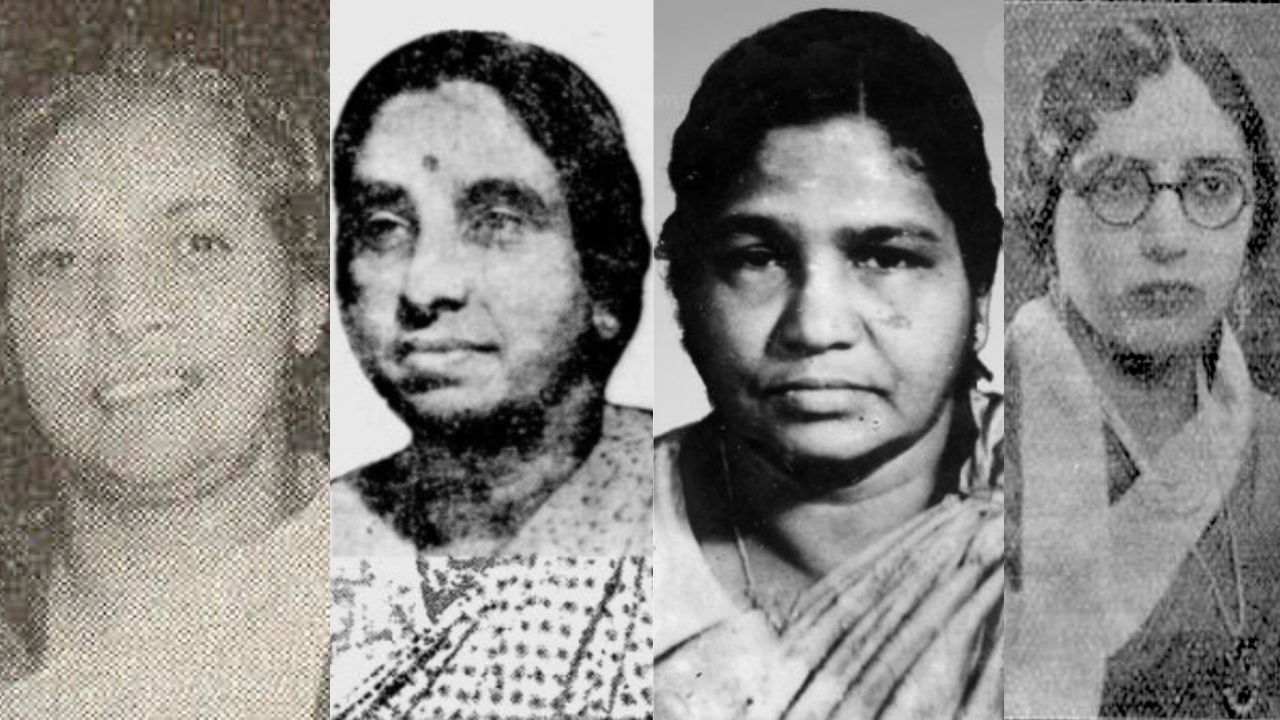
Renuka Ray, Ammu Swaminathan, Annie Mascaren and Begum Aizaz Razul.
Synopsis: On International Women’s Day, here’s a look at the views of female members of the constituent assembly. They were mostly of the view that, instead of infantilising women, they should be considered as individuals with their own autonomy. In contemporary India, one would also see that at the state level, women didn’t just play second fiddle to men; in fact, they seized power with razor-sharp cunning.
On International Women’s Day, amid the platitudes, one might attempt a single question, perhaps the question that cuts through all the hubris: What do Indian women truly want?
Gone are the days when this eternal conundrum of what women want was the sole preserve of husbands or partners; now it equally or, in fact, more dramatically troubles the political machinery.
Hence, one would notice that allegiance of women is becoming sacrosanct to the crucible of electoral politics, whether through Karnataka and Delhi’s complementary bus travel for women, Maharashtra’s Laadki Behna Yojana, or Bihar’s provision of bicycles to schoolgirls.
Let us set aside for a moment what women want. Our political class and theorists alike will tirelessly insist that women’s wants can be fathomed through seemingly “simple” favours like bus rides, bicycle rides, while stoutly refusing to ask the true question that endures: “What do women think?”, which makes these favours so critical.
In the 77th year of its republic, one might reasonably expect a nation to have forsaken its bewilderment about half of its own people. Alas, no! To unpack this question, where must we venture? Perhaps we could turn to the Constituent Assembly debates themselves, where the nation’s dreams and aspirations took shape in its members’ fervent arguments.
Let us now turn to the women who spoke in those debates, because there stands a small but decisive answer to this question.
Annie Mascaren, representative of the State of Travancore, stood at the rostrum of the constituent assembly and stated that for the rudimentary values of democracy, “principles of ethics are more suitable…than principles of expediency.”
She also warned the assembly against the traps of centralisation, that “centralisation would look more autocratic than democratic.” In making those remarks, not only did she prove her erudition but also proved, beyond demagoguery or cliché, that the nation’s women possessed minds of true independence, fiercely articulate, and beholden to none.
From the same pulpit of the constituent assembly, Dakshayani Velayudan, representative of Madras, while arguing for freedom from “forced labour” as one of the fundamental Rights of Freedom, noted that this right will help the marginalised and economically exploited castes “to assert their rights and keep up their self-respect and dignity and they too will have a right to enjoy like the people belonging to the upper class and upper caste.”
In doing so, she was forging a republic’s values against the cold calculus of caste and economic exploitation.
Another woman member of the constituent assembly, Begum Aizaz Razul, argued in favour of a sovereign individual based on modern principles of justice, rather than collectives like village panchayats, whom she thought were capable of tyranny at the local level.
G Durgabai Deshmukh relentlessly insisted on the independence of the judiciary, while also arguing for eradicating distinctions based on caste and class in the country’s institutions, from temples to schools.
Purnima Banerji of the United Provinces spoke of the trope of religious education, she stated “religious instructions….instead of broadening the mind of the child, they miseducate the mind and sometimes breed a certain type of fanaticism and religious bigotry as a result of receiving education in these ‘Maktabs’ and ‘Pathasalas.’”
Such an argument, in today’s time, might unfortunately pass for a right-wing speciality rather than a critique of organised religion. For a young democratic country that was still debating its political and social ideals, the strength of these women’s arguments is a testament against the modern rhetoric of nationalism, where the women are made to choose family building as a way of nation-building.
The strength of each of their arguments lies in their demand for a republic that honours every individual’s sovereign spark.
Author Wendy Lower, in her book Hitler’s Furies, while describing the Holocaust, argues that “women were not just bystanders; they were perpetrators”. Hence, it would be truly risky and infantilising to pretend women transcended caste, class, or nativist venom that characterised Indian polity.
Historian Ann Taylor also said that endowing women with innocence of the crimes of the modern state, we are just placing them “outside of history itself.” Thus, a sceptical eye, arguably a suspicious lens, is also required on the murky matter of how women thought.
Renuka Ray, in the constituent assembly, stood firmly and made her objections against reservations for minorities, by stating that the assembly had “given every consideration to those who are swayed by communal and religious considerations, even to the sacrifice of national interests.”
And, in a similar vein, Sarojini Naidu, rather prematurely, insisted that caste, privilege, will not inform the republic just emancipation for peasants, tribals, marginalised all alike.
These statements should not just make us wary of how women thought or still think, but grant them the same shadowed footing as men: Equal in their grandeur, and equally in the small, tangled troubles they make and are capable of.
In contemporary India, one would also see that at the state level, women didn’t just play second fiddle to men; in fact, they seized power with razor-sharp cunning.
Consider Mayawati, who became the chief minister of Uttar Pradesh, which outnumbers most nations in population; Mamata Banerjee, the unyielding Bengal firebrand; Jayalalithaa in Tamil Nadu, lionised as the “woman warrior” of social justice. These aren’t just sentimental icons but shrewd tacticians, known both for their grit and ingenuity.
On the 51st International Women’s Day, as Hansa Mehta from the constituent assembly would say, “Women have asked for social justice, economic justice, and political justice”, we would also add, women ask for sovereign justice, that is, equality in their thoughts, not just demands.
So the short answer to what women think would be: Women aspire for greatness and fall prey to a limited worldview alike, and their demand is the demand for recognition as autonomous minds capable of doing and thinking above and beyond what we currently ascribe to them.
Also, let’s emphasise that the promise of social, political and economic justice remains unfulfilled too. The 2024 elections marked a historic inflexion; women’s turnout eclipsed men’s for the first time, echoing the Constituent Assembly’s hopes for equitable agency.
Although today, despite surging ballots and numerical parity on rolls, Parliament holds a meagre 13-14 percent women and state assemblies, nine percent. The promise of Hansa Mehta and Ammu Swaminathan, and also that of Women’s Day, continues to remain half forged.
(Views are personal. Edited by Muhammed Fazil.)


