

Published Apr 22, 2026 | 7:47 AM ⚊ Updated Apr 22, 2026 | 7:47 AM

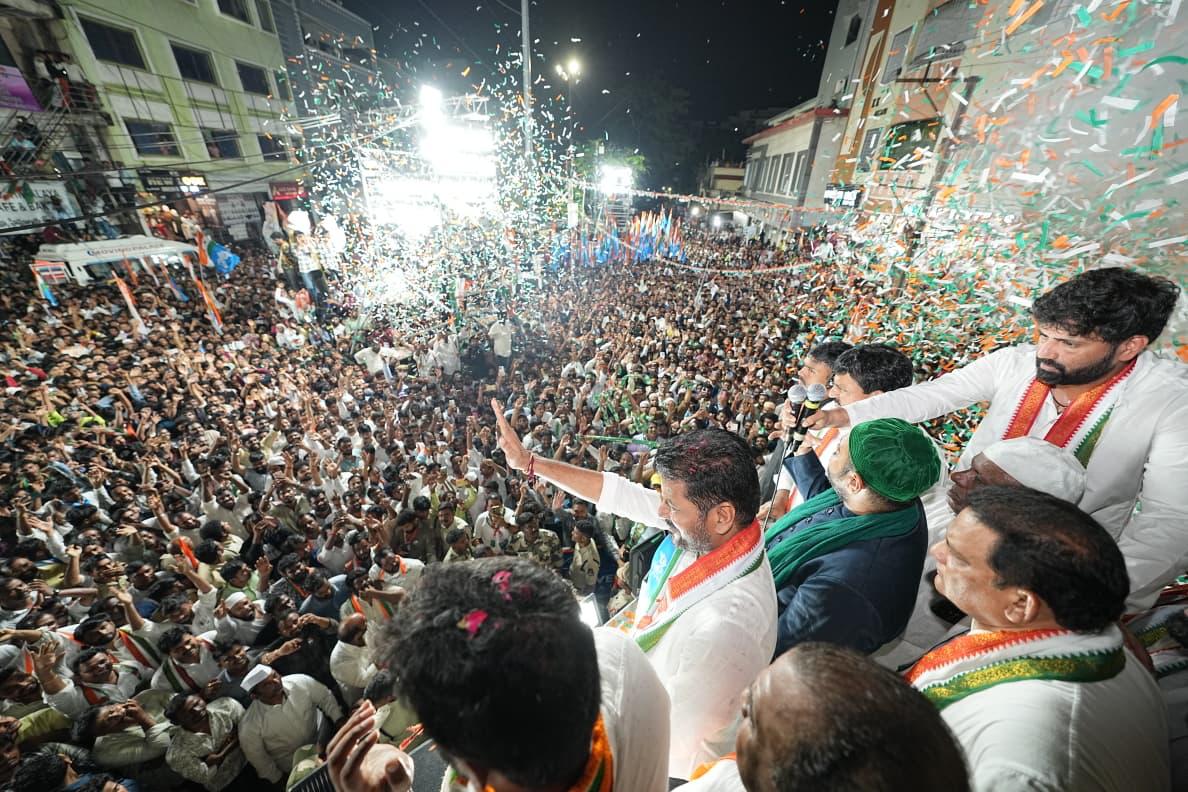
Congress leaders during a poll rally in Telangana.

Synopsis: Two and a half years after assuming power in Telangana, the Congress-led Revanth Reddy government in Telangana is at a critical phase. Some promises made by the party before the elections were implemented, but some others are still partial or pending. The public appears willing to credit intent and partial delivery but demands accountability on the full slate of promises and long-term economic prudence.
Two and a half years into the Congress government’s tenure in Telangana, Chief Minister A Revanth Reddy’s administration stands at a critical juncture. Elected in December 2023 on the powerful platform of six election guarantees — promising immediate relief to women, farmers, youth and the poor — the regime rode a wave of anti-incumbency against the BRS.
Expectations were sky-high. The Congress had positioned itself as the harbinger of “Indiramma Rajyam,” a people-centric governance model rooted in welfare and transparency. Yet, as the government prepares its two-year performance report and gears up for the 2026-27 budget, public discourse reveals a more nuanced reality: Tangible progress in some welfare schemes alongside serious concerns over fiscal sustainability, implementation gaps and political vulnerabilities.
An objective assessment must weigh these elements against the expectations the party itself set.
Also Read: Telangana RTC buses set to go off roads after talks between unions and govt fail
On the credit side, the government moved swiftly on select guarantees. Within days of assuming office, it rolled out free bus travel for women under the Mahalakshmi scheme, disbursing benefits worth over ₹7,100 crore in 23 months. The Rajiv Aarogyasri health cover was doubled to ₹10 lakh, and construction began on a new Osmania General Hospital and Telangana High Court complex, each at ₹3,000 crore.
The crop loan waiver — covering loans up to ₹2 lakh for approximately 22-40 lakh farmers — saw ₹18,000-31,000 crore released, albeit in phases rather than the promised 100-day blitz. Recruitment drives filled over 55,000 government vacancies, addressing a long-standing grievance.
The administration has also initiated structured reviews: Quarterly performance appraisals of secretaries, department-wise evaluations and the ambitious Telangana Rising 2047 vision document, which outlines a roadmap to a $1 trillion economy by 2035 and $3 trillion by 2047 through economic zones, tourism and skill development. Proponents point to GSDP growth of 10.1 percent in 2024-25, outpacing the national average, and the recent Congress sweep in urban local body polls in February 2026 as evidence of public endorsement of “praja palana” (people-centric governance).
Yet these successes are overshadowed by persistent criticisms that the regime has fallen short of its own rhetoric. Several guarantees remain only partially fulfilled or delayed — most notably promises of two lakh annual jobs and comprehensive support for farmers and women beyond the headline schemes.
Opposition parties, particularly the BRS and BJP, have released detailed “charge sheets” alleging betrayal: Revenue receipts reportedly slipped into negative growth territory in 2024-25 (from a 220 percent rise under the previous regime), leaving the exchequer strained.
Critics argue that aggressive welfare spending has come at the expense of capital expenditure, pushing the state toward fiscal stress, delayed pensions and stalled development projects. Public anger has surfaced over unfulfilled assurances to Telangana movement participants, youth unemployment and perceived neglect of rural infrastructure.
Even Congress voices, including All India Congress Committee (AICC) leaders, have called for an internal performance review, admitting that achievements have not been adequately publicised or translated into visible grassroots impact.
People’s observations, gleaned from street-level feedback, local body elections and media discourse, reflect this duality. Many women and beneficiary farmers appreciate the direct cash transfers and free services that have eased immediate burdens.
Urban voters, in particular, appear to have rewarded the government’s administrative energy in the recent civic polls. However, a growing segment—especially in rural heartlands and among the middle class — expresses disillusionment.
The gap between grand announcements and on-ground delivery has bred cynicism. Controversial moves, such as the Hyderabad Disaster Response and Assets Monitoring Authority (HYDRAA)’s demolition drives, have sparked protests over perceived high-handedness. Allegations of selective enforcement and attempts to curb dissent through new regulatory frameworks have further eroded trust among civil society observers.
In essence, the public appears willing to credit intent and partial delivery but demands accountability on the full slate of promises and long-term economic prudence.
Politically, the regime finds itself increasingly vulnerable to strategic opponents. The 2024 Lok Sabha results — Congress securing only eight of 17 seats, with the BJP matching that tally — served as an early warning. The BRS, though diminished, continues to weaponise fiscal data and unkept pledges, while the BJP frames the Congress as a “pickpocket” state that has squandered the fiscal surplus inherited from the previous government.
Internal party rumblings and the need for constant high-command intervention suggest that the Congress high command’s initial momentum has not fully translated into cohesive state-level machinery.
The delimitation debate has allowed Revanth Reddy to position himself as a defender of South India’s interests, yet it also underscores the larger federal fault lines that could distract from governance deliverables.
Also Read: Telangana releases caste survey, reveals BCs make up 56% of state’s population
In sum, the Revanth Reddy regime has demonstrated administrative agility and a genuine commitment to welfare outreach. It has stabilised certain core services and articulated an ambitious long-term vision.
However, the failure to fully honour the six guarantees within the promised timelines, coupled with evident fiscal strain and communication gaps, has allowed opponents to seize the narrative.
Public patience is not infinite; voters who propelled the Congress to power expect results, not merely reviews and roadmaps. As the government finalises its two-year report and charts the 2026-27 budget — with infrastructure likely receiving greater emphasis — the acid test will be whether it can bridge the gap between promise and performance.
Without course correction on implementation, fiscal discipline and transparent communication, the very wave that brought it to power risks receding.
Telangana’s voters, pragmatic yet expectant, will render their verdict not on rhetoric alone, but on outcomes that touch their daily lives. The regime’s legacy, ultimately, will hinge on its ability to convert partial gains into enduring transformation.
(Views are personal.)



