
Published Sep 07, 2023 | 10:00 AM ⚊ Updated Sep 07, 2023 | 10:00 AM

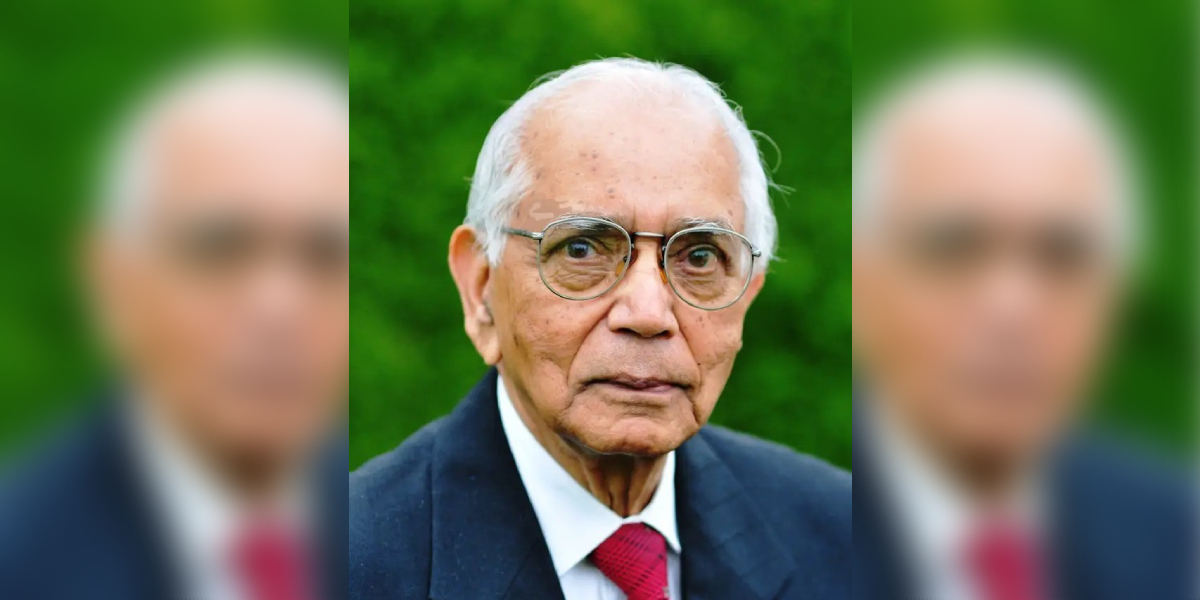
File photo of CR Rao. (DrTamilisaiGuv/Twitter)

Who would have guessed that a statistician par excellence was rejected in a job interview for the post of a mathematician before the world discovered his genius? That is the journey of Calyampudi Radhakrishna Rao (CR Rao).
CR Rao was born on 10 September, 1920, in Hoovina Hadagali, now a small town in Karnataka, but originally in the Madras Province of British India. His father CD Naidu was an inspector of police and his mother Lakshikanthamma was a housewife.
Rao was the 8th child of his parents and following a general custom in South India, as mentioned by Rao himself in his autobiography, he was named Radhakrishna after Lord Krishna, who, according to the mythology, was the 8th child of his parents.
Rao graduated with a degree in Mathematics from Andhra University in 1940, but failed to obtain a scholarship to do research in the same university because his application came in late. He then came to Kolkata to appear for an interview for the position of a mathematician at the army survey unit, and was not selected for that job either.
Later, when Calcutta University started a Master’s degree programme in Statistics in 1941, he joined that as a student. He passed the MA degree examination in 1943 with first class and secured the first rank. Rao was one of the first five students who graduated from Calcutta University with a Master’s degree in Statistics.
In one of his autobiographical essays, Rao gave an entertaining description of that postgraduate degree programme that is worth quoting here. “None of the teachers had any experience in teaching Statistics and, further, they were as ignorant as the students in some areas of Statistics. As there were no textbooks on Statistics, the teachers had to learn by reading original papers and then teach. The courses given in the first two years benefitted the faculty as well as the students.”
Rao joined Indian Statistical Institute (ISI) as a statistical apprentice in 1943 and decided to settle down in the city of Kolkata. He started teaching soon after joining the institute and it was in the course of his interactions with the students that he co-invented his famous Cramér–Rao Lower Bound and Rao–Blackwell Theorem.
At ISI, one of Rao’s several responsibilities was the analysis of anthropometric data on different castes and tribes collected during the decennial census of the Indian population in 1941. In 1946, JC Trevor, a Cambridge University anthropologist, requested ISI to depute a scholar, who would analyse some anthropometric data collected by the Cambridge University Anthropological Museum.
Rao was deputed and he arrived in England in August 1946. According to Rao, he sailed for England by a steamship named Andes that was carrying mostly Italian prisoners of the Second World War from Mumbai to Naples. The Italian soldiers were captured in Africa and detained in India.
Soon after arriving in Cambridge, Rao took admission as a research scholar at King’s College. This was in addition to Rao’s assignment at the Anthropological Museum at Duckworth Laboratory at Cambridge.
Ronald Fisher was the Balfour Professor of Genetics at Cambridge at that time. Rao requested Fisher, whom he met in 1944, to accept him as a PhD student. Fisher agreed and suggested that he should work in the genetics laboratory to gain experience with breeding of mice for linkage studies.
On the other hand, Rao’s assignment at the Anthropological Museum involved analysis of measurements taken of skeletal materials excavated by a British expedition in the ancient graves in Jebel Moya in North Africa.
The general theme of Rao’s PhD research was discriminant analysis using multivariate data, and it was deeply connected with Fisher’s work on discriminant analysis. Towards the end of his two-year-long stay at Cambridge, Rao met HE Daniels, who asked him to submit a discussion paper to the Royal Statistical Society based on his PhD research.
The paper that was submitted by Rao was titled “The Utilization of Multiple Measurements in Problems of Biological Classification”. Rao’s paper was accepted for a discussion at the Royal Statistical Society and it was read before the Research Section of the society in 1948. It was also published in the Journal of the Royal Statistical Society, Series B (Methodological) in the same year.
Rao extended Fisher’s discriminant analysis for more than two populations. He also established the Bayes risk optimality of Fisher’s linear discriminant function for multivariate Gaussian populations. Another significant part of Rao’s paper is the development of a graphical tool for visual representation of multivariate populations by projecting them into some appropriate lower dimensional spaces so that observations from different populations cluster into groups of similar populations.
Rao’s 1948 paper is a fundamental contribution in discriminant analysis that has influenced several generations of research in multivariate statistics. While discussing his PhD research, Rao once wrote, “For my PhD thesis, I wanted a theoretical topic. I asked Fisher to suggest some problem on which I could work. He said: ‘Problem must be yours and I shall help you if I can’. I wrote my PhD thesis on classification problems extending Fisher’s work on the discriminant function to more than two populations, which arose in my work at the museum. I did not take much help from Fisher. Finally, when I showed him the thesis, he said, ‘The problem was worth investigating’.”
After returning to India from Cambridge, Rao joined the Indian Statistical Institute as a professor, when he was only 28 years old. As the Head of the Research and Training School of ISI, he created an internationally renowned teaching and research programme in Statistics.
Other distinguished positions that CR Rao held included Distinguished Professorship at University of Pittsburgh, and the Eberly Professorship at Pennsylvania State University, both in the US. Rao was the recipient of many prestigious awards, including the US National Medal of Science awarded by the President of the US, and the Padma Vibhushan awarded by the Government of India.
In 2002, Rao established the CR Rao Advanced Institute of Mathematics, Statistics, and Computer Science in Hyderabad.
Rao breathed his last on 22 August, 2023. He is survived by his daughter Tejaswini and son Virendra, as well as several grandchildren.
(The author, Probal Chaudhuri, is a Professor at Indian Statistical Institute in Kolkata. He is an elected fellow of all three Science Academies in India and a recipient of the CR Rao National Award in Statistics and and Shanti Swarup Bhatnagar Prize.)



