
Published Dec 10, 2025 | 3:34 PM ⚊ Updated Dec 10, 2025 | 3:34 PM

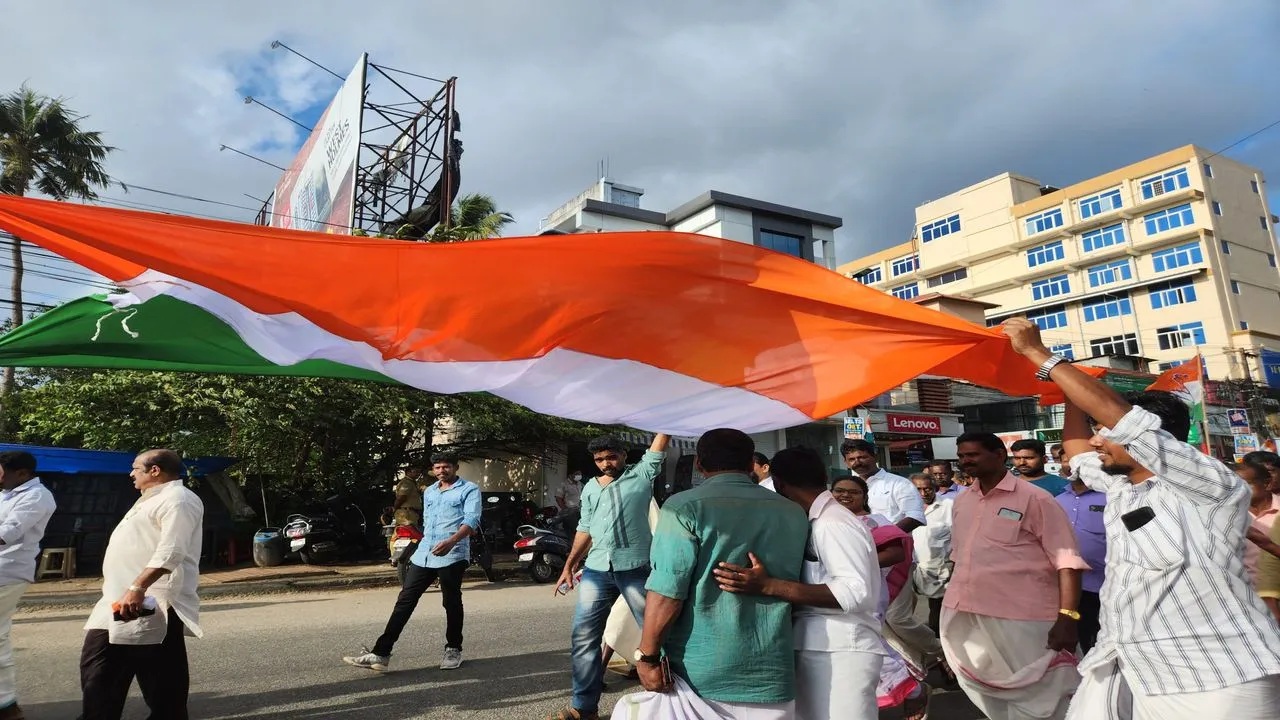
For the Indian National Congress to survive in the contemporary Indian electoral landscape, it must have the courage to bid farewell to its Gandhian nationalist image as a “party of all Indians”. (File pic/Anusha Ravi Sood/South First).
Synopsis: A national party must make a choice: either it aligns with the deeply entrenched upper-caste minority, or reinvents itself as an unapologetic party of the lower-caste majority, with their political, economic, and cultural emancipation as its explicit goal. Unless the Congress recognises this structural reality, it will remain trapped in its Gandhian-nationalist past, speaking to an imaginary nation, while the living Indians in flesh-and-blood have long moved to a new political age. It must have the courage to realise that “The mega-organisational structure that belonged to the Congress can today serve a new end, if it lets itself be seized by the oppressed majority of millennia.”
“No caste, no religion and no god, but ethics, ethics and ethics; most appropriately and accordingly” – Sahodaran Ayyappan
For the Indian National Congress to survive in the contemporary Indian electoral landscape, it must have the courage to bid farewell to its Gandhian nationalist image as a “party of all Indians”.
This myth of the nation, which excluded the majority of Indians, had some rhetorical utility in the pre-1947 era, when national politics was framed within a manufactured binary of “Indian nationalism versus colonialism”.
During that period, the upper castes, the self-anointed representatives of ‘all Indians’, successfully masked the fundamental social reality of the subcontinent.
For millennia, a great wall has stood between the world of the upper caste minority and the lower caste majority. Through this wall, certain limited transactions advantageous to the upper castes are allowed, including the manual labour of the lower castes for the upper castes and the transfer of the excreta of the upper castes towards the lower castes (1).
The upper-caste leadership of the Congress party and other organisations enshrouded this reality under the abstraction of the “Indian Nation”. The nationalist narrative externalised oppression and rendered caste domination a non-political, social question, thereby allowing upper-caste supremacy under the cover of nationhood.
Once the ‘politics of the nation’ acquired a sacred and unquestionable status, lower-caste struggles against the ‘internal colonialism’ of Indian upper castes were delegitimised through terms such as “Urban Naxal”, “Maoism”, and Ambedkarism (as if it were a slur).
All lower-caste leaders, who courageously demanded the destruction of the caste order, were denounced as serving the interests of British colonialism and, therefore, deserters of the national struggle.
Mahatma Phule, Periyar, BR Ambedkar, Ayyankali and Sahodaran Ayyappan were routinely branded as British collaborators, stooges or fifth columnists.
In the post-power-transfer era, this politics of the ‘nation’ remained effective until the political explosions that accompanied the Mandal Commission (Socially and Educationally Backward Classes Commission), which created caste consciousness and deep fissures as Other Backward Classes (OBCs) and Dalits challenged the foundations of upper-caste nationalism.
In other words, one of the most important outcomes of the Mandal movements is this realisation among the lower caste majority that “The politics of India under modern conditions had been nothing other than the identity politics of the upper castes. Savarna identity politics ensured that the cultural and social identity of the upper castes of all religions was projected as national identity”.
Subsequently, when Congress was found unsuitable for the task, the upper castes, led by the RSS-BJP combine, sought to revive the “Hindu hoax” through the Babri Masjid demolition movement (2). Through those Rama-mutinies – ritual riots masquerading as piety, leaving behind burnt homes and violated bodies, Muslims and Dalits – the RSS attempted to diffuse the lower-caste militancy.
The demolition of Babri Masjid on 6 December 1992 and the portrayal of Muslims as the ‘enemy’ of ‘Hindus’, succeeded in producing — even among the lower-castes — a pseudo pride in being ‘Hindu’. This false Hindu identity was widely marketed by the upper-caste controlled media, masking the fact that the real oppressor of lower castes has always been the upper-castes, and not the Muslims, among whom the majority are lower caste.
The subsequent publicity and legitimacy were ultimately transformed into an escalating process of electoral capture of power by the BJP. The Congress failed to grasp the structural shift in ideological reconfiguration, emergent caste consciousness and kept revolving around the worn-out paradigm of being the ‘party of all Indians’, which is exemplified by the UPA-1 slogan, “Congress ki hath aam aadmi ke sath” (the hand of the Congress is with the common man).
This non-existent abstract “common man” stood for caste invisibilisation, and the slogan was appropriated later by the upper-caste Baniya party, Aam Aadmi Party, created by the RSS.
The figure of the ‘Indian’ has now virtually disappeared and is replaced by the fabricated undivided ‘Hindu’. The minuscule but influential liberal upper-caste public sphere, surrounding the Congress, struggled to make this new ‘Hindu’ reality of India succeed through the distinction between “Hinduism” (Congress) and “Hindutva” (RSS), which is a false distinction.
Since Ambedkar, it was Divya Dwivedi who brought out the reality of caste oppression, the upper-caste minority control of the Indian public sphere, and the falsity of the ‘Hindu vs Hindutva’ distinction in the mainstream English public sphere through an NDTV address in 2019—“The Hindu Right is the corollary of the idea that India is a Hindu majority population, and this is a false majority. The Hindu religion was invented in the early 20th century to hide the fact that the lower caste people are the real majority of India.”
Dwivedi was being a true Ambedkarite in this moment as Ambedkar said, “Hinduism is a political ideology of the same character as the fascist and or Nazi ideology and is thoroughly anti-democratic.”
OBCs, Dalits, Pasmanda Muslims (and lower castes across religions) and the Dravidian movement have made it impossible to sustain the fiction that Indian politics can exist without addressing caste oppression. A national party must make a choice: either it aligns with the deeply entrenched upper-caste minority, or reinvents itself as an unapologetic party of the lower-caste majority, with their political, economic, and cultural emancipation as its explicit goal.
The BJP has already chosen the former, and the upper castes have embraced the party as their authentic political instrument.
Unless the Congress recognises this structural reality, it will remain trapped in its Gandhian nationalist past, speaking to an imaginary nation, while the living Indians in flesh-and-blood have long moved to a new political age. Rather, it must have the courage to realise that “The mega-organisational structure that belonged to the Congress can today serve a new end, if it lets itself be seized by the oppressed majority of millennia.”
The BJP’s electoral prowess does not arise only from its formidable organisational strength, nor from being the richest party in India, nor from the clever electoral alignments, and not even from the absolute media control it exercises through the central government. At its core, its success emerges from the wide marketing of a political fiction, brewed like a potent potion – designed to make the oppressed forget their wounds. The idea of a homogeneous ‘Hindu’ cloaks the lived, historical, flesh-and-blood identities of caste.
Tragically, smaller sections of the oppressed, especially the OBCs – whose ancestors were crushed, degraded, and humiliated by the Hindu-dharma order — have fallen under its spell. It is one of history’s most bitter ironies: the wounded return to the chambers of their own tormenters, mistaking the very hands that cut them for the hand that heals.
In the middle of poverty and anxiety about their future, the poor, lower-caste majority, have no conception of their destiny today other than some vague ‘Hindu civilisational pride’, which had historically excluded them. The ‘Hindu’ control of the lower-caste majority has only begun, and it can be nipped if the Congress desires to — by destroying the political illusions in the national political theatre.
Illusions can be undone only when the real is allowed to return. And the real India is casteist India – not a moral ideal but as a social fact that structures power, privilege, existence, dignity and humanity.
The Congress party, in its leadership and policy, was a Brahmin-Kshatriya-Bania coalition presenting itself as the nation. Today, much has changed. I will list them:
Under these conditions, a simple but historic decision confronts Congress: will it be the parliamentary political arm of the upper-caste minority or the emancipatory instrument of the lower-caste majority? If it chooses the latter, it must not merely adjust its slogans or manufacture alliances. It must restructure its internal anatomy, reshape its ideological line, and realign its social base.
But most importantly, it must declare openly and unequivocally that it is the party of the oppressed majority, the OBCs, SCs, STs, Pasmanda Muslims, Dalit Sikhs and Dalit Christians, and the ‘religious minorities’. It must affirm that democracy in India is impossible without the Phule-Ambedkarite torch, without overturning millennia of ‘internal colonialism, without confronting the entrenched power that disguises itself as ‘Hindu’.
Through this act, the Congress will lose whatever remains of its traditional upper-caste votes. But it will gain something enormously larger: the electoral confidence and moral legitimacy of the vast oppressed majority, who have long lacked a sense of political belonging. For every upper-caste vote lost, the Congress could gain nine lower-caste votes, provided it speaks truthfully, courageously and consistently with the radical vision of equality.
This epochal transformation will not only help Congress win elections, but more importantly, it will redefine the destiny of India. The 20th century was a century of the clash of two destinies – one the Tilak-Gandhian destiny and the other, the Phule-Ambedkarite destiny. The victory of Tilak-Gandhi destiny temporarily weakened the march of Phule-Ambedkarite destiny.
India today needs a new pantheon, a new epic, and a new story. Let the traditional nationalist pantheon of Vivekananda, Tilak and Gandhi vanish. Let the pantheon of radical lower-caste liberators — Mahatma Phule, Ambedkar, Birsa Munda, Periyar, Ayyankali and Sahodaran Ayyappan and others – occupy this place.
In place of the epic of the ‘Hindu’, the Congress must craft a new epic of ‘Annihilation of Caste’. It must present itself not as an aghast centrist coalition of interests, but as the uncompromising, militant force that challenges the fiction of Hindu through the force of social equality and fearless truth-telling.
When the Congress becomes the Congress of the oppressed majority in India, the India of the 90 percent, a new dawn will arrive. Only then can the epidemic of Hindutva be ultimately eradicated.
(Edited by Majnu Babu).
References:


