

Published Dec 31, 2025 | 7:00 PM ⚊ Updated Dec 31, 2025 | 7:05 PM

The year gone by: A recap.
Synopsis: The year 2025 witnessed several major developments that hinted at the shape of things to come. These included an 88-hour conflict with a terror-exporting neighbour, India’s proud movement in space research, technological advances, apparent divisive forces gaining strength and even questions raised at the judiciary. A recap:
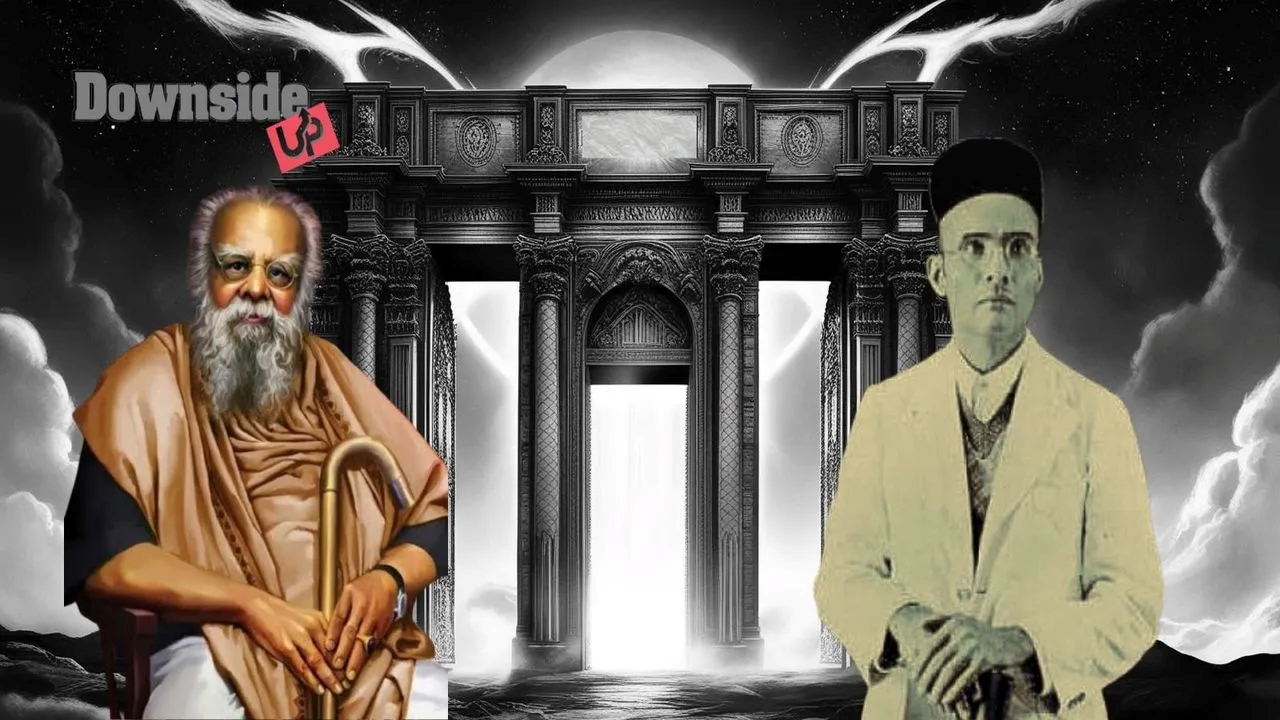
If Mahatma Gandhi was furious at the racial discrimination he suffered in South Africa, Periyar was upset over what happened to him when he was a Congress activist, and Savarkar by what he saw in the Khilafat years. A political play set at Pearly gates.
It is important to consider the full set of changes from the lenses of the principles and politics they espouse, as well as the (missing) specifics, which will have hard-to-forecast effects, with varying implications for different parts of the world.
Few obey a leader out of gratitude or kinship value like it used to be. Party workers reserve the option to switch between factions within a party or between parties. Keeping the flock together while maintaining leadership is increasingly difficult. Ideological fluidity, in which welfare schemes are offered by most parties, make party switches easier.
On the one hand, the CPI(M) advisory says that the eleven years of BJP rule resulted in the consolidation of right-wing, communal, and authoritarian rule. Having said that, Karat wants us to conclude that neither the Modi government nor the state are fascist or neo-fascist entities.
The Tamil Nadu government and the Union government are in a battle over the implementation of the NEP 2020 and the three-language policy in education. The author analyses the stand of Tamil Nadu and that of the Union government.
The Radical Students Union, founded in 1975, had its ears close to the ground, and it encouraged students to stay in villages and have first-hand knowledge of rural life, especially that of Dalits. The Union, which took up issues pertaining to students, however, did not curry favour with the government, and was banned in 1992. Successive governments extended the ban but could not prevent people from having the glorious memories of an organisation that did not exist for even a quarter of a century.
The 7 February attack on Chilukuru Balaji Temple priest CS Rangarajan has triggered questions over fringe communal outfits like Rama Rajyam that thrive on superstitions and falsehood. Such organisations with divisive agenda spread communal venom in society, and it’s time that all come together to check their growth.
The southern states bear a disproportionate share of the aging population with one-fifth of their population in the above 60 age group. Such a situation requires a re-evaluation of the existing fiscal frameworks, with the distribution of resources being adjusted to the new population realities and pressing socio-economic concerns.
In an era of echo chambers and manufactured consent, satirists like Chaplin and Kamra are vital. They don’t just make us laugh; they make us see. Whether it’s 1940s fascism or 2020s populism, the playbook of power remains similar—and so does the role of art in challenging it.
Tamil Nadu Chief Minister MK Stalin is upset over the “weaponisation” of delimitation, saying states that efficiently controlled their populations would potentially be punished for what they achieved. India’s political system is described as “federal with a unitary bias” to suggest that the Union government often wields powers disproportionate to the states. There is a need to shift the political centre of gravity away from the Union government so that federalism shifts from the coercive to the collaborative or at least, the conciliatory variety.
Fascism is not just a political structure — it is a worldview, an ideology, and a moral code. To defeat fascism, we must replace its values with alternative social ethics — not just through slogans, but in practice.
The journey from Pulwama to Pahalgam underscores the evolving nature of terrorism in India and the persistent challenges in ensuring national security. While military and intelligence responses are crucial, a holistic approach that includes political will, community involvement, and international cooperation is essential.
Pre-checked, controlled interviews instead of taking questions at a press conference, bravado in public rally and monologues in his ‘Mann Ki Baat’ and parliament instead of answering questions in an all-party meeting, turning the spotlight away from him when his government is on the backfoot — Prime Minister Narendra Modi has to stop wriggling out of tough situations.
The Supreme Court is evidently under stress – and it is for citizens and the legal community to wake up, become more constitutionally literate, and speak out on the nuances because we seem to be in danger of frequently facing monarchical interpretations of a democratic republic.
Even though the AIADMK has restored its alliance with the BJP in Tamil Nadu, it is highly unlikely to make any significant electoral impact. The BJP’s perceived anti-Tamil and anti-minority image continues to hinder the AIADMK’s efforts to retain its voters and woo new voters.
President Droupadi Murmu invoked Article 143 to seek the Supreme Court’s advisory opinion on 14 specific questions related to the Governor’s role. The presidential reference underscores the need for clarity in interpreting Article 200 and its interplay with other constitutional provisions.
The Union government has announced two new genome-edited rice varieties, DRR Rice 100 and Pusa DST Rice 1, claiming significant yield gains, reduced greenhouse emissions, and improved climate resilience. However, the lack of transparency about how these traits were achieved and the potential ecological impacts is cause for concern. Farmers already have bitter memories of past interventions and the new rice varieties appears to be more about promoting biotechnology than addressing real agricultural challenges.
What we need for meaningful policies is a socio-economic survey to determine backwardness and change among communities, not just a simple headcount based on caste or community.
To say you were from Mangaluru once meant you were worldly, cultured, and trusted – a person of dignity, adventure, and unmatched hospitality. So many titles came with that name. But today, people from the erstwhile undivided Dakshina Kannada district find themselves having to say, ‘I am from Dakshina Kannada, and I am not a communalist.’
As with every year, the Sangh Parivar, instead of reflecting on the thousand wounds they have inflicted upon the Constitution over the past eleven years, continue to remind us of the blow Indira Gandhi delivered to the Constitution fifty years ago. Through this, they attempt to mask their own fascist rule – one that is far more insidious. The surrender letters written by the supreme RSS leader, Sarsanghchalak Balasaheb Deoras, who was imprisoned during the Emergency, from Yerwada Jail to Indira Gandhi, as well as the letter he wrote to Vinoba Bhave requesting him to influence Indira Gandhi to consider it, help us understand the true role of the RSS and Jan Sangh during the Emergency.
As of 26 June 2025, over 285 individuals from 23 countries have visited the ISS, and over 680 people from 47 countries have reached space. Shubhanshu Shukla’s journey is not new, but if you consider the history of humankind and a world population of around 9 billion, his presence inside the ISS at 5.54 pm IST places him and India among the elites.
Who does the forest belong to? Who has the monopoly over its well-being? It is urgent, now more than ever, to redefine these social relationships of nature and its interdependent species. A substantial body of scientific evidence and literature continues to highlight the negative impact of this top-down approach to conservation strategies.
India seems to have shifted from bureaucratic inefficiency marked by slow activity to a greed for speed and profit that has ugly side effects.
The West Asia crisis is challenging India’s foreign policy, once built on balance but now strained. India risks appearing unreliable—dodging moral clarity, tough choices, and favouring optics over substance.
What we are witnessing is not governance, but governance weaponised – where laws are bent to favour capital, institutions are neutered to silence workers, and the entire machinery of the state is marshalled to break the spine of labour.
Over the past two years, there have been a series of murders in coastal Karnataka and more than 114 communal clashes across the state. In Mangalore, Sanghi fascists continue to engage in violence with impunity, much as they did during the BJP rule.
When a single forwarded video can spark nationwide chaos before the truth emerges, our schools can rise as the first line of defense. By making classrooms hubs of digital discernment and civic responsibility, we can equip the next generation to question, verify, and challenge misinformation at its roots.
What makes VS Achuthanandan’s political legacy towering is not that he lived for over a century, but that for the majority of that time, he remained mentally lucid, morally uncompromised, and politically vigilant.
The Modi government is falsely claiming that the court has endorsed the process and is rushing ahead—uploading forms without photos, documents, or even signatures. Independent YouTubers like Ajit Anjum, who exposed this, are being targeted with legal cases.
The latter-day Janaki, deemed as an artistic icon for the archetypal woman, needs no “Lakshman Rekha,” – which is an evocative metaphor from the Ramayana in which Lord Rama’s younger brother draws a line of control on Sita before she is abducted. The line was meant for her protection, but is also viewed in contemporary discussions as an exercise of undue authority.
Constitutional secularism, with its rhetoric of inclusivity, is rendered impotent here because the quest for purity thrives on the very refusal of the secular contract.
Reels glorify dominant-caste “heroes,” often recasting Tamil film villains, overlaying violent imagery with coded music. Amplification follows: algorithms reward engagement, pushing such content into sympathetic feeds.
Since #VoteChori has already succeeded in 2024, we are destined to endure its consequences until 2029; if it happens again in 2029, the political voice of the marginalised could disappear entirely.
RSS chief Mohan Bhagwat said that he was in favour of Indian parents having three children. However, what Bhagwat said is somewhat naïve at best, and manipulative at worst, if you look at the context in which he has been making his statements.
As the forests fall silent, the nation must confront these root causes head-on, channelling that enduring spirit into equitable reforms to prevent the Maoist ideology’s embers from reigniting in unforeseen, perhaps more volatile, ways.
Some argue that since such a 42 percent quota violates an earlier Supreme Court judgment, the Congress knowingly took a technically flawed step only for political optics. But the argument itself is unsound. Reservation based on population proportion is a principle endorsed by the Constituent Assembly itself.
The most reactionary, fascist forces in India — the Hindu Mahasabha, RSS, and Jana Sangh — neither supported nor assisted Ambedkar in any election. Nor did Ambedkar ever seek their help.
Trolls and keyboard warriors deploy slurs, memes laced with sarcasm, and ad hominem attacks that debase discourse.
For all of 70 years, Thayil Jacob Sony George spoke truth to power, in recent years at risk of being labeled ‘anti-national.’ One of the most accomplished editors in the country, George’s was a life well spent in newsrooms and J-schools across South India.
Karur over Manipur: An actor, deadly stampede, and race for political mileage
For individuals whose ambitions are greater than their political convictions, and for those who lack an organisational base rooted in strong ideology, the BJP often presents itself as a waiting opportunity, a fallback path to power.
The modern debate over capital punishment took shape in Andhra Pradesh, following the execution of Naxalite prisoners K Bhoomaiah and Kishta Goud during the early months of the Emergency in the mid-1970s.
Every act of governance has a political rationale. But to carry out a political act as a mere bureaucratic operation is to embody a sense of mechanical inhumanity. Or perhaps the government believes it has no moral or propagandist grounds to stand on. In that sense, it has admitted that it has nothing but brute force at its disposal.
NDA is cannibalising its junior partner in Maharashtra, but the big sensational political headlines focus on a stable single-party government in Karnataka. With the backing of 138 MLAs in the 224-member Karnataka Legislative Assembly, the Congress government doesn’t have a threat of instability, but that hasn’t stopped the perception of trouble — mostly sparked by a section of Congress leaders, fanned by Opposition parties and duly dramatised by a lopsided media.
Central food security rosters show that Kerala still has around 5.9 lakh Antyodaya yellow-card households. If such large numbers remain on the Union government’s “poorest” lists, the state’s claim to have entirely “eradicated” extreme poverty looks, at best, partial, and at worst, a reclassification exercise.
Since the ascent of the Narendra Modi government, Vande Mataram has been politically repurposed within a wider project to reshape India into a Brahminical Hindu Rashtra (Hindu Nation). The state-sponsored commemoration of Vande Mataram–150 exemplifies this ideological agenda.
Murders of married women are partially visible under categories such as “dowry deaths” in NCRB data, but murders of husbands are obscured, folded into broad, unspecific homicide data with no relational context.
BJP’s success emerges from the wide marketing of a political fiction, brewed like a potent potion – designed to make the oppressed forget their wounds. The idea of a homogeneous ‘Hindu’ cloaks the lived, historical, flesh-and-blood identities of caste.
Publicly available data suggest that the Civil Aviation Minister has not taken up any reforms in the one-and-a-half years that he has been at the helm.
If a Division Bench ruling is to be overturned, the matter must go before a larger bench or the Supreme Court. A single judge cannot do it.
The state must prove that the speech itself is the immediate trigger for the public disorder it seeks to prevent. The Karnataka Bill’s broad definition fails this test.


