


Published Jan 23, 2026 | 11:34 AM ⚊ Updated Jan 23, 2026 | 11:34 AM

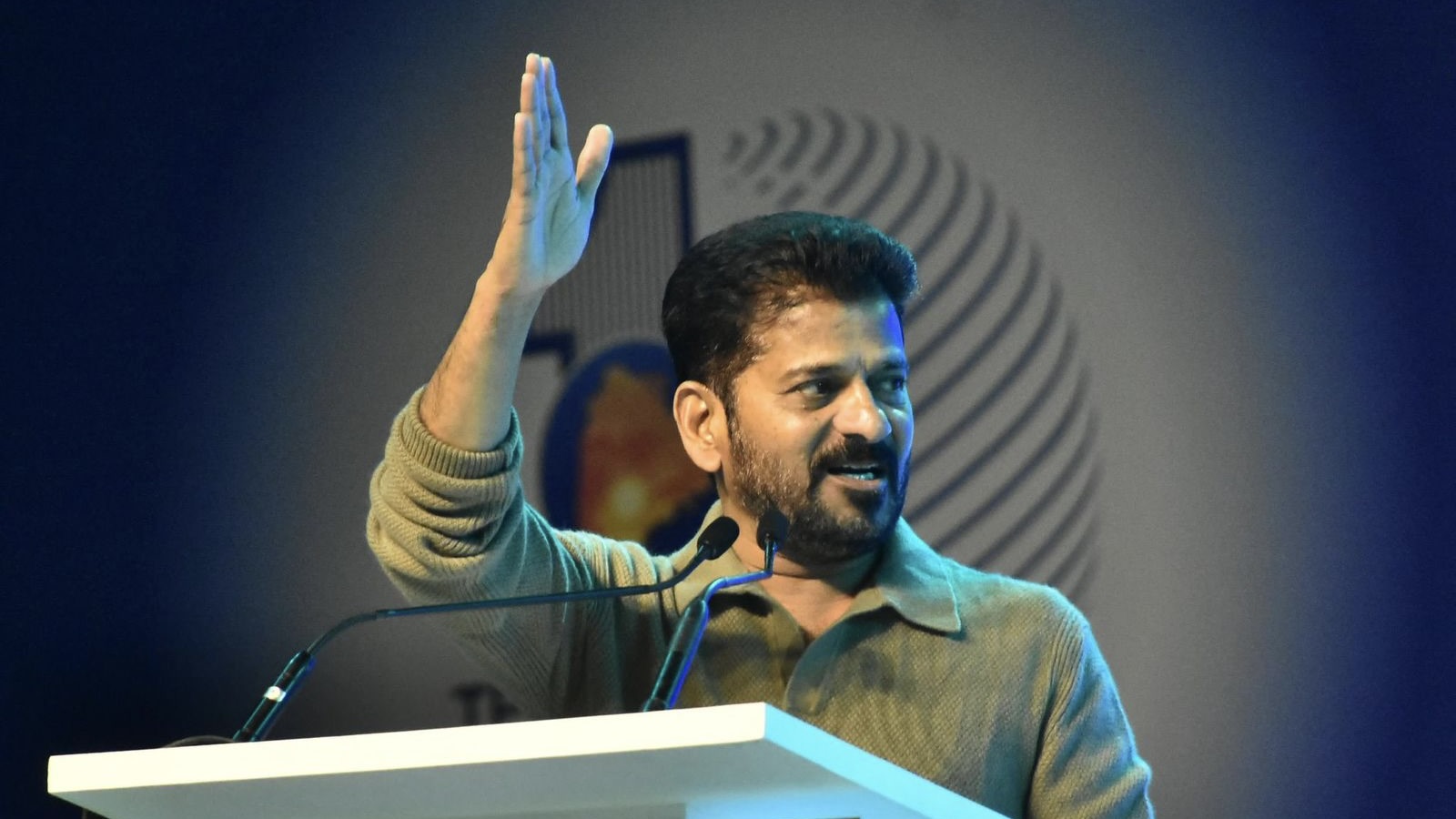
Telangana Chief Minister A Revanth Reddy.
Synopsis: In a democratic government, a person who is its head, no matter how violent or authoritarian his instincts may be within, is expected to speak with composure and in a democratic manner. Even if he harbours a desire to crush the opposition, to bury it, he must respect the role of the opposition in a democracy.
When a person’s words become controversial, an attempt is often made in social debates to separate the speaker from the office he or she occupies, saying those words were unbecoming of his or her position.
In fact, there is no scope for separating the person from the office. As the saying goes, what is ingrained at birth does not disappear with age; merely climbing into a chair does not change one’s nature.
At best, even if one’s nature does not change, there are occasions when it must at least appear to have changed—be displayed as such, be acted out. Those who ascend to certain offices are required, at the very least, to restrain their speech to protect the dignity of the office they occupy and to uphold the neutrality and democratic standards expected of it.
They must curb their verbosity according to time and context. In a democratic government, a person who is its head, no matter how violent or authoritarian his instincts may be within, is expected to speak with composure and in a democratic manner. Even if he harbours a desire to crush the opposition, to bury it, he must respect the role of the opposition in a democracy.
Even if he personally admires individuals who have committed unforgivable treachery against the society he leads, he must refrain from proclaiming that admiration publicly and thereby insulting that society. All this, of course, belongs to the realm of moral principles. Today, our political arena has reached a point where it questions what morality itself even means.
On hearing the words spoken by Telangana Chief Minister A Revanth Reddy at a public meeting at Maddulapalli in the Khammam district, questions inevitably arose: can a person holding the Office of the Chief Minister speak they way he did? Indeed, can even an ordinary person belonging to Telangana speak in such a manner?
One is compelled to wonder whether Telangana, through its silence, is emboldening someone to make such statements. His words are not merely an affront to the identity of Telangana, to its self-respect, and to the role of the opposition in a democracy; they are also offensive to basic standards of civic decency.
They are words that no one with even minimal knowledge of Telangana’s history can possibly accept. Today we have reached a sorry state where the chief minister of Telangana is glorifying Telangana’s betrayers—those who pursued political policies that endangered Telangana society, Telangana’s economy, and Telangana’s very identity.
Because political leaders in general—and Revanth Reddy in particular—have developed an incurable habit of speaking in such a manner, and because our political arena has sunk to a condition where the more debased the words, the more “normal” and even “attractive” they are considered, these words too will fade away after a day or two of controversy. This will happen not merely because public memory is short, but also because political leaders are poised to utter words even more insulting than these.
Long ago, the classical meaning of politics—as the discussion of social realities and social problems, and the proposal of creative solutions to them—has been replaced by self-glorification, vilification of others, lies, and half-truths. The more one boasts about one’s party in self-praise, the more extravagant the claims one makes, the greater the recognition one receives as a “great” political leader.
Moreover, “one’s party” here means only the party one happens to belong to at that moment.
Since no one knows which party one belonged to yesterday, which one today, or which one he or she might belong to tomorrow, it has become a case of “the present moment alone matters”: one must speak only about the present moment and the party one happens to be in at that moment.
As for vilifying others, it no longer means courteous criticism or concern for public interest; the more crudely one abuses the opposing party or rival, the more it is counted as criticism. As for lies and half-truths, there is no accounting at all. In fact, the very meaning of being in politics has crystallised into this: brazenly telling a thousand-percent lies with facial expressions that claim to be speaking two hundred percent truth.
In his Maddulapalli speech, the chief minister followed this tradition to the letter. That day happened, by coincidence, to be the death anniversary of NT Rama Rao. However, the meeting did not appear to have been organised specifically for that purpose. It was a meeting arranged on the occasion of the chief minister’s visit to lay foundation stones for, and inaugurate, certain development works in that mandal.
If activists carrying Telugu Desam Party flags participated in that meeting, then—although it was a government meeting and a Congress meeting—it is possible that there was already some tacit understanding with the Congress’s adversary and NDA partner, the Telugu Desam Party. Or perhaps, seeing Telugu Desam flags there on the spot, and since it was also NT Rama Rao’s death anniversary, old memories were stirred in Revanth Reddy and he became enthusiastic.
Offering at least a token tribute to NT Rama Rao, once his leader and a chief minister of undivided Andhra Pradesh, on his death anniversary might also have seemed unavoidable.
But using that occasion to make the statements Revanth Reddy made was excessive, unnecessary, undesirable, and deserving of strong condemnation by the entire Telangana society. At the first level, he stated a half-truth: that NT Rama Rao, N Chandrababu Naidu, and the Telugu Desam Party have lakhs of admirers in Telangana. At the second level, he claimed that the Telangana Rashtra Samithi or Bharat Rashtra Samithi, driven by spite, wiped out the Telugu Desam Party from Telangana, and therefore he called for BRS to be completely buried by digging a hundred-metre pit, and for its structures to be demolished in villages.
He said that only by politically burying the BRS party would one truly pay tribute to NT Rama Rao. At the third level, he said that taking NT Rama Rao and YS Rajasekhara Reddy as ideals, his government was implementing welfare schemes in Telangana.
NT Rama Rao may still have admirers in Telangana as a film actor, or there may be sympathy for him as someone who, in his final days, was stabbed in the back by his own son-in-law and died under the weight of humiliation. But lumping together such admirers with the so-called “associates and followers” of Chandrababu Naidu in Telangana in a single sentence is a travesty of truth. It is a cruel mockery of NT Rama Rao. Indeed, merely uttering Chandrababu Naidu’s name alongside NT Rama Rao’s on his death anniversary is itself a mockery.
Very well, perhaps this was part of settling old debts to former mentors. But to say that “KCR and the BRS party, driven by a vendetta to eliminate the Telugu Desam Party from Telangana, severely damaged its leadership; there was no attempt they did not make to wipe out the TDP; the BRS that once suppressed the yellow flag must now be completely buried by digging a hundred-metre pit; that party’s leaders must be brought down from their pedestals; its structures must collapse in villages” is, in many ways, meaningless, vicious, and undemocratic.
In truth, it was not any single party that sent the Telugu Desam Party out of Telangana; it was the Telangana society as a whole that consciously did so. Because the TDP refused to even utter the name “Telangana” in the Assembly, ignored Telangana’s aspirations, failed to recognise or accept them, it was alienated from the people of Telangana by its own self-inflicted wrongdoing.
The TRS (now BRS) carried forward the Telugu Desam legacy, directly and indirectly. One may have any number of criticisms of the BRS and may demand that it be punished (in fact, the people of Telangana have already punished it), but to demand that it be punished for the act of eliminating the Telugu Desam Party—something it did not do—is not only a display of the chief minister’s lack of understanding, but also a public exhibition of blind devotion to a Telugu Desam Party that is already dead.
Further, if eliminating the existence of a party that opposed Telangana is portrayed as a wrong, then demanding the elimination of the BRS for committing that “wrong” amounts to advocating the very same wrong, does it not? In any case, calls to dig pits, bury parties, and inter them are profoundly objectionable in democratic politics.
While speaking about the humiliation suffered by the Telugu Desam Party that came later as a sort of appendage to him, Revanth Reddy seems to have recalled, in reality, his own first political station—the RSS ideology—that came earlier like the ears before the horns. It is precisely the Sangh Parivar that daydreams of a Maoist-free India, a Congress-free India—an India without opposition.
With the same ideology, Revanth Reddy appears to be dreaming of a Telangana without opposition in the form of the BRS. Even more strangely, he declared that “only when we politically bury the BRS party will we have truly paid tribute to Nandamuri Taraka Rama Rao; only then will democracy stand firm in Telangana politics,” thus proclaiming the topsy-turvy notion that the absence of an opposition itself constitutes democracy.
Perhaps there is some minimal propriety in remembering NT Rama Rao on his death anniversary. But remembering YS Rajasekhara Reddy on that occasion is an insult to Telangana’s identity and self-respect. All chief ministers of the undivided Andhra Pradesh wronged Telangana; all of them were betrayers of Telangana.
At the very top of that list stand NT Rama Rao, Chandrababu Naidu, and YS Rajasekhara Reddy. By praising all three, the chief minister of Telangana has, without explicitly saying so, revealed what he himself stands for.
As an individual, Revanth Reddy may hold whatever opinions he likes. But as the chief minister of a state that the people of Telangana realised through six decades of dreams, struggles, and sacrifices, he has no right to glorify Telangana’s betrayers. In a place that claims to be a democratic government, he has no right to utter such profoundly undemocratic words.
(Edited by Majnu Babu).


