
Published Mar 13, 2026 | 9:32 AM ⚊ Updated Mar 13, 2026 | 9:32 AM

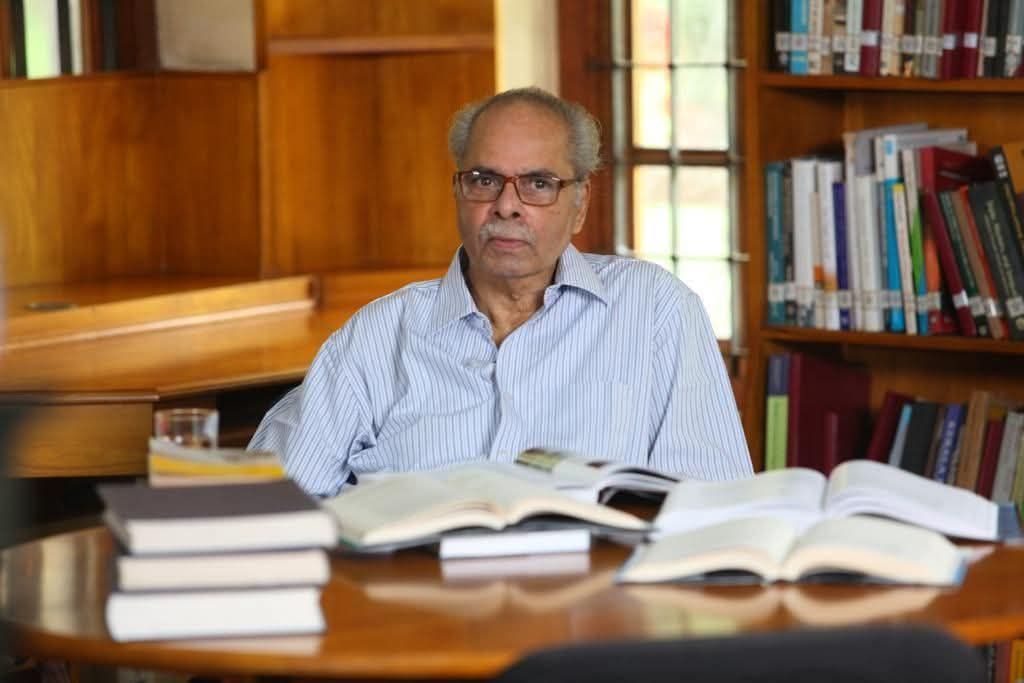
Prof KN Panikkar (26 April 1936 – 9 March 2026)
Synopsis: Prof Panikkar concentrated on the intellectual and cultural history of colonial India to begin with and ended up in the fight against fascism, which infiltrated into the body politic through school textbooks.
A doyen among modern Indian historians, Prof KN Panikkar, passed away aged 90 on 9 March in Thiruvananthapuram. His demise was three days after his birthday, celebrated by students and friends at his residence.
Prof Panikkar left behind a rich legacy of historicising the cultural and intellectual movements in
colonial India by skillfully using the Marxian tool, particularly the Gramscian method.
Instead of approaching the Marxian conception of base and superstructure in a mechanistic way, he used it in an organic manner, which resulted in the publication of innumerable articles and several books.
However, the question remains: To what extent have the intellectuals in Kerala internalised him and treated him as a warrior in the battlefield of history?
Since Prof Panikkar treated ‘history as a site of struggle’, he can truly be called a warrior historian. Panikkar’s metamorphosis started as an intermediate student days at the Government Victoria College, Palakkad, in the early 1950s. He pursued an undergraduate course in science at the same college.
A student movement activist, he was elected as the Chairman of the College Union. As an activist, he was naturally drawn towards the agitations going on in Malabar, organised by the peasants, workers, teachers and writers. One of the eminent leaders of the agitation was K Damodaran, a communist leader and intellectual.
Panikar’s friendship with Damodaran lasted till the latter’s death in Delhi.
As a graduate, Panikkar wanted to join politics after securing a degree in law. But his elder brother dissuaded him and took him to Rajasthan, where he pursued a postgraduate degree in History.
Though he was initially hesitant to approach History, he soon realised that it was his calling. He soon found himself immersed in the whirlpool of historical research and eventually became a teacher — the beginning of an odyssey that took him to the Jawaharlal Nehru University.
At JNU, he was the head of the department, Dean of the Faculty of Social Sciences and Professor Emeritus. He married his colleague, Usha Bhargava and had two daughters.
After his exit from JNU, he moved to Kerala to become the Vice Chancellor of the Sree Shankaracharya University of Sanskrit (2001-2004), Chairman of the Kerala Council of Historical Research (2001-2017) and the Vice Chairman of the newly constituted Higher Education Council (2007-2011).
Prof Panikkar also chaired the Textbook Review Committee in 2008 when the contents of a school textbook in Social Science caused a furore in the state. A certain religious organisation found the textbook obnoxious.
His well-studied report was enough to douse the fire. He was also the founder President of the Kerala History Congress, a professional body of the practitioners of history.
As a historian, Prof Panikkar concentrated on the intellectual and cultural history of colonial India to begin with and ended up in the fight against fascism, which infiltrated into the body politic through school textbooks.
Following the footsteps of DD Kosanbi, he treated history as the “presentation in chronological order of the successive changes in the means and relations of production”. It was the sweat of the toiling masses that shaped the course of history, and not the glittering clothes of Maharajas and Nawabs and the marauding march of their plundering armies.
Inspired by Antonio Gramsci, he concentrated his studies on the superstructure of society, the base of which is built by the forces of production.
Gramsci’s books became available in India in the min-1950s. They motivated young researchers to follow historical materialism. They treated Marxism as a tool for analysis and not as a substitute for original thinking.
Historians such as Romila Thapar, RS Sharma, Irfan Habib, Harbans Mukhia, Bipan Chandra and many others plunged themselves into research by utilising historical materialism as a tool for analysis. Panikkar concentrated on the superstructure component of historical materialism by delving deep into the social and cultural processes that gave birth to value systems of each mode of production.
The advent of colonialism, with its components of commodities and capital, overhauled the Indian society. It saw the emergence of a contradiction between the values of the old and new. It was out of this contradiction that social reform movements arose, which in due course, sparked critical thinking and the quest for equality in society.
Prof Panikkar analysed the contradiction between Ayurveda and English medicine, traditional education and English education, the traditional storytelling literature and modern novel in native languages. The result could be seen in several articles and books like ‘Culture, Ideology and Hegemony’.
His studies concentrated on how a particular ideology established its hegemony over society and how it survives even after the mode of production that produced it gave way to another mode. He analysed the role of caste, which was a product of the feudal economy that survived even after the capitalist mode of production gained control in society.
His study of the Malabar Rebellion — the peasant revolt against landlords — is a seminal and pathbreaking. He emphasised the role played by caste and Islam in mollifying and invigorating the struggle. The low-caste Hindus refrained from the struggle against the Hindu landlords because caste functioned as a system imposing subservience. Islam motivated the struggle because it said the agitation was a holy war against the enemies.
The same system of exploitation aroused contradictory results by refraining from agitation and invigorating it. Thus, caste and religion functioned as tools that swayed their hegemony over the respective social groups.
About four decades ago, Prof. Panikkar warned intellectuals and political leaders that fascism was about to dawn on the Indian horizon (Before the Night Falls). The social science textbooks for school in UP, Rajasthan and Gujarat were the forerunners of this catastrophe. The demolition of the Babri Masjid and the launching of the textbooks — knowingly or unknowingly — happened simultaneously. The result was disastrous.
Prof Panikkar, along with his colleagues, launched a crusade against this conquest of the young minds. They toured the country and abroad, lecturing on the saffronisation of the school curriculum. He warned the Indian elite that education is a powerful tool to impose the hegemony of the ruling class over the people.
1. British Diplomacy in North India (1985)
2. Against Lord and State: Religion and Peasant Uprising in Malabar (1989)
3. Culture and Consciousness in Modern India (1990)
4. Culture, Ideology, and Hegemony: Intellectuals and Social Consciousness
in Colonial India (1996)
5. Communal Threat and Secular Challenge (1997)
6. Agenda for Cultural Action and Other Essays (2002)
7. Before the Night Falls: Forebodings of Fascism in India (2002)
8. Colonialism, Culture, and Resistance (2009)
9. History as a Site of Struggle (2013)
10. Society and Culture in Kerala (2017)
1. John Malcolm’s Political History of India (1980)
2. Communalism in India: History, Politics, and Culture (1991)
3. National and Left Movements in India (1990)
4. Peasant Protest and Revolt in Malabar (1990)
5. The Making of History (2000)
6. Towards Freedom (2011)
7. The Concerned Indians Guide to Communalism (2019)
8. Caste in Kerala (2020).
(Edited by Majnu Babu).


