

Published Jan 14, 2026 | 9:00 AM ⚊ Updated Jan 14, 2026 | 9:00 AM

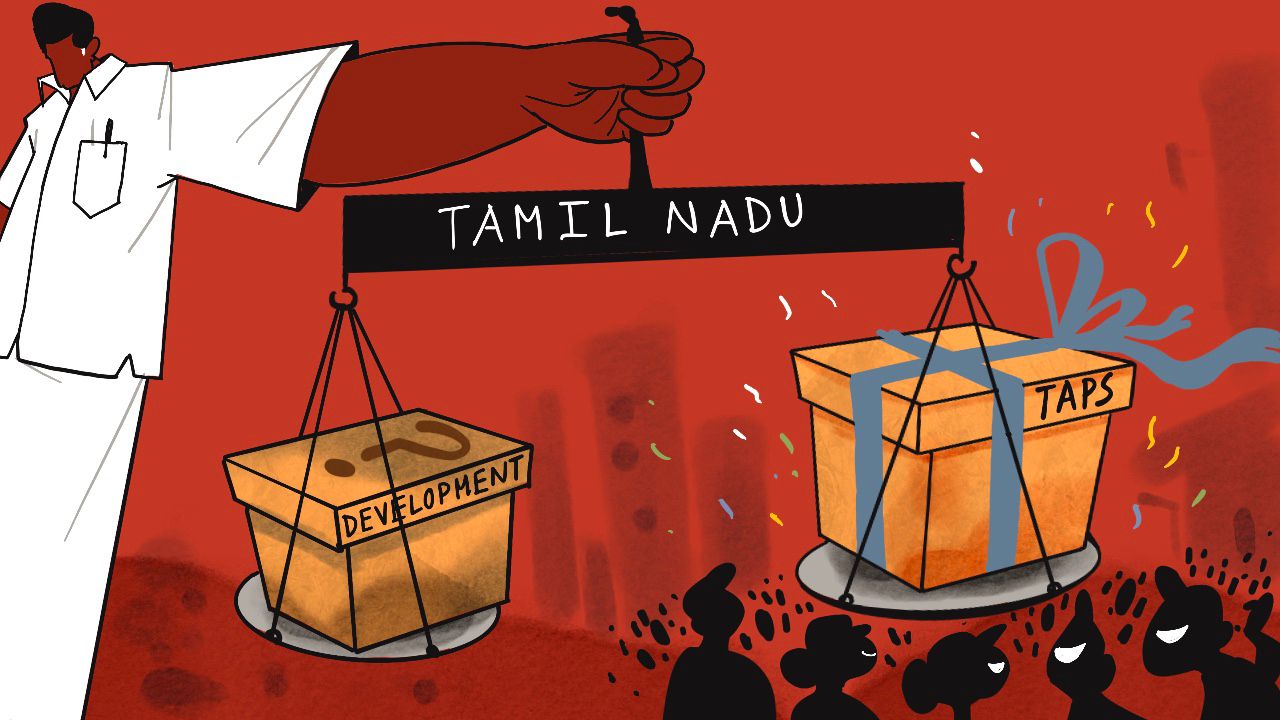
With the introduction of TAPS, Tamil Nadu will incur an additional expenditure of ₹13,000 crore for the pension fund.
Synopsis: Tamil Nadu’s experiment, the assured pension scheme for government employees, will be judged not by its intent, but by its outcomes — particularly its ability to sustain welfare commitments without compromising development spending. The scheme is not merely a pension reform, but a test case for the future direction of welfare politics in the region.
Tamil Nadu Chief Minister MK Stalin announced the new Tamil Nadu Assured Pension Scheme (TAPS) for state government employees on 3 January. Under the new arrangement, state government employees will be provided an assured pension equal to 50% of their last-drawn basic pay.
The state government had reviewed a recent report submitted to the chief minister by a three-member Pension Committee before making the announcement. The panel examined different pension models and recommended a framework suited to Tamil Nadu.
Under TAPS, employees will contribute 10% of their basic pay to the pension fund, while the state government will cover the remaining amount required to ensure an assured pension.
With the introduction of TAPS, Tamil Nadu will incur an additional expenditure of ₹13,000 crore for the pension fund. Additionally, the state will have to contribute approximately ₹11,000 crore annually, an amount likely to increase based on the salaries of employees.
Tamil Nadu has opted for assured retirement security, effectively moving closer to the old pension framework while retaining limited employee contributions. The political message is clear: social security commitments, particularly to government employees, are being prioritised even at the risk of expanding long-term liabilities.
This marks a decisive shift in welfare orientation and positions the state as a regional outlier in pension policy.
Later, in a post on X, Stalin described TAPS as a New Year and Pongal gift to government employees, calling it the fulfilment of a long-pending demand under the Dravidian model of governance. He said the move reaffirmed his government’s commitment to those who had placed their trust in it, and assured that as Tamil Nadu’s financial position improves, the demands of all sections of society would be addressed.
Several employee organisations welcomed the decision and withdrew their planned protests and strikes. While supporters welcomed the move as a solution to pension insecurity, it contrasts with the decisions taken by other southern states, highlighting that the region no longer follows a uniform approach to governance.
The Kerala model
Kerala, known for its ‘development model’, in contrast, has taken a much more cautious path. With a heavy debt burden, limited borrowing capacity and rising fixed expenses, the state is struggling to meet even its day-to-day financial commitments.
Successive governments have cited this fiscal strain as the primary reason for avoiding guaranteed pension schemes. Although employee unions continue to press for reforms, the fear of deepening an already tight financial situation has led to hesitation.
Kerala’s approach is driven by financial reality, but it has also drawn criticism for policy paralysis at a time when employees are seeking clarity and assurance.
Karnataka is sticking with the contributory pension system, largely because it wants to avoid adding long-term financial pressure to its budget.
While the state has a relatively strong revenue base, driven by Bengaluru’s IT economy and industrial growth, it also faces rising expenses on infrastructure, welfare schemes and urban development.
The government has been cautious about reopening pension reforms, fearing that guaranteed pensions could lock future budgets into fixed commitments and reduce flexibility for development spending. Karnataka’s approach reflects an effort to strike a balance between employee welfare and the need to protect long-term financial stability.
After Telangana’s strong initial growth post its formation, the state saw a sharp rise in public debt due to large-scale spending on welfare schemes, irrigation projects and capital investments.
Borrowing levels increased, and the fiscal pressure tightened in recent years. Against this backdrop, the government has been reluctant to roll back pension reforms, arguing that assured pensions could further strain an already stretched budget.
Telangana has therefore continued with the contributory pension system, prioritising fiscal control over politically attractive but financially risky promises.
Andhra Pradesh has taken a middle ground. Rather than undertaking a full-scale rollback, it experimented cautiously with incremental adjustments to pension benefits and eligibility, attempting to balance employee welfare with fiscal constraints.
These contrasting approaches of southern states highlight a deeper divergence in governance philosophies across Peninsular India.
Tamil Nadu’s move challenges the prevailing consensus around pension reform and forces other states to respond — politically, if not immediately in policy.
The question now confronting the region is whether assured pensions represent visionary governance that restores trust in public service, or a fiscally risky precedent that could destabilise state finances if widely emulated, as seen in Punjab. A large portion of its revenue is locked into salaries and pensions, leaving very little room for development spending.
The result is rising debt, stalled economic growth, and fewer opportunities for the next generation. This is not sustainable governance. It is fiscal decay.
As South India watches closely, Tamil Nadu’s experiment will be judged not by its intent, but by its outcomes — particularly its ability to sustain welfare commitments without compromising development spending. In that sense, the scheme is not merely a pension reform, but a test case for the future direction of welfare politics in the region.
(Views are personal. Edited by Majnu Babu).


