

Published Dec 14, 2025 | 10:55 AM ⚊ Updated Dec 14, 2025 | 10:56 AM

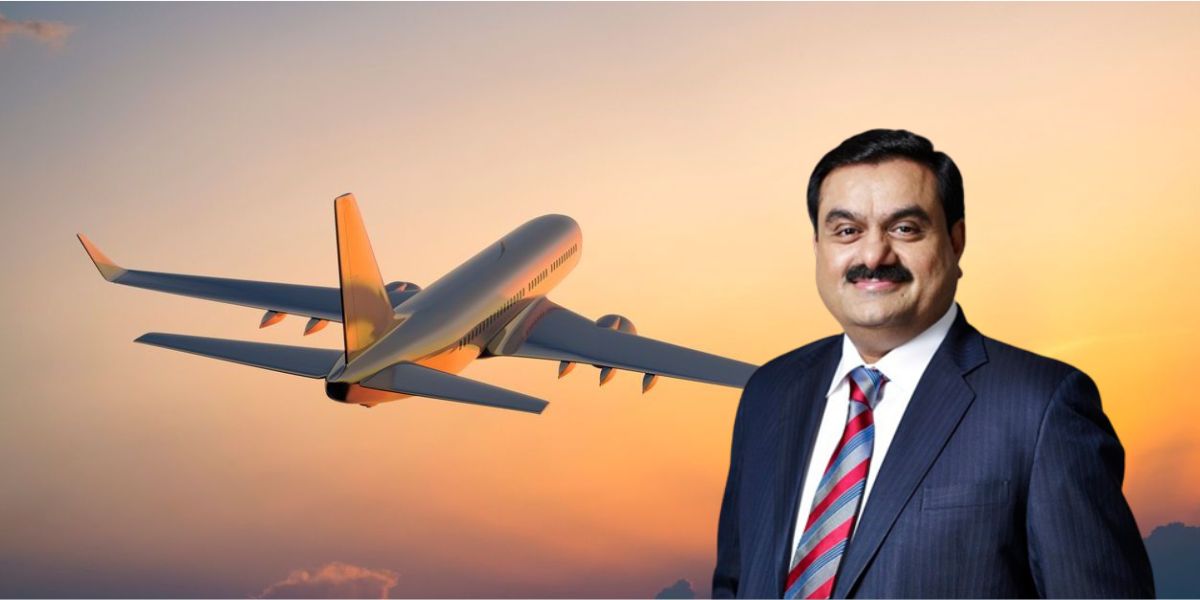
Gautam Adani.
Synopsis: Recently, the cancellation of numerous IndiGo Airlines flights caused a nationwide uproar, bringing India’s aviation sector close to a shutdown. However, little attention was paid to how the sector became highly monopolised, with IndiGo controlling more than half of the market share. At the same time, the Adani Group appears to be laying the groundwork to establish its own airline.
For more than two weeks now, the mainstream media have been resounding with news reports and commentaries about the difficulties faced by air passengers, about the callousness of a private airline that abruptly cancelled flights, and about the irresponsibility of the government in handling the situation. Even if not the core issues, at least peripheral matters are being aired loudly and repeatedly.
Passenger hardships are nothing new in this country, nor are they matters that anyone takes particularly seriously. Perhaps crores of passengers in this country experience many such hardships every single day: A chaotic public transport system, insufficient trains coupled with the recent reduction of general compartments, buses being run arbitrarily, not arriving on time, overcrowded buses, and private transport vehicles that test the patience of passengers.
However, who cares about the suffering of the poor and the lower middle classes? Who sheds tears for those who die every day?
Air travel, which was once the exclusive monopoly of the rich and powerful, has in recent times come down to some extent to the middle classes, too. Even so, one keeps hearing the irritation-filled remarks of the elite that airports have turned into bus stands or fish markets.
Be that as it may, air travel is neither all that easy nor all that affordable. That is why, when speaking about the difficulties of air passengers, one usually sees a certain deference towards the upper classes, a clear class bias. When they face hardship, it becomes a big topic of discussion in our media.
In reality, when compared to the crores of people who suffer daily during train and bus journeys, only a few thousand — at most a few lakhs — of air passengers were inconvenienced.
Their hardships, too, must necessarily be taken into consideration by society. But the recent aviation crisis is an example of how society chooses whose suffering to consider and whose suffering to ignore as if unseen.
However, despite the intense discussions and debates, what also needs to be noted here is that the core issues have not entered the discussion at all; even when they were mentioned somewhere in passing, there was no attempt to go into their depths.
IndiGo Airlines, the country’s largest airline, operating on average about 2,700 flights a day within India and to some foreign destinations, cancelled more than 5,000 flights over the last two weeks. As these cancellations happened at the last minute without prior warnings, air passengers faced severe difficulties at airports across the country.
With a 64 percent share of the domestic aviation market, IndiGo’s sudden disruption of its services threw air travel as a whole into chaos. This aviation crisis, which began in the first week of December, has not been fully resolved even at the time of writing.
Reports said that the compensation IndiGo is paying to passengers affected by flight cancellations has crossed Rs 500 crore.
When passengers whose flights were cancelled at the last minute tried to look for alternative options, they found that Air India is the only airline capable of competing with IndiGo in the country. Sensing an opportunity, the airline hiked ticket prices exorbitantly. Ticket prices that were under ₹10,000 went up to as much as ₹50,000.
IndiGo Airlines, which entered civil aviation in 2006, had fewer than 100 aircraft and annual profits of less than ₹2,000 crore by 2016. Over the next 10 years, it grew at a staggering pace. At present, the company has about 450 aircraft and earns annual profits of around ₹8,000 crore. For such a rapidly grown and still-growing company, the present crisis is a major blow.
Refunds to passengers for cancelled flights, compensation payments, redeployment of staff to other duties, the overall task of regaining lost goodwill among passengers and in the market, and above all, the steep fall in the share prices of its parent company, InterGlobe Aviation — all these have added up to serious losses and difficulties for IndiGo Airlines.
It has also become glaringly evident that the Union Ministry of Civil Aviation and the Directorate General of Civil Aviation (DGCA), which are responsible for regulating civil aviation in the country and for ensuring passenger safety and discipline in the operation of flight services, failed to discharge their responsibilities properly.
It has come into circulation that the immediate cause of this entire crisis was IndiGo Airlines’ disregard for implementing the Flight Duty Time Limitation (FDTL) rules issued by the DGCA, and that when it finally reached a stage where it had no option but to implement those rules, the airline chose to cancel flights in order to exert pressure on the government.
Since the ministry is headed by a leader belonging to the TDP, this issue also acquired a political dimension.
Thus, while some of the technical and political reasons behind this crisis did come out into the open and were discussed, none of the media platforms went into depth or produced investigative reports, commentaries, or analyses. Four issues that have not come out at all must necessarily be examined.
First, who allowed and who facilitated IndiGo Airlines reaching such a monopolistic (or highly inequal duopolistic) position in a crucial sector like aviation?
In fact, no business, commercial, or public-interest activity should be allowed to have a monopoly. Monopoly leads to the disruption of the lives of all those dependent on that sector. Because the national movement opposed the monopolies practised by British colonialism in certain sectors, Article 39 of the Indian Constitution incorporated, as a Directive Principle, the idea that the state should not allow monopolies.
In continuation of this, statutory prohibitions against monopolistic and restrictive trade practices began in the 1970s. Even though those prohibitions were severely diluted in the wave of globalisation under the new economic policies, some restrictions and limits on monopoly still formally exist.
However, in civil aviation, despite the presence of many airlines such as Jet Airways, Kingfisher Airlines, SpiceJet, Akasa, Go First, Air Costa, Deccan Airways, Paramount Airways, and Air India, the government followed policies that led to all of them shutting down.
Air India (Indian Airlines), which was a public sector enterprise, was sold off at a throwaway price to the Tata Group. While even the smallest and poorest countries in the world have their own state-owned national airlines, it is the Modi government that ensured India no longer has one.
Second, if IndiGo’s monopolistic market share was one reason for its arbitrary functioning and disregard for DGCA orders, another important factor is that in the electoral bonds scam, InterGlobe Aviation purchased electoral bonds worth ₹5 crore, InterGlobe Air Transport ₹11 crore, InterGlobe Real Estate Ventures ₹20 crore, and Rahul Bhatia, one of IndiGo’s promoters, personally purchased bonds worth ₹20 crore.
Anyone can guess to which party these bonds worth ₹56 crore might have been donated.
Third, how did the DGCA remain inactive without taking any action even as IndiGo brazenly ignored its directives, and which powerful hands were behind this DGCA inaction — this too must necessarily be discussed.
Fourth, and the most serious of all — something that no one even mentioned in the discussions of the past two weeks — is the possible role of businessman Gautam Adani in this entire affair.
By July 2020, Adani had no minimum experience, either in aviation or in airport management. Yet in July, he sought to acquire the Mumbai airport.
Although GVK, which had built and was operating the airport, was facing financial difficulties at the time, it was unwilling to sell it to Adani and instead sought loans from Abu Dhabi investment institutions.
However, after raids by the Enforcement Directorate (ED) and the CBI on GVK in the immediate aftermath, the Abu Dhabi investors withdrew. Left with no alternative, GVK was forced to sell its airport to Adani.
Over the next five years, Adani acquired another seven or eight airports. Recently, he announced plans to invest $15 billion over the next five years in the airport business — passenger handling, airport upgradation, new terminals, taxiways, and runways.
In November, he acquired a flight training and simulation company (FTSC), a pilot training firm, and began making arrangements to train several thousand pilots. In other words, he has entered all forward and backward linkages of the aviation sector except for actually operating airlines.
At Mumbai airport, where until now only bank guarantees were accepted towards operational charges from airlines, Adani suddenly introduced a new stipulation demanding payments in cash, thereby beginning to trouble both IndiGo and Air India.
Taken together, considering what Adani has been doing in other business sectors so far and what he is now doing in aviation, one can reasonably speculate that an Adani Airlines (or ‘Modani Airlines’) may be launched soon. When that rises and establishes itself, there is every possibility that IndiGo too may be lying in the rubble beneath it.
(Views are personal. Edited by Muhammed Fazil.)


