


Published Feb 12, 2026 | 5:00 PM ⚊ Updated Feb 12, 2026 | 5:00 PM

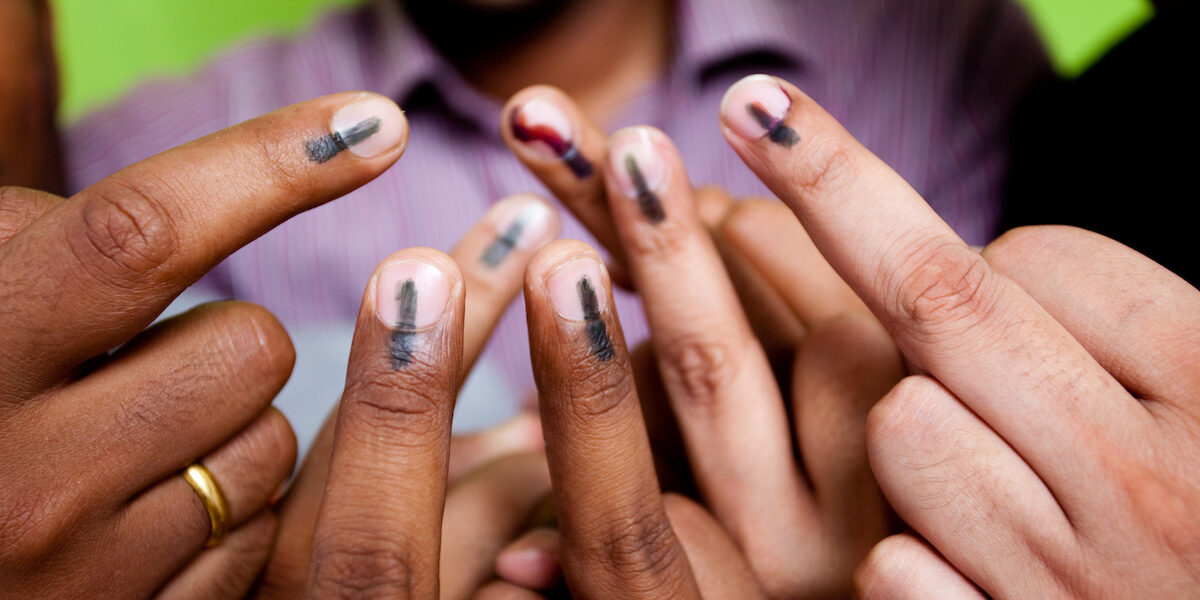
“One person, one vote” is the foundational principle of democracy. (iStock)
Synopsis: If one observes the campaign style of leaders over the two weeks since the election announcement in Telangana—the accusations and counter-accusations exchanged between parties, the mudslinging, the unrestrained distribution of money, gold, goods, and vehicles to lure voters—one is compelled to question whether these elections bear any relationship at all to democracy.
By the time you read this article, polling in elections to Municipal Corporations and Municipalities across seven cities and 116 towns in Telangana would have been completed.
While there are a total of 10 Corporations and 121 Municipalities in the state, elections are not being held in three Corporations and five Municipalities as their terms have not yet expired.
In the elections, 5.243 million voters cast their votes to elect 2,996 representatives for their respective wards and divisions.
The election process, which began with the notification issued on 27 January, appears—if one goes by the details provided by officials and the statistics released—proceeded smoothly, lawfully, and in an orderly manner.
Indeed, all elections conducted in the country over the past seven-and-a-half decades have presented this same glossy facade in official statements and statistical accounts.
However, if one observes the campaign style of leaders over the two weeks since the election announcement in the state—the accusations and counter-accusations exchanged between parties, the mudslinging, the unrestrained distribution of money, gold, goods, and vehicles to lure voters—one is compelled to question whether these elections bear any relationship at all to democracy.
One need not even invoke lofty ideals such as democracy. One wonders whether there is even a semblance of basic civility, cultured conduct, courteous criticism, or free and fair elections untainted by inducements.
“One person, one vote” is the foundational principle of democracy. But today in the state, these elections reveal a degenerated condition where it has been reduced to one threat for one vote, one act of intimidation for one vote, one humiliation for one vote, one bribe for one vote.
The language employed by leaders, the opportunistic alliances between political parties, the expenditure running into tens and hundreds of times the legally prescribed maximum limits, the torrents of money and liquor flowing freely, the blatant misuse of official machinery, and the reckless incitement of caste and religious passions—all these are visible everywhere.
If one listens to the speeches, observes the gestures, hears the language chosen and the abuses hurled by leaders of the three major parties during the campaign, one is astonished: is this a civilised society? Are these leaders who must face one another tomorrow? Or is it that they are great actors who hurl the most atrocious abuses from the stage to provoke the people, and once they step down, smoothly join hands in business dealings, contracts, and distribution of wealth?
Even if a fraction of the allegations they level against one another is true, none of them would be fit to serve as public representatives. None would deserve to occupy positions of power. Since they all make accusations of equal gravity against each other, the people may reasonably believe that at least some of them must be true.
Yet, during their respective terms in office, not one of them has ordered investigations into these allegations, proved them, imposed punishment, or sought to drive their rivals out of politics. This means all political parties are partners in crime—accomplices in the singular offence of deceiving the people. Depending on time and circumstance, one may have secured a smaller share and another a larger share. In this country, politics has come to mean that those who obtained a smaller slice of the spoils strive for a larger one, while those who secured a larger slice strive to consolidate it.
During this election campaign itself, the BRS declared that the Congress and the BJP are the same. The Congress alleged that there is an alliance between the BJP and the BRS. The BJP asserted that the Congress and the BRS are identical.
In mathematics, if A is equal to B and B is equal to C, then A is equal to C. If each of these three parties claims that the other two are identical, it logically follows that all three are alike—that all three are ruling-class parties, anti-people parties.
Each party has publicly alleged that the other two are bound by secret understandings. Not even the polite term “alliance” is used. Instead, phrases such as covert agreements, conspiracies, betrayals, dark friendships, traitors, adopted sons, illegitimate sons, histories of fake passports, blackmail politics, hundred-crore deals, inseparable bonds like Veena and Vani, “Revanth-uddin,” “Kalvakuntla Kishan Reddy,” and so on have filled the newspapers.
What they actually say—captured without editing on electronic and YouTube channels—is unfit even to be written.
The Chief Minister, who, by virtue of holding power, ought to conduct himself with greater responsibility than others, appeared to have forgotten that he occupies a constitutional office and used the language of street brawls. Given that power rests in his hands, it is hardly surprising that official machinery has been misused for election campaigning.
The BJP, believing that urban voters are inclined in its favour and eager to secure major victories in these elections, acted aggressively and used similar language. Bandi Sanjay, Kishan Reddy, Raghunandan Rao, Ramachandra Rao, and Arvind competed in aggressive rhetoric and even brought the new national president for campaigning and flooded newspapers with advertisements.
In comparison, it must be said that the BRS could not match those two parties either in campaign intensity or in the degradation of language. K Chandrashekar Rao, who sought time citing his involvement in the municipal election campaign when notices were issued in the phone-tapping case investigation, did not appear to have actively participated in the campaign. Though T Harish Rao, KT Rama Rao, and local leaders campaigned, much of their time seems to have been spent responding to the Congress leadership and the Chief Minister.
Another striking feature of these elections has been the blatant opportunistic alliances. One may argue that since these are local body elections, local issues predominate and ideology or political loyalties matter less. Yet, it is always astonishing when a political party enters into alliances detrimental to its own declared principles.
In one Municipal Corporation, the CPI threatened that it would ally with the Congress across the state only if it was allotted the number of divisions it demanded there; otherwise, it would go alone. It even declared that it might join hands with other parties if necessary.
Ultimately, when that bargain failed, the CPI–Congress alliance collapsed. To abandon a unity that had continued for over two years since the Assembly elections, merely because an agreement over ten or fifteen corporator seats could not be reached, reveals the narrowness and self-interest on both sides.
On the other hand, the CPI(M) entered into agreements with the BRS, which it had criticised until yesterday. In the Khammam district, the CPI(M) simultaneously allied with the ruling Congress and the opposition BRS. Thus, parties that are adversaries elsewhere have united in certain places.
At a time when multi-cornered contests already split the anti-incumbency vote to the advantage of the ruling party, new actors have entered the fray to fragment it further. Internal conflicts within parties have surfaced.
In Vikarabad, a BRS candidate was elected unanimously and immediately joined the Congress. A leader of Reddy Jagruti, whom the BRS had earlier accused of filing a High Court petition to block BC reservations at the Congress’s behest, is now a BRS candidate.
This frog-leap politics bluntly reveals a simple truth: though these parliamentary political parties appear different in form, they are identical in substance. None of them has any hesitation in mortgaging their proclaimed principles and ideals at the altar of power.
The bankruptcy of parliamentary politics was laid even more bare in these elections by the bait offered to voters. These inducements are illegal, immoral, and undemocratic. The law stipulates that ward members contesting in Municipalities must not spend more than one lakh rupees, and division members in Corporations must not exceed one and a half lakh rupees.
Yet any candidate, from any party, appears to have spent several multiples beyond these limits—beyond imagination. There are reports that, in some instances, ₹30,000 were paid for a single vote.
News reports suggest that in just six Municipalities alone, ₹250 crore was spent. This implies that of the total legal expenditure permissible for the three thousand representatives to be elected across the state, 95 percent was spent by merely 5 percent of the candidates.
By this calculation, statewide expenditure is estimated to exceed ₹1,000 crore—many times the legal maximum.
In some places, candidates distributed liquor, mutton, chicken, basmati rice, cash, sarees, and even half a tola of gold to every household. The absurdity of this spending reached such a point that in Kodad Municipality, when a ward was declared unanimously elected, residents staged a protest saying, “What do we gain from unanimity? We have been deprived. Had there been an election, they would have given us two to three thousand rupees per vote!”
Can an election process riddled with such distortions be called a democracy?
Municipal institutions are also known as local self-governing bodies—that is, structured institutions that enable people to govern themselves where they live. The essence of democracy lies in people governing themselves.
Democracy does not mean an autocratic king who proclaims himself divine—“Na Vishnuh Prithvipati”—or claims to be a divine incarnation or ruling by celestial sanction. Nor does it mean a brute strongman who seizes power by crushing others through sheer muscle. Nor does it mean a moneybags leader who roars, “I can buy anyone.” The true representation of the people is the cornerstone of democracy.
Democracy rests upon each individual consciously, freely, voluntarily, and without inducement choosing their representative.
Does such a democracy exist in this country? Is this it?
(Views are personal. Edited by Majnu Babu).


