

Published Apr 22, 2026 | 12:02 PM ⚊ Updated Apr 22, 2026 | 12:02 PM

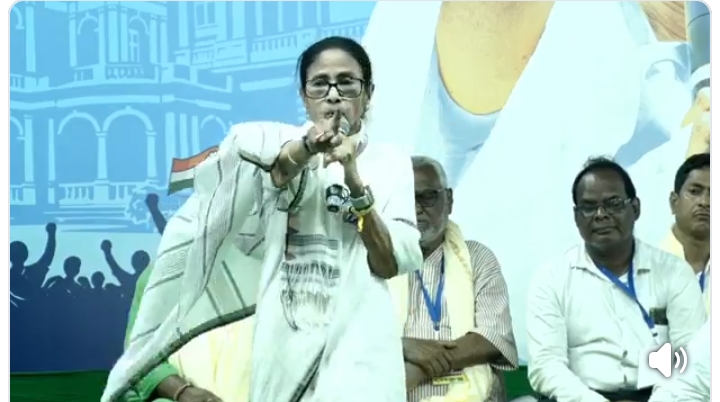
Mamata Banerjee continues to command a strong personal connect with voters that goes beyond local dissatisfaction.

Synopsis: Approximately 11.6 percent of voters, close to 89 lakh individuals, have been removed from the rolls during the SIR. To understand its significance, one must recall that the vote share gap between the TMC and BJP in 2021 was around 10 percent. The scale of deletions exceeds that margin, immediately raising the possibility of a reshaped electoral outcome.
While the West Asia war continues to dominate international headlines, political attention in India is steadily turning toward the upcoming Assembly elections in West Bengal.
What appears at first glance to be a routine electoral exercise is, in reality, shaping into a high-stakes political contest where structural dominance, voter behaviour, and institutional interventions are colliding in complex ways.
A close reading of the ground situation observed by People’s Pulse Research Organisation suggests that the political atmosphere favours the incumbent Mamata Banerjee-led All India Trinamool Congress (TMC).
The contours of the contest itself reveal an asymmetry. While the TMC is contesting all 294 constituencies, the principal opposition, the Bharatiya Janata Party, is contesting only around 200. In effect, if the TMC is attempting a full 100-mark examination, the BJP is attempting only about 65 marks.
This imbalance is not merely symbolic; it reflects a deeper structural reality. Ground-level assessments, along with an analysis of the last three elections, indicate that in nearly 90 constituencies no political party currently possesses the strength to defeat the TMC. This places a formidable burden on the BJP. To form a government, it need an extraordinary strike rate of around 75 percent in roughly 204 constituencies. Anything short of that would likely result in another electoral setback.
There is, however, a visible shift in the BJP’s approach compared to previous elections. Both its central and state leadership appear to be working with greater restraint and strategic discipline, avoiding the high-decibel campaigns of the past. The role of grassroots mobilisation has become more pronounced, particularly through the efforts of the RSS and its affiliated organisations, which have been active on the ground for several months.
Unlike earlier elections, where the party leaned heavily on defectors from other formations, this time it appears more cautious and calibrated. West Bengal’s political history also shapes the present contest. Elections in the state have often been followed by political violence and vendetta, creating an atmosphere of fear among party workers. Anticipating this, the BJP has sought the deployment of central forces to instil confidence among its cadres and strengthen its organisational footing.
The most disruptive variable in this election is the Special Intensive Revision (SIR) of electoral rolls conducted by the Election Commission of India. Approximately 11.6 percent of voters, close to 89 lakh individuals, have been removed from the rolls. This is not a routine correction but a structural shock to the electoral system. To understand its significance, one must recall that the vote share gap between the TMC and BJP in 2021 was around 10 percent. The scale of deletions exceeds that margin, immediately raising the possibility of a reshaped electoral outcome.
Yet, the political impact of SIR is far from linear. The central question is not how many votes were deleted, but whose votes were deleted and how that translates across constituencies. District-level trends indicate that higher deletions have occurred in regions where the TMC previously enjoyed strong leads, particularly in border districts.
In theory, this could narrow the TMC’s advantage. But electoral outcomes rarely follow theoretical assumptions. Scenario-based analysis offers a more grounded perspective. If voter deletions disproportionately affect TMC supporters and are accompanied by even a modest anti-incumbency swing of 2 to 3 percent, the BJP could move closer to a competitive position.
However, if deletions are evenly distributed or if they also impact BJP-leaning voters, the overall effect could neutralise itself. Evidence from past elections, including Bihar, suggests that voter deletions do not automatically benefit one party and can sometimes produce counterintuitive results.
Equally important is the behavioural response. Large-scale deletions can trigger anger among affected families, potentially increasing turnout rather than suppressing it. In such a scenario, SIR may end up energising voters rather than reshaping the electoral balance in a predictable direction. This makes SIR not a decisive factor on its own, but a conditional one that interacts with anti-incumbency sentiments and ground mobilisation.
Also Read: Questions ECI didn’t answer on ‘vote theft’ and Bihar SIR
A longer historical perspective reinforces the argument for continuity. Since Independence, voters in West Bengal have demonstrated a preference for stable, long-term governments. The Congress governed for about 25 years, followed by 35 years of Left rule. In that context, the possibility of the electorate extending another term to the TMC aligns with an established political pattern.
Leadership remains a decisive factor. Mamata Banerjee continues to command a strong personal connect with voters that goes beyond local dissatisfaction. While there is visible resentment against some TMC leaders and workers at the grassroots level, this has not translated into widespread anger against her leadership.
In contrast, the BJP lacks a state-level leader who can match her political stature or emotional resonance. The dynamics of minority voting further strengthen the TMC’s position. Efforts to fragment Muslim votes through smaller parties have not succeeded, instead reinforcing consolidation behind the ruling party in constituencies where such voters are decisive.
Another distinctive feature of Bengal politics is the role of the Congress and the Left. While these parties strongly oppose the BJP at the national level, in West Bengal they are often perceived as indirectly aiding the BJP’s prospects, functioning as a “B-team” in the state’s political narrative. Beyond these dynamics lies the central electoral question: do the people of West Bengal want to give Mamata Banerjee another term. Ground-level insights suggest a nuanced answer. There is dissatisfaction, but not decisive rejection. There is criticism, but not a unified demand for change.
TMC’s strength is most visible in its dominance across 13 key districts. In 2011, out of 207 seats in these districts, the TMC and Congress alliance won 161. In 2016, the TMC secured 151 out of its 211 seats from these regions. By 2021, this dominance deepened further, with 183 out of 215 seats, nearly 88.4 percent, coming from these districts.
The party’s consistency is equally striking. It has won 118 constituencies consecutively across three elections and secured another 44 at least twice, giving it strong influence in around 162 constituencies. Notably, 104 of these consistently held seats are concentrated within these 13 districts.
In contrast, the BJP’s strength remains uneven. In these 13 districts, it won only 23 out of 207 seats in 2021, around 11 percent. However, it performed significantly better in the remaining 10 districts, winning 54 out of 87 seats. A substantial share of its victories came from SC and ST constituencies, indicating a different social base of support.
Recognising this, the TMC has intensified its focus on these segments. Through targeted campaigns such as “Tapashilar Sankalp,” it has engaged directly with voters in reserved constituencies, highlighting welfare measures and countering the BJP’s narrative. At the same time, it has undertaken major internal adjustments, changing candidates in 159 constituencies, including sitting MLAs and previous contestants.
Demographic realities further shape the electoral landscape. There are 89 constituencies where Muslims constitute more than 35 percent of the population, and when seats with over 25 percent Muslim population are included, the number rises to 112. In these constituencies, voter consolidation becomes a decisive factor.
At a broader level, this election reflects the distinction between politics and strategy. With the singular objective of capturing power, the BJP’s central leadership is deploying every available instrument in West Bengal. Developments such as the SIR process and enforcement actions have added intensity to the contest. Yet, elections are ultimately decided not by strategy alone but by outcomes.
As the saying goes, “Jo Jeeta Wohi Sikandar.” West Bengal today stands at that critical intersection where entrenched political structure meets strategic disruption. Whether disruption can overcome structure will determine not just the next government, but the future trajectory of politics in the state.
(Views are personal. edited by Majnu Babu).



