

Published Feb 22, 2026 | 3:27 PM ⚊ Updated Feb 23, 2026 | 4:10 PM

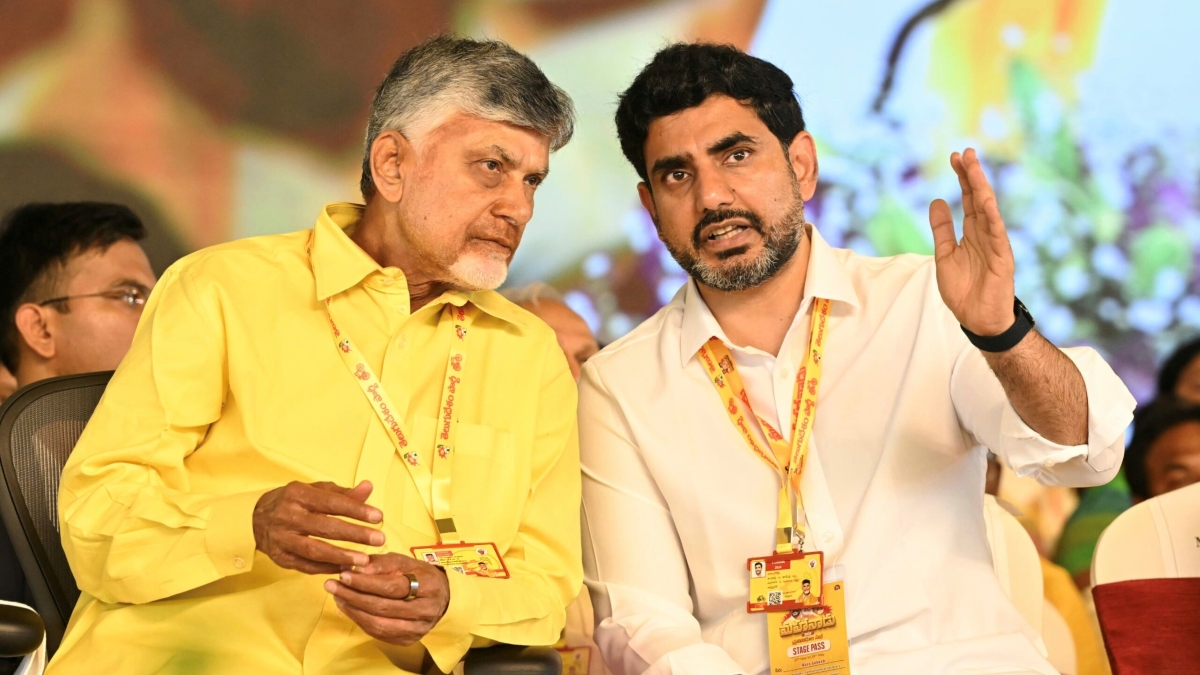
N Chandrababu Naidu and Nara Lokesh. (X)
Synopsis: Signals are emerging from Andhra Pradesh that the process of installing Nara Lokesh as the state’s chief minister has begun in earnest. Of late, Cabinet meetings and other important meetings are chaired by Lokesh, instead of Chief Minister N Chandrababu Naidu, his father. However, the transition will likely see obstacles within the NDA and a formidable challenge by YSRCP chief YS Jagan Mohan Reddy.
In Andhra Pradesh’s political landscape, unmistakable signals are emerging that the process of installing Nara Lokesh as the state’s chief minister has begun in earnest. With no Assembly elections on the horizon, this is not a verdict of the ballot box but a planned transfer of power from father to son.
The choreography is already visible: Rapid shifts in the TDP’s internal dynamics and in the functioning of the state government point unmistakably in one direction.
The real question is not whether the move is being attempted, but whether the political, organisational and social conditions will permit its success — and what obstacles may yet derail it. At the heart of the matter lies Chief Minister N Chandrababu Naidu’s own state of mind.
Is he convinced that the moment has arrived to hand over the reins, or is he reluctantly yielding to family pressure while privately believing that the time is not yet ripe? Only time will tell.
The precedent from Telangana is cautionary. BRS chief K Chandrashekar Rao’s determined effort to elevate his son KT Rama Rao collapsed dramatically.
Will Lokesh fare better within the current term? Has Deputy Chief Minister and Jana Sena chief Pawan Kalyan already given his quiet consent, or might resistance surface? What posture will the BJP adopt?
Above all, how will the people who voted for the NDA alliance — trusting Naidu’s leadership — view a mid-term succession? These are not idle speculations; they are the questions ordinary citizens are asking.
Recent developments inside the government and the party reinforce the impression that Lokesh’s elevation is being methodically prepared. Key decisions on nominated posts, bureaucratic transfers and postings, once formally the chief minister’s prerogative, are now effectively taken by Lokesh.
Cabinet meetings are routinely preceded by informal gatherings of ministers at the chief minister’s residence, where Naidu is absent, and Lokesh is the central figure. The traditional “Praja Darbar” — the open public grievance redressal mechanism — is now handled by Lokesh, who receives petitions and listens to citizens’ problems.
A more personal outreach is also underway. District-wise dinners are being organised for MLAs, MLCs, ministers and MPs, along with their families.
These are not mere social events; Lokesh inquires about their well-being, strengthens personal bonds, and, according to reports, presents sarees to the women of the households. The strategy is clear: Convert institutional loyalty into emotional allegiance. Lokesh himself has articulated the philosophy: alongside IT, AI and quantum computing, human relationships and personal connect remain vital.
The exercise began in the Krishna district and has now covered most districts. Simultaneously, Lokesh’s visits to Delhi have intensified.
Central ministers, young leaders of NDA constituents, and, crucially, Prime Minister Narendra Modi and Home Minister Amit Shah are being cultivated — often with Naidu personally facilitating the meetings. This is markedly different from his earlier stint as minister between 2014 and 2019, when such systematic networking was absent.
Yet the critical variable remains Naidu himself. A man who has been described as functioning like a “robot” since 1983 — constantly driven by the imperative to act — is unlikely to embrace idleness. Some speculate he may move to national politics, perhaps occupying a Rajya Sabha seat and playing a more active role in the NDA.
However, formidable obstacles exist. The Modi-Shah combine has never fully trusted him and is notoriously averse to sharing power with strong regional satraps. Their alliance with Chandrababu is transactional, not sentimental.
Recent remarks by the chief minister himself are revealing. At the launch of a book by his brother-in-law, he spoke light-heartedly about planning for retirement, citing how his relative was spending his post-retirement years.
Contrast this with his 1989 response to a question about his future: even out of power, he said, he would continue travelling the state with fact-finding teams.
The tension between these two instincts — the lifelong urge to remain politically active and the dawning acceptance of a possible exit — will ultimately decide Lokesh’s timeline.
Naidu is also a man of monumental legacy projects — the new capital Amaravati, the Polavaram project and others. Will he hand over the baton before these are completed, or only after they are?
His studied silence on Lokesh’s grooming so far can be read either as tacit approval or as reluctant acceptance of an inevitability. Either way, the outcome is the same: The party is being prepared to accept “Chinna Babu” (the younger Babu) as its new leader at the earliest feasible moment.
Whether the broader ecosystem will accept this transition is less certain. The TDP rank-and-file may fall in line, but the alliance partners are another matter.
Jana Sena supporters were visibly unsettled when rumours of Lokesh being made Deputy Chief Minister went viral; the party had to issue an official denial to calm the waters.
Pawan Kalyan’s recent assertion that the alliance would continue for “another fifteen years under Naidu’s leadership” suggests his cadres are far from ready to accept Lokesh as chief minister with Pawan as number two.
The BJP, although not directly involved, watches alliance manoeuvres closely — as the Maharashtra example demonstrates — and intervenes when it suits its interests. Lokesh will need acute political antennae to navigate these cross-currents.
Nor can the question of public acceptance be ignored. The 2029 Assembly election will be the real test. History offers a sobering parallel: When Akhilesh Yadav became the chief minister of Uttar Pradesh in 2012, it was not because voters had chosen him, but because they had chosen his father, Mulayam Singh Yadav.
Five years later, the family paid the price at the ballot box. Lokesh, like Akhilesh, would be assuming office without a direct popular mandate for his leadership.
The biggest challenge, however, will come from YS Jagan Mohan Reddy. Even if Lokesh becomes chief minister through an internal arrangement, the 2029 contest will inevitably be framed as a direct clash between the two. Jagan remains a formidable opponent. Despite the YSRCP’s catastrophic fall from 151 seats to 11 in 2024, the party retained a 40 per cent vote share.
It possesses a loyal social base, a robust organisational structure, residual Congress networks, and Jagan’s personal image as a determined, pro-poor leader who stays among the people. His persistence and ability to rapidly rebuild support are well documented.
Lokesh, by contrast, lacks grassroots combat experience. His image remains that of an urban, “hi-fi” leader rather than a “down-to-earth” mass politician. In a state where the sons of most former chief ministers — from PV Narasimha Rao to NT Rama Rao to Kotla Vijaya Bhaskar Reddy — failed to reach the top, Jagan stands as the sole exception who succeeded through relentless personal struggle.
That historical singularity will not be lost on voters.
Andhra Pradesh today is an aspirational society that has become more demanding. Citizens expect governments to deliver economic prosperity and then ask, “what next?” Caste considerations often overshadow governance debates. The youth, by and large, remain detached from politics, more focused on careers than on parties.
Political formations increasingly function not as competitors but as enemy camps. In such an environment, Jagan will relentlessly highlight every failure of the present government and every unfulfilled promise from Lokesh’s Yuvagalam padyatra.
Naidu’s legendary political craftsmanship, organisational patience and crisis-management skills enabled him to survive and triumph through decades of turbulence — from his quiet rise in the 1980s to the daring 1995 power shift and subsequent comebacks. Those qualities are not yet visible in Lokesh to the same degree.
With his current legislative strength and tactical acumen, Naidu can undoubtedly engineer Lokesh’s elevation. But two stern examinations lie ahead: first, executing a smooth succession without fracturing the NDA alliance; second, securing a popular mandate in 2029.
The upcoming years will test not only the father’s statesmanship but also the son’s ability to transform himself from a privileged heir into a leader whom the people of Andhra Pradesh are willing to accept in their own right.
(Views are personal. Edited by Muhammed Fazil.)


