
Published Sep 30, 2026 | 6:42 PM ⚊ Updated Oct 19, 2026 | 11:53 AM

Kavita Krishnan on ‘De-democratisation’

Synopsis: In conversation with South First, author and activist Kavita Krishnan speaks about the new world order where democracy has been relegated to the sidelines, changing global political dynamics, India’s digression from the moral, conscientious stand it had once taken, and the hope in the future she saw in the youngsters who came out onto the streets for a common cause.
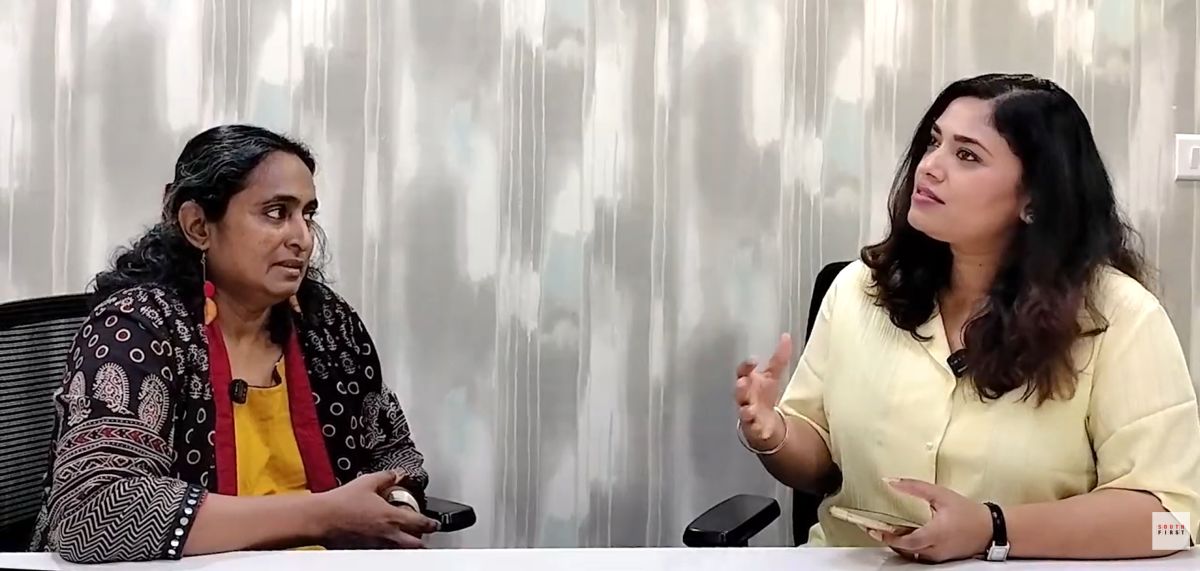
In her new book, De-democratisation — The Global Story, Indian author and feminist activist Kavita Krishnan explores the deeply problematic erosion of human rights and the weakening of democratic processes by authoritarian governments worldwide. In conversation with Anusha Ravi Sood, Editor, South First, Krishnan speaks about India’s role in global de-democratisation and why unconventional friendships and mutual inspiration between a “gallery of rogues” are changing the dynamics of the global order, where the big loser is human rights. Edited excerpts:
Q: Two things to ask you. How did this book come about? And please tell me about its timing.
A: Well, the book is actually a work of the past four years. So, in a sense, over the past four years, my book has been writing itself because what’s happening in the world and in India seems to confirm what I’m saying.
So, what I have been saying, what the book argues mainly, is that we are used to thinking about progressive society, especially about America and American imperialism, the West, as the worst threat to everything in the world. So, it’s West versus the Rest.
My argument is that we urgently need to get rid of that fallacy. It stands in the way of seeing the real problem: the West’s character is at stake.
So, you no longer have a West that is pretending to be democratic, and that is hypocritical and is using democracy as an excuse to violate others’ rights. You have in the West leaders like Donald Trump who are themselves openly leading the way in demolishing the idea of universal democratic rights.
And he is joined by Xi Jinping, by (Vladimir) Putin, and our country—the government of the day—which also has a similar vision of the world order: we don’t want a rights-based order. We want an order in which, if you’re powerful enough, you can do whatever you like in your sphere of influence, and others will not meddle with you.
So, human rights and all, no such considerations.
I think that’s a very urgent thing because it’s not just that these guys are doing this. The problem is that we people are being asked to cheer along, and in fact, we are being asked to lead a revolution to get rid of universal rights.
So, at that time, I think defending universal rights, the concept of it, should be of urgent priority, just like we are defending the Constitution in India.
Q: I’m very glad you spoke about how West versus the Rest was an idea that perhaps no longer exists because your book also explores this concept of whether the US really looks at Russia anymore as a rival, whether it is politically, economically, whether it looks at China as a potential economic rival. Those lines have pretty much been blurred because the interests lie elsewhere. The interests lie, if I could use the word, in authoritarian bulldozing of any other resource or any other resources, especially in vulnerable societies. I want to understand where India stands in the scheme of things because you referred to our existing government. Have we, as you see, actually made a very deliberate shift in our diplomacy, or is it just in tandem with the government of the day?
A: I think diplomacy in general—I think that we are in an era where the government, especially this particular government, assumes that your foreign policy should be dictated by pragmatism, by so-called national interest, and not by a moral position which India hopes to hold in the world.
That shift has been happening over a period.
But at this specific juncture, I think there is an additional element where I think China, in fact, has become a sort of model to which India aspires to be.
So, you have Mr Jaishankar, the External Affairs Minister, as well as even RSS chief Mohan Bhagwat, saying as much more than once that, look, China does what it likes and it doesn’t care what people say. India needs to be that way.
In fact, Mr Jaishankar has written a book, The India Way (The India Way: Strategies for an Uncertain World, HarperCollins), where he argues that the rights-based order post-1945, you know, India was not at the table then. That’s all Western stuff. And none of it should apply.
Just like China says, we don’t answer to any universal bodies and universal rights and UN human rights and whatnot. Likewise, India also should do the same.
But I think that in India also, we argue against that notion. We say the Constitution was built by people who also participated in the construction of the UN Charter and the UN Declaration of Human Rights.
India then was not yet an independent country. India’s freedom struggle sent representatives who argued against unlimited sovereignty.
See, they were asking for sovereignty. They wanted to be free, but they said people should be free, but no state should be so free that it is free to do whatever it likes with the rights of its individuals and its minorities.
And I think that that is what the government of the day here wants to reverse. And in that, it is looking at China, at Russia, at Trump as friends and as part of a joint project.
Q: And Israel? India’s friendship with Israel, much in contradiction to our long-standing foreign policy on Palestine, per se. Following up on the question that I asked, you mentioned how the writers of the Constitution had a particular ethos in mind when they codified what the moral conscience of this country should be. Are you insisting that we are not Vishwa Guru?
Also Read: Changing equations between nations.
A: See, the point is, those are terms which are essentially reduced to propaganda, right? What does it mean? When you say Vishwa Guru, it means you’re going to offer some moral conscience; that’s not what you’re doing.
So, you are openly saying to refugees, to asylum seekers, Rohingya asylum seekers, that we are going to pick you up and throw you out in the Bay of Bengal. You’re literally leaving people at sea.
And you are even picking up your own citizens on charges of being Bangladeshi and throwing them out into the wilderness.
So this is not the behaviour of anyone with a moral vision to offer the world.
But I think that that is the least of it. I think the problem is that you mentioned Israel, and that’s very useful because it is not just, you know, in India; progressive, sort of democratic people see the comparison between Israel and the BJP or the RSS.
They see the comparison between Trump and Mr Modi, and I think that is apparent.
What I argue here is that you are missing the comparison with China and Mr Putin, especially the fact that Israel has an extremely close relationship with China, which Mr. (Benjamin) Netanyahu has cultivated since 2018. Hence, it isn’t entirely dependent on America.
So, in a sense, it’s Israel that is wagging America’s tail and not the other way around in whatever they have been doing since 2023.
China has been absolutely important to Israel in holding up most of its crucial tactical and strategic infrastructure, as well as being among its top trading partners and providing cutting-edge surveillance technology at a low cost in the West Bank.
Q: It could also be true for the newfound camaraderie between the US and Pakistan. There, at least in recent months, we have seen that the US — not to say that it matters which country the US chooses to align itself closely with — but considering that India has always seen itself as diplomatically stronger in the region, increasingly, have we, do you believe that given the changing dynamics in the global order, are we losing that spot? Is India being isolated in the Global South, or is it just another addition to what you said, like Mr Jaishankar said, “We’ll do us”?
A: It’s not being isolated. I think, in fact, it is becoming part of a larger community of nations where those in power have a similar de-democratising vision.
Look at the recent BRICS conference. Well, Lula (Brazilian President Luiz Inácio Lula da Silva) was absent, who would have been the probable outlier there. Otherwise, it was a gallery of rogues, where everyone from Iran to Saudi Arabia, Russia, China, and India — I mean, all those who were there quite explicitly want the idea that no one should tell us (what we should do).
And when they say no one, they mean an imaginary West. But they all know that the West right now is not talking about human rights to them.
What they mean is that internally, their own citizens should not question them on human rights because human rights are a non-existent thing. It’s not universal, etc.
And I think that, you know, earlier you had the Taliban here. India’s vision is deliberately cultivating this.
Even on China — there are tensions at the border and so on, none of which it responds to. India has responded to them in the last few years.
But more important to me is that where China violates human rights, if India wanted to set itself up as a moral centre, it would say, “Look, we’re a democracy, China’s not.”
What it is doing is the opposite. In all international fora, it is supporting China against any human rights investigation into what it does to its Uyghur Muslim citizens, because they want to say that, “Well, the same way we don’t want any inquiry into what we are doing to our minorities.”
So, I feel, I find that discussion about these positions almost non-existent in geopolitical conversation.
Okay, it’s as though geopolitical commentaries in India tend to focus very much on India, and it also tends to be this sort of so-called realist framework.
But realism is, I think, an ideology which is now very far from reality. It is refusing to face that reality is changing, you know.
Q: When you say de-democratisation, I understand in the context of your book it may be completely different, but given whatever is happening in India, say with the SIR (Special Intensive Revision) process, with targeting of supposedly suspected migrants who turn out to be Indian citizens later, I’d like to understand what your take is on institutions actively allowing and accommodating or actively working towards de-democratisation in a country like ours.
A. Yeah, I think that that is very key to what is happening in the sense that, I mean, the latest is, of course, what we now know about the Election Commission and the situation in which even the West Bengal election was held in the SIR process.
But I think that for a long time now we’ve been seeing that the important institutions, you know, if you look at the judiciary, you look at the higher judiciary, you look at the Election Commission, and you look at even the separation of powers, the police as well as the legislature and Parliament. Parliament, in a sense, has been reduced to a cypher.
So, I think the institutions, instead of fighting this process, have fallen much faster, I think, than they have in other countries, too, possibly.
I think in America, too, they’re falling now. In the first Trump term, I think they stood up to things a little better, but this time, definitely, institutions there are not really standing up.
If you’re born a woman or a queer person or a minority in India or an oppressed caste person, you know how fragile your rights are.
They’re there on paper, but the judge, when you are brought up in front of them, may not respect them.
You go to the magistrate who is supposed to get you married under the Special Marriage Act; in case of inter-caste or inter-religion, he may not respect that; your school and college authorities certainly won’t respect that.
And so, you know how much you depend on the fact that your Constitution has already set universal human rights, democratic rights, as a moral aspiration.
So you can always tell any authority that you have the power to do wrong, but you are doing wrong by this measure.
And the measure is the Constitution, the UN Declaration of Human Rights, other conventions, etc.
The point is, where did those things come from? They didn’t come from the sky. They were not a gift from Western countries.
They were fought for. So many anti-racist, anti-colonial, feminist movements fought for them. And eventually in 1945, at a particular juncture, they became accepted as universal.
And I think that that is something we depend on.
If tomorrow that were not to be there, then what are we going to stand on to argue that women should be allowed to marry whosoever they like or not marry if you’re an adult?
You know, you have a government that is already bringing in, you know, under the name of Uniform Civil Code, they are already beginning to bring in laws which will prevent adult persons from living as they like, whether it’s in live-in relationships or queer relationships or marriage or whatever.
So, I think that, you know, the fragility of this is what is driving us in India today, and we should be, in fact- why should the government be a moral leader?
We should be the ones who actually have the moral courage not to polarise victims of, you know, injustice on geopolitical grounds.
Here, the ones who are victims of Israel and the US are going to be treated better. We will be nicer to them. We won’t be so nice to Ukrainians or to Uyghurs in China.
And this is not just a left problem. In India, I think the entire opposition suffers from this too.
Unfortunately, therefore, they don’t oppose the ruling party now, the BJP’s or the RSS’s closeness to these powers, because they also see it through the lens of realpolitik.
Q: So, “your oppressed is more oppressed than my oppressed” is a scenario that should not be acceptable to anybody.
A: Yes, absolutely.
Also Read: West Asia turmoil exposes fractures in India’s foreign policy strategy
Q: When you were talking, when you were answering this question, you spoke quite a bit about feminism, the movement, the movement of women taking charge, wanting to be counted, wanting to be included and heard is so important. Which drives me to a question because, over the last few years, as a feminist myself, every time I see somebody of, say, celebrity status who’s popular, go on public platforms and say, “Oh, I’m not a feminist,” I do not know how to respond to it. What do you want to say to women who have been given an opportunity, a platform, or have been beneficiaries of, say, decades of feminism, for them to come out and say, “I’m not a feminist”? What’s your first impression?
A: I think the question to ask them is: why do they feel compelled to say this? What exactly are they distancing themselves from, you know?
Somebody should ask, you know, follow-up questions. Like, who are the feminists you think you are distancing yourself from?
Please name them. Who are you talking about? Who are you exactly talking about, are you talking about Hansa Mehta, Akka Mahadevi, or the Buddhist nuns? Because feminism is many things, right?
So please tell us which feminist you are shying away from.
I think that would clarify things a lot. I always like to speak in specifics, not in abstractions.
And I feel that the minute you bring it down from an abstract feminism to a position: Are you there? Do you think that women are equal? They should have equal status, and they are not equal today. They’re not treated as equal.
So, I think those questions clarify things a lot.
Q: Suppose you’re wondering why she’s also so passionate about rights, because her activism started during her student days. Could you share a little about your days as a student leader and how student politics is different today?
A: I think student politics today is much, much harder.
I did not try to be active. I wanted to run away from being active because I felt that once I started, I would probably do nothing else, and I didn’t want to.
So, I tried very hard not to, and I was a very private person. I didn’t want a public life at all, in that sense. I found that very stressful.
But eventually, you know, it was the ’90s, and the rise of the Hindu right was a very big factor for me in my Bombay BA days and then in JNU, Delhi. I think the rights of women and their vision for women- their very violent vision for minorities and women was very much part of my feelings. I could see the connection.
So you can be called a ‘Dimaagi Naxal’; you can be called whatever.
But the thing is, even there, I think feminists are used to this.
Women, you know, every time you talk about rights, people used to say, “Oh, that’s a Western concept,” right? So feminism: Western concept, talking about rights: Western concept.
So we are more used to recognising this pattern now that it’s become mainstream.
But (you speak) of any kind of rights means they say, “From Soros, you are taking money from Soros, and that’s why you’re talking about your rights.”
You don’t need to do that, right?
And I think, therefore, that, you know, in today’s student activism, the kind of pressure there is on campuses comes directly from the state.
There is no place, no single, even a small campus, where if someone wants to do something tiny, you know, like hold a little talk, even if they want to call me for a chat with 20 people, they will not be able to do it because there will be so much pressure on them.
If they want to do something like just read a particular book, there is surveillance. You know, student activists and just ordinary students have become used to no victories, only losses. You have to survive losses.
So, which is why I think the CJP protests were very important because at least they gave, you know, they suddenly vindicated what students have been fighting for all these days by saying you’re not actually alone and so on.
You’re not just some tiny bunch of JNU or Jadavpur University or Delhi University or whatever students.
You know, there are so many other students all over the country, young people who feel like you do.
It was a very big and important thing to happen because I do hope that it strengthens young people who have had to be so courageous.
They shouldn’t be expected to do what they’ve had to do over the last 10 years or so.
Also Read: UN Security Council, an old club with members who don’t want to be questioned.
Q: You were talking about how you didn’t want to actually be in the public domain, not really in activism. But you were part of the CPI(ML) Liberation. What happened after your student days?
A: Yeah. No, I think I talk about that actually in my book in the introduction because I had to think about what happened.
I entered student politics, as I said, in the ’90s, early ’90s. And I entered it because I wanted to fight for democratic rights and so on.
I felt the AISA and the CPI(ML) were the place to do this because others were doing this, others who were feminists.
There were lots of women in the organisation when I joined JNU, and they were feminists and so, you know, we were part of that and then queer rights and so on.
I mean, no one was talking about it, but I could at least- there was space enough for me to fight it out inside the organisation and outside and all of that.
But I think what happened is that, why I left was also because I could see this, you know, it’s like watching that avalanche coming in Nepal and Tibet.
As you see it’s coming, this de-democratising tide, and people are sitting, you know, I felt that my party and others and other friends and all of that, they are sitting as though, “Oh, look how nice the weather is,” and the fight is something entirely different.
So, they are trying to fight, you know; they are trying to ignore the tsunami or even say the tsunami is a good thing because it’s going to, you know, throw away, it’s going to get rid of, wash away all kinds of useless bad things.
So, you’re talking about, you know, the so-called decline of the West in Gaza, in the light of Gaza, the decline of the moral. Pankaj Mishra said it in an interview sometime back, “Oh, this is the decline of, you know, the moral and economic weakness of the West is showing in Gaza and in Ukraine.”
Look, you know, Indians won’t support Ukraine because they won’t support sanctions on Russia because, you know, NATO, this, that.
Now the point is, you are doing the job of justifying; then the left is doing the job of amplifying all the de-democratising propaganda, none of which is true.
Why should Indians believe something false? Why should they think that Russia is justified in invading or that Ukraine should negotiate peace by giving Russia whatever it wants, you know?
So, I do think that the impulse for me in left politics began to strain when I realised that it wasn’t just that they were pro-Russia, pro-China. They were willing to criticise Russia, I was free to criticise China and its treatment to Uyghurs.
You were not supposed to say, “Look, these guys and Trump, look at them. They are not enemies. They are not poles, you know, you’re talking about polarity, multiple poles. They are not poles. They are now- I wish they were enemies, but they are not; they’re friends.”
Yes, they’re a nice bunch of friends on most things, and they are openly saying so.
So, to pretend that they are not, you know, screaming out their friendship is to ignore, I think, something that was too dangerous to ignore, and I could not possibly keep doing that.
Q: The last section of my interview with you, very quick thoughts, the first thing that comes to your mind.
Current political leader whose side you would put your weight behind.
A: Oh, definitely I would say Rahul Gandhi. Certainly. Because I think he’s a human being who can make mistakes and will be embarrassed if he does. And, yeah, who is comfortable with women, comfortable with young people.
And on the whole seems to lack the megalomania that nowadays we have come to associate with leadership.
So, I’d like a leader who is, in a sense, someone who considers themselves afraid of the public, in a sense, okay? So, respectful of the public and public protest.
Also Read: At Jantar Mantar, a generation that stopped being afraid
Q: A student leader who’s caught your imagination in recent years.
A: Student leaders, I think, I mean, in fact, I mean, of course, there are wonderful student activists. There’s Neha from JNU right now who’s been very important.
But to me, I think the real inspiration came from people who are not leaders.
Or, to put it another way, I think we are in a new generation where everyone can see themselves as a hero in their own story.
So, they’re not looking for heroes. So even Abhijeet Dipke isn’t a hero; Saurav Das isn’t a hero. Each one, each youngster with a reel, you know, the camera, how they are responding to a police officer with the lathi or tear gas. They are the centre of the story, and I do think that is what we need.
So, if Dipke’s tweet went viral when, you know, the cockroach remark was being made, I want hundreds of Dipkes, and I think that is what began happening.
Somebody sings a song about Bal Narendra that goes viral. Someone else says something, does something.
So, I feel that, you know, we are now in an age when you really can expect leadership not from just individuals who become famous, but from a whole generation.
So, I’m very hopeful about that.
Q: Last question, your appeal to the younger generation.
A: Oh, I’m just going to tell them that, look, I’m in awe of you, and I think that, you know, I’m very happy that young people want to feel angry, that they have the capacity.
So, all I would say is that I hope that they hold on to the capacity for just anger. An anger channelled into active civic participation.
And always in respect of dissent.
So, I think above all things I would say, be afraid of being in—if you think everyone’s agreeing with you, then maybe say stop and wonder whether someone who’s in a minority might have a point of view, no matter what majority that is.
Even if everyone’s thinking as Kavita Krishnan does, then Kavita Krishnan and/or XYZ must wait and stop and say, “Hmm, that can’t be right, you know? There must always be something to learn, new or to correct yourself.”
(Edited by Majnu Babu).



