
Published Dec 22, 2025 | 12:02 PM ⚊ Updated Dec 22, 2025 | 12:02 PM

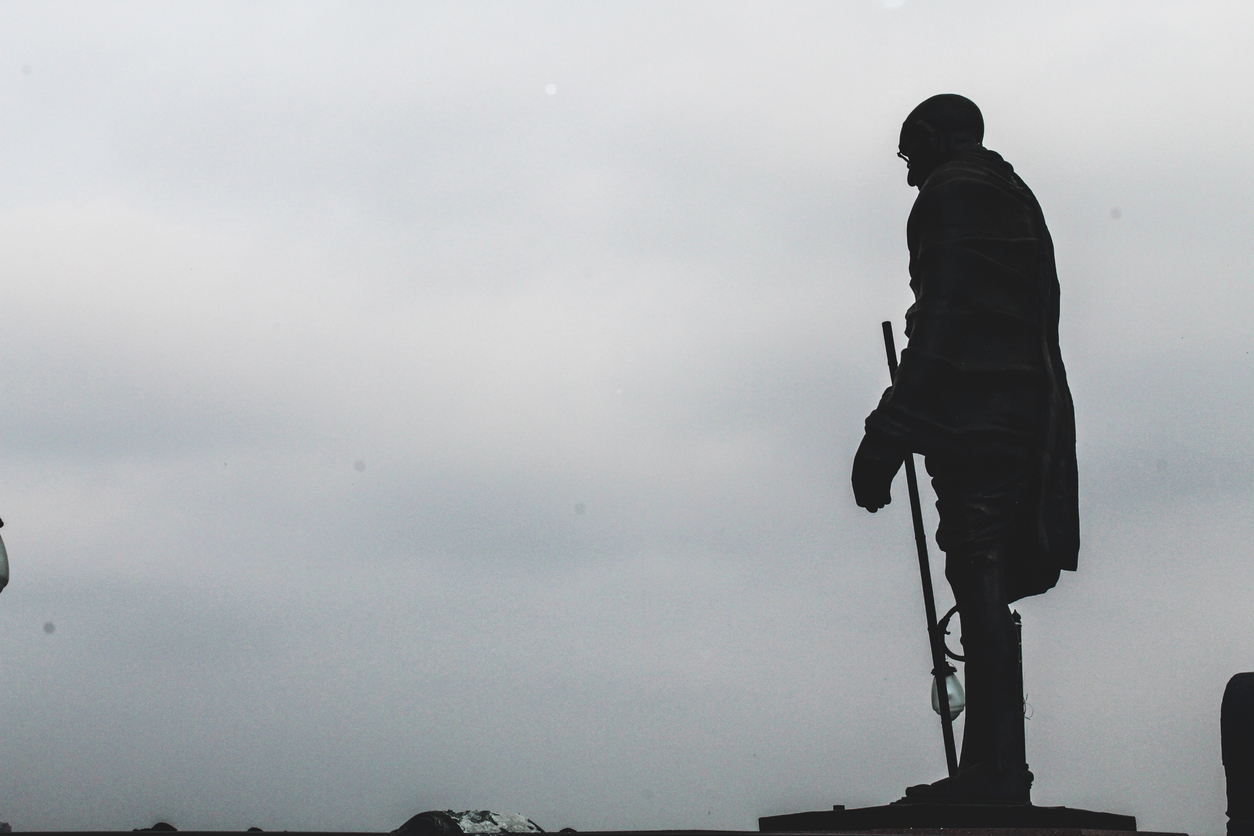
Mahatma Gandhi. (iStock)
Synopsis: The Union government replaced the Mahatma Gandhi NREGA with a new Act, VB GRAMG. It is essentially replacing Gandhi, a devout follower of Ram, with the right wing’s Ram of Ayodhya. With the Ram who once confronted mighty Ravana in the Treta Yuga, today’s Kali Yuga politicians are staging strange spectacles. They made him fight Babur. Now they are pitting him against Gandhi! They are turning him into a puppet for the game of votes!
When he was shot and was collapsing to the ground, Gandhi is said to have uttered “Hey Ram.” He was deeply devoted to Ram. In his bhajans, he prayed to Ram to grant wisdom to everyone, saying “Ishwar Allah Tere Naam.”
A song which Gandhi loved described a good Vaishnava who chants the name of Ram as one who empathises with others’ pain and helps.
Among the many Rams who live in Indian popular lore, Gandhi’s Ram was unique. He fashioned a Ram suited to the ideals of the national movement and to the needs of modern India. There is no doubt that Gandhi’s spirituality was political in nature.
Nathuram — who himself bore the name of Ram — was also a Ram devotee. Like him, there must have been many who hated Gandhi and believed his assassination was a duty. After such people grew stronger and became entrenched in positions of power, their intolerance extended even to the remnants of Gandhi.
They wished to erase Gandhi, who had sacrificed his life, and the disciples he had placed in power, from national symbols, and to install new icons instead.
Considering it a necessary emblem for cultural and religious nationalism, they constructed a valiant, heroic Ram. They “built” his birthplace. This Ram is not Gandhi’s Ram.
This is the Ram who is stepping into Gandhi’s place — the Ram of Ayodhya.
Prime Minister Narendra Modi’s own words serve as evidence. Almost erasing from memory the Indian national movement against the British, he declared at the temple inauguration ceremony that Ayodhya had drawn the curtain on a thousand years of subjugation and five hundred years of humiliation, and that this marked a new liberation.
He thus redefined the timelines of Indian freedom and the national movement.
Before Modi articulated this explicitly, his flatterers proclaimed that India became truly free only in 2014. While continuing their silent endorsement of the worship of Godse, the justifications offered for him, the persistent vilification of Nehru, and the topsy-turvy propaganda blaming the non-violent, non-Vedic Buddha for India’s enslavement, they had so far lacked the audacity to erase Gandhi from history.
Now even that has begun.
Removing Mahatma Gandhi’s name from the rural employment guarantee scheme and attaching “G Ram G” to it was not done casually, nor is it akin to merely renaming roads. Behind the renaming of a hugely popular, nationwide scheme that bore Gandhi’s name lies the resolve to topple a towering leader of the Indian national movement itself.
Even if the new name is merely a compressed set of initials derived from a long title, the sounding of “Ram Ji” in it is no coincidence.
Gandhi represented one kind of nationalism. This Ram represents a new nationalism. If Gandhi was the leader of the national movement that achieved victory in 1947, then for the “Viksit Bharat” journey, said to run from 2022 to 2047, Ram is the leader. New-age Bharatas, ruling in the name of Ram’s sandals, are the stage-managers of this era.
Since they find no universally accepted moral figure, either in their history or in the present, the proponents of “Viksit Bharat” feel compelled to take inspiration from a deity charged with intense emotions. Or is it that, after 40 years of painstakingly constructing a grand ideological passion brick by brick, they have concluded that nothing else can serve as a stronger driving force for their political and economic objectives?
Whatever the case, Mohandas Karamchand Gandhi — a Ram devotee himself — would never have imagined that one day a Ram would stand as his rival.
How pained he would have been to see a Ram for whom the situation arose where Gandhi’s name had to be pushed aside so that his own could take its place!
Union government leaders now argue: What does it matter if Gandhi’s name is absent, so long as his ideals are being fulfilled in the scheme? After all, the programme began in 2005, and Gandhi’s name was added only in 2009. If it were only an addition, why can deletion be wrong?
They ask innocently: Are we not increasing the number of workdays from 100 to 125? What, then, is the problem?
Yet the ideological and strategic objectives behind changing the name in its entirety, including the removal of Gandhi’s name, are evident. Nor has the government stopped there—it is also altering the very essence of the rural employment scheme.
When rural livelihoods, especially in rain-fed regions, began facing severe distress, governments experimented with a rural employment guarantee programme, starting with Maharashtra in the early 1980s.
Over time, several other initiatives, such as food-for-work, were introduced to prevent village conditions from slipping out of control.
Such schemes aimed to prevent mass migration from villages to cities and to enable rural families to survive somehow, even if precariously. Behind these efforts lay nothing more than a vision of temporary relief and welfare. They were not revolutionary, but they were like life-saving medicines.
In 2005, the UPA government enacted the NREGA (NREGA) law, guaranteeing at least 100 days of work per year as a right. That right was to be implemented within fifteen days of application. Transforming a welfare measure into a legal right was an extraordinary and unprecedented step.
Now, the bill passed in its place—the “VB–G Ram G Bill”—does not have this rights-based approach. It treats the scheme merely as a programme. Moreover, it imposes numerous restrictions on the provision of employment. It introduces a policy that employment guarantee work should not be provided during periods when agricultural work is underway.
What connection did Gandhi have with this rural employment guarantee? Did he ever recognise a right to work? Such doubts may arise. The “Viksit Bharat” journey of the Amrit Kaal extols citizens’ duties rather than rights. Gandhi too said that rights flow from the fulfilment of duties. But there is a profound difference between the two arguments.
Gandhi’s perspective was moral, grounded in justice and ethical discernment. However idealistic or however rooted in feudalism it might have been, Gandhi wanted villages to be self-sustaining. He said migration from villages should not occur. He declared that physical labour was everyone’s duty.
From mutual cooperation and village-based food security, he believed, all forms of security should emerge. He wanted everyone to have a share in village decision-making. He asserted that a guarantee of dignified livelihoods in villages should arise from the collective itself.
If Gandhi’s words are translated into the language of rights, that spirit stands very close to an employment guarantee.
Even after many decades of independence, the rural poor had to dig pits for their sustenance, and that is boasted as “development” — this is what the BJP commented on NREGA, even after 2014! But it could not abolish the scheme. On the contrary, it has now added another 25 days to the scheme.
Still, it never seems to ask itself why, even after 11 continuous years of its governance, providing work and food to rural people remains necessary.
Now, to implement the new name in place of the scheme that bore Gandhi’s name, changes must be made to existing stationery, signboards, and publicity material. This, it is said, will cost several hundred crores of rupees. From this, one can grasp how vast and massive the employment guarantee scheme truly is.
What can we do except express astonishment that Gandhi — whom we consider a leader of the national movement of such stature — no longer seems to belong to the present rulers?
With the Ram who once confronted mighty Ravana in the Treta Yuga, today’s Kali Yuga politicians are staging strange spectacles. They made him fight Babur. Now they are pitting him against Gandhi! They are turning him into a puppet for the game of votes!
Hey Ram!
(Views are personal. Edited by Muhammed Fazil.)


