

Published Jul 22, 2024 | 4:35 PM ⚊ Updated Jul 22, 2024 | 4:35 PM

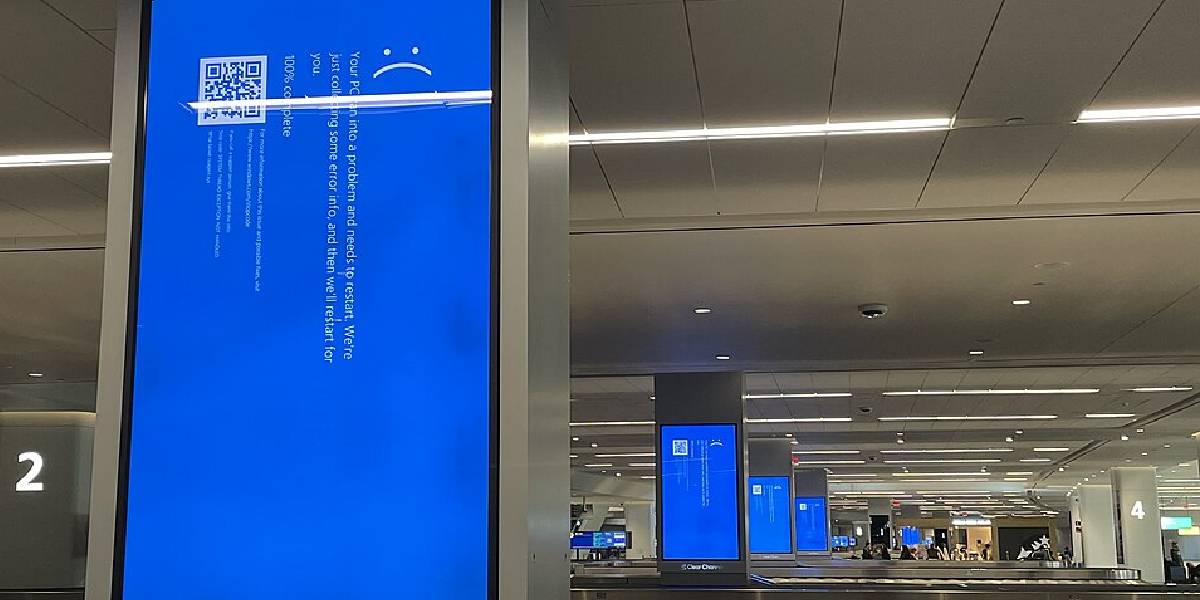
The update by CrowdStrike caused a segmentation fault, and led to a “Blue Screen of Death” on Windows boot-up. A scene from LaGuardia Airport, New York City. (Smishra1/Wikimedia Commons)

On the morning of Friday, 19 July, many users in Australia woke up to a weird error on their Windows devices, leaving them confused.
Little did they know it was the start of the biggest-ever tech outage globally. A few hours into the day, it was thought that the error was due to a cyberattack on Australian systems but it became slowly, but steadily, evident that it was a software glitch on Microsoft’s Windows systems and the culprit was CrowdStrike, which has now become a household name globally.
CrowdStrike is a US-based security company with 24,000 business customers that protects against cyberattacks by monitoring events at the system level (despite it sounding ironic at this point).
In simple terms, CrowdStrike provides anti-virus to Windows systems to keep the systems safe and secure. With this very urge, it rolled out a software update to enhance cybersecurity protection. And then this outage happened!
The software update released by CrowdStrike triggered OS (Operating System) updates for all systems worldwide that had updates enabled.
The update caused a segmentation fault (illegal memory access by a computer programme), and led to a “Blue Screen of Death” on Windows boot-up, which millions of users worldwide had seen.
It was learnt later that the problem was much worse than initially anticipated. The update also created a continuous boot loop resulting in systems getting fully stuck and unrecoverable.
Subsequently, CrowdStrike released a fix for this software bug and one hoped all the services affected worldwide would recover immediately.
But as described above, the boot loop meant that IT admins have to manually perform the recovery, requiring up to 15 attempts in some cases.
So, it’s wide and clear: The task is cut out for all those IT and system operations personnel — and it is going to be a long haul.
While all of this is taking time, it is important to understand the extent of impact this outage had on services across the world. From Australia to America, Asia to Africa, Europe, no one was spared.
The airline industry worldwide had to grapple with thousands of flights being grounded, passengers left stranded and not knowing where to go. Several banking and market services came to a grinding halt, leaving people panicked not knowing if their money is safe.
Healthcare services viz., hospitals, PHCs, pharmacies could not access patient records and provide medical care. In some countries like the UK, there was a huge spike in ambulance requests which can be correlated to unavailability of medical services.
Any and all services that rely on digital technology were impacted by the outage.
This entire episode from which the world is still recovering, presents an opportunity to start thinking about redundancies and plan for such scenarios in future.
The world is so fragile that a small piece of code written by a developer in Texas in the US could impact a small business in Telangana in a short time.
The redundancy planning can involve using services that are cloud agnostic, which means the service can easily switch between any cloud provider. Critical services should have strict gating criteria of accepting any updates from any kind of software and also phase out the updates to users.
The chaos also provides an opportunity for India to increase the breadth of its India-stack and start building systems that increase robustness of its tech space. While it is easy to say that we could go the China way, it is perhaps important to take a more inclusive approach, yet reducing reliance on such providers.
An important but perhaps lesser discussed aspect is that during the process of recovery, millions and millions of these systems will be prone to cybersecurity vulnerabilities and may have consequences that may not even been heard in the global noise.
Imagine a student’s machine getting compromised and losing his/her complete bank balance. Imagine a small business losing its
USP or trade secret. All of these and many more are among those CrowdStrike or Microsoft should take strict cognizance of and provide a transparent closure to instill confidence to consumers in digital technology.
(Sri Harsha Prem Kumar Guggilam is an IIT-Delhi alumnus with experience in MNCs, unicorns, and early-stage startups. Views are personal. Edited by Majnu Babu).
(South First is now on WhatsApp and Telegram)



