

Published Feb 02, 2026 | 5:38 PM ⚊ Updated Feb 02, 2026 | 5:38 PM

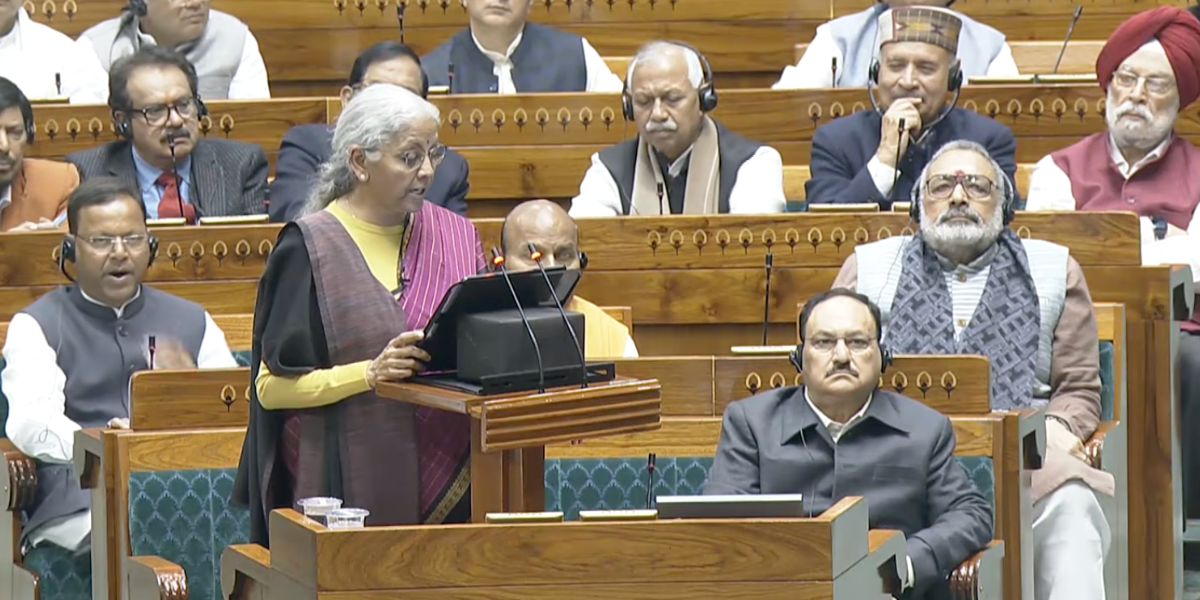
Finance Minister Nirmala Sitharaman presenting the Union Budget 2026.
Synopsis: Agriculture and the rural sector remain the highest priorities, receiving an allocation of ₹1,62,671 crore. The Budget proposes the Mahatma Gandhi Gram Swaraj Initiative to strengthen khadi, handloom and handicrafts by connecting them to global markets through branding and skill upgrades. This initiative aims to ensure that economic growth translates into village-based self-reliance.
In a historic ninth consecutive Budget speech, the Finance Minister highlighted the government’s kartavya (duty) of accelerating growth and fulfilling the aspirations of every citizen.
A significant portion of this vision is powered by the “Colour Economies”, a strategic framework targeting specific sectors from the blue of our oceans to the orange of our creative industries. The Blue Economy is a prime example, where India has consolidated itself as a global seafood supplier to over 130 countries.
Despite global trade hurdles, the recently concluded India–EU trade deal has opened new territories for marine exports. The Economic Survey 2025–26 highlights that fish production increased by more than 140 percent during 2014 to 2025 compared to the previous decade.
This Budget further bolsters marine trade by treating fish caught in the Exclusive Economic Zone by Indian vessels as duty-free, supported by the highest-ever budgetary allocation of ₹2,761.80 crore for the Department of Fisheries.
This includes the integrated development of 500 reservoirs and Amrit Sarovars to strengthen coastal value chains through women-led groups and startups.
Agriculture and the rural sector remain the highest priorities, receiving an allocation of ₹1,62,671 crore. The Budget proposes the Mahatma Gandhi Gram Swaraj Initiative to strengthen khadi, handloom and handicrafts by connecting them to global markets through branding and skill upgrades.
This initiative aims to ensure that economic growth translates into village-based self-reliance.
To diversify farm incomes, the government is promoting high-value crops such as coconut, cocoa and sandalwood in coastal regions, alongside nuts like walnuts and almonds in hilly areas.
By focusing on “asset-linked employment”, the government is transitioning the rural economy towards modern, technology-led farming and livestock management, ensuring that India’s development begins at its roots.
The SME and MSME sector, recognised as the engine of employment, received a monumental push with the announcement of a dedicated ₹10,000 crore SME Growth Fund. This fund is designed to create “champion” enterprises, complemented by a ₹2,000 crore top-up for the Self-Reliant India Fund to support micro businesses.
To solve liquidity issues, the Budget mandates the TReDS (Trade Receivables Discounting System) as the settlement platform for all MSME purchases by Central Public Sector Enterprises.
Furthermore, the introduction of “Corporate Mitras” in Tier 2 and Tier 3 towns will provide professional support to small businesses, helping them navigate regulatory requirements at an affordable cost.
This three-pronged approach of equity, liquidity and professional support is set to turn India into a global manufacturing hub.
Women-led development sits at the heart of this year’s social agenda.
The Budget increases the allocation for the Deendayal Antyodaya Yojana–National Rural Livelihoods Mission by 20 percent to ₹17,280 crore, targeting the economic empowerment of 100 million rural women. A standout proposal is the establishment of SHE-Marts (Self-Help Entrepreneur Marts), which are community-owned retail outlets designed to give women-led businesses a platform for their products.
To ensure that the next generation of women can pursue higher education and research safely, the government has committed to building a girls’ hostel in every district of the country.
This initiative specifically targets dropout rates and supports girls in STEM and scientific disciplines such as astrophysics and astronomy.
The creative, or Orange Economy, is another emerging pillar. India is now a top digital content producer, with segments such as animation and VFX generating approximately ₹103 billion in revenue.
To meet the demand for 2 million professionals by 2030, the Budget proposes the Indian Institute of Creative Technologies, which will establish AVGC labs in 15,000 schools and 500 colleges.
Similarly, the White Economy, or healthcare, is being propelled by the Biopharma SHAKTI initiative, with a ₹10,000 crore outlay to turn India into the world’s pharmacy.
The Budget also provides significant relief to citizens by exempting customs duty on 17 cancer drugs and seven rare disease medicines, while setting up five regional medical hubs to boost medical tourism.
Tourism and culture have been redefined as key sectors for employment and regional development.
The Budget proposes transforming 15 major archaeological sites, including Lothal and Sarnath, into immersive heritage destinations.
To promote eco-tourism, the government is developing world-class trekking trails in the Himalayas and the Western Ghats, turtle conservation trails along the coast, and bird-watching routes near Pulicat Lake.
A pilot project in collaboration with the IIMs will provide world-class training to 10,000 tour guides, ensuring that visitors receive a high-quality experience while local communities benefit from sustainable tourism.
Finally, the Green Economy and sustainability are addressed through the launch of Semiconductor Mission 2.0 and the SHANTI Act. Customs duty exemptions for nuclear power projects until 2035 and the reduction of duties on lithium-ion cell manufacturing components signal a clear shift towards an energy-driven, self-reliant future.
With 4,000 new e-buses for the North-East and the exclusion of biogas from excise duty, the government is building a greener future without compromising industrial growth.
Notably, many of these visionary proposals emerged from the Viksit Bharat Young Leaders Dialogue 2026, proving that the government is not just building a future for the youth, but shaping it with their direct input.
From farms to gaming centers and from oceans to high-tech semiconductor labs, Union Budget 2026–27 provides a comprehensive roadmap for India to become a $10 trillion economy by 2047.
(Dr Byreddy Shabari is the Member of the 18th Lok Sabha representing the Nandyal Constituency in Andhra Pradesh. She is also the deputy floor leader of TDP in Lok Sabha. Adarsh Kuniyillam is a parliamentary, policy and financial expert.)


