


Published Dec 26, 2025 | 1:58 PM ⚊ Updated Dec 26, 2025 | 1:58 PM

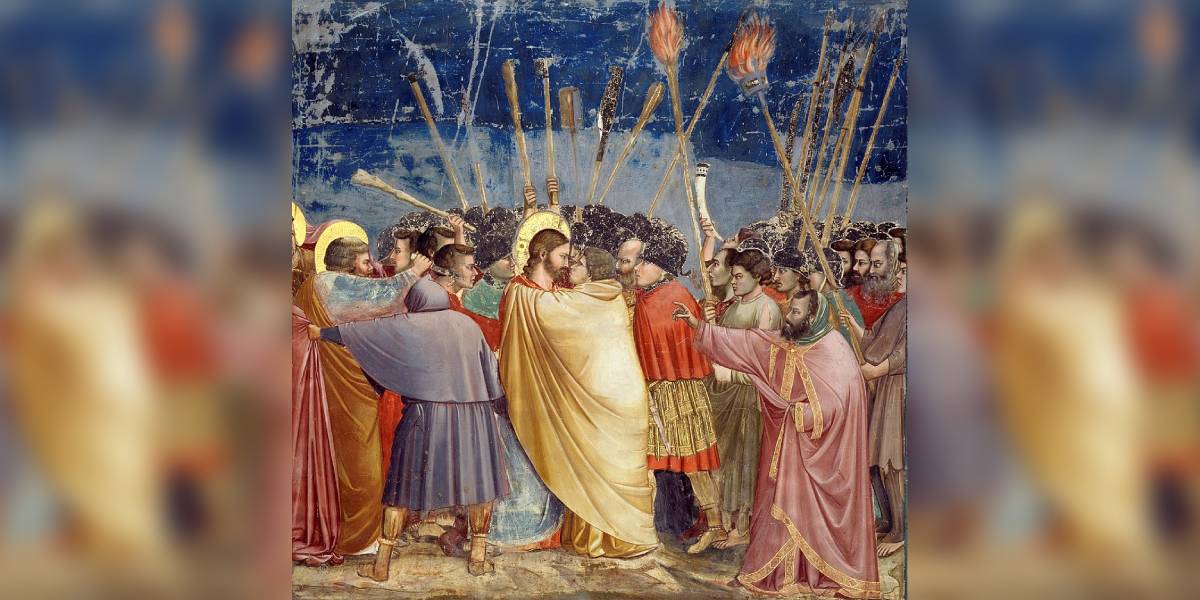
Even as the BJP is wooing Christians in Kerala, its leaders are maintaining a stoic silence on the attacks on the minority community elsewhere in India. Pictured, Italian painter-architect Giotto di Bondone's (1267-1337) 'Kiss of Judas, a fresco in the Scrovegni Chapel (Arena Chapel), in Padua, northern Italy. (Wikimedia Commons)
Synopsis: Political leaders in Kerala — from both LDF and UDF — have accused BJP leaders of hypocrisy and questioned their moral standing when they “celebrate Christmas in Kerala but ignore communal violence elsewhere.”
A spate of incidents affecting Christmas celebrations in different parts of the country has brought political focus on the BJP’s approach towards Christian communities, which conflicts with its outreach programmes in Kerala.
As reports of harassment of carol groups, intimidation near churches, and disruptions of prayer meetings emerged during the Christmas season, political attention has turned to whether the ruling party’s response has been consistent across regions.
Multiple news reports in December document a surge in anti-Christian attacks. The reports spoke of Sangh Parivar-linked vigilante groups disrupting church services and targeting Christmas decorations and celebrations in several states.
Church leaders, including bishops, publicly decried the violence and urged authorities to protect the believers. Opposition leaders accused the central government and home ministry of failing to safeguard minorities, and highlighted more than 1,500 documented anti-Christian attacks in 2024–25.
These recent attacks are part of a long-term trend of rising harassment and violence against Christians in India.
The attacks are not confined to recent years. It should be viewed from a historical perspective:
These events, and others documented by independent human-rights observers, illustrate that religiously motivated violence against Christians has a deep and painful history in India.
Amid this background, the BJP’s political approach toward Christian communities appears deeply contradictory:
Kerala, home to one of India’s largest Christian populations, has become a target of BJP outreach:
However, the electoral payoff has been mixed: recent local elections showed losses in several Christian-dominant wards, with party analysts attributing this partly to community opposition to anti-Christian incidents elsewhere in India.
While courting Christians in Kerala, some BJP leaders have been notably silent about violent attacks on Christians in other states:
This contrast — Kerala vs inaction on national violence — feeds accusations that the BJP deploys religious identity politics to extract electoral gain while tolerating or downplaying violence elsewhere.
Senior Congress leaders in Kerala have accused the BJP of deliberately pushing an anti-Muslim narrative to make electoral inroads among Christians in the state.
Leader of the Opposition VD Satheesan said the BJP was attempting to “repackage communal politics” by sowing mistrust between minorities instead of addressing real concerns of safety and constitutional rights.
“Christians are being told to see Muslims as the problem, while the same BJP remains silent when Christians are attacked in north Indian states,” he said, calling it a calculated strategy to fracture Kerala’s social harmony for votes.
Other Congress leaders echoed the charge, arguing that the BJP’s outreach to Christians is not about protection or inclusion, but about isolating communities politically and weakening Kerala’s long-standing tradition of interfaith solidarity for short-term electoral gain.
Opposition leaders have raised a direct question:
If the BJP’s Christian outreach is sincere, why is there no unequivocal condemnation when Christians are attacked in BJP-ruled states?
“The Prime Minister can send greetings and attend Christmas events, but what message goes out when attacks on Christians continue without accountability?” asked a senior Opposition leader, adding that symbolic gestures cannot substitute constitutional responsibility.
Another Opposition spokesperson remarked, “You cannot celebrate Christmas with one hand and look away when churches are attacked with the other.”
Church leaders and civil society have responded with increasing alarm:
At the same time, political leaders in Kerala from both LDF and UDF have accused BJP leaders of hypocrisy and questioned their moral standing when they “celebrate Christmas in Kerala but ignore communal violence elsewhere.”
The experience of Christians in India today stands at a crossroads of festive faith and political fracture. As Christmas 2025 unfolded, it exposed not just violence and intimidation, but also the contradictions in political engagement where symbolic outreach exists alongside a broader climate of communal tension.
The contrast between local bows and national silences raises urgent questions about India’s constitutional commitment to pluralism, equal citizenship, and the true meaning of secular democracy.
(Vijay Thottathil is a social media influencer and Indian National Congress worker. He is also President, INCAS-Dubai, Kozhikode District Committee. Views are personal. Edited by Majnu Babu).


