
Published Jun 15, 2026 | 7:00 AM ⚊ Updated Jun 15, 2026 | 7:00 AM

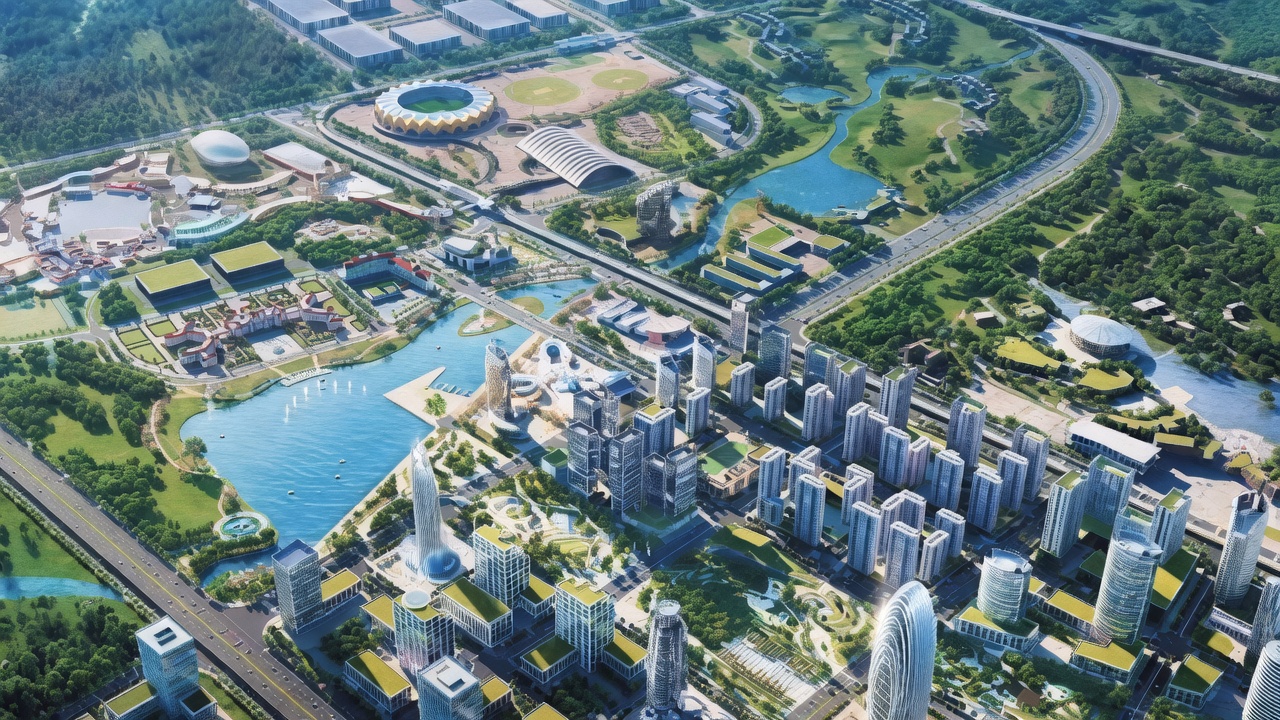
Artist's impression of Bharat Future City.

Synopsis: Bharat Future City is designed for companies. Companies, unlike people, do not make cities. Building a city in India is not an act of political will alone. It is a legal obstacle course that even the most enthusiastic bureaucracy cannot sprint through. The FCDA must obtain Environmental Clearance under the EIA Notification, 2006, a process that requires a detailed impact assessment, a public hearing in which displaced communities can register objections, and appraisal by a state expert committee.
On 10 June, 2026, the Telangana Chief Minister inaugurated the headquarters of the Future City Development Authority, declaring that Bharat Future City—30,000 acres south of Hyderabad, between the Srisailam and Nagarjuna Sagar highways—was the answer to every Indian’s desire for a modern, well-planned urban centre.
The announcement was made with the theatrical certainty that has characterised this project from the beginning. It deserves an equally direct response: this city, as currently conceived, has no soul. And without a soul, it will have no life.
The idea has four intellectual parents: Chief Minister Revanth Reddy’s personal career in land and real estate; the GIFT City model in Gujarat; the original Hi-Tech City in Madhapur; and the Hyderabad Pharma City, of which nearly 70 percent was eventually earmarked for non-industrial purposes. None of these is a reliable template.
GIFT City works narrowly because it has a dedicated financial services regulator and Gujarat’s industrial ecosystem behind it.
Hi-Tech City worked because it rode a historic wave of software outsourcing that India no longer monopolises. The Pharma City is, by the government’s own choices, not quite a pharma city. What Future City inherits from all three is not the conditions for their success, but the political grammar of their announcement: the authority, the consultant, the design brief, the investor summit, the MOU stack.
The project’s geography is itself opaque. The FCDA’s jurisdiction spans 765 square kilometres—approximately 1.89 lakh acres—an area larger than the existing GHMC city. Yet the project is marketed as a 30,000-acre city. What is the legal and land-use status of the remaining 1.6 lakh acres? There is no published answer.
More troublingly, the government’s own statements confirm that 15,000 acres within the FCDA zone consist of existing forest land, which promotional material has rebranded as ‘green fingers’ and an eco-tourism zone. Reserved forests are legally protected under the Forest Conservation Act, 1980, and the Indian Forest Act, 1927. Any diversion for non-forest purposes requires prior Central Government approval.
A Net Zero city cannot count pre-existing reserved forests as its ecological credentials while simultaneously treating them as developable land. The master plan covering this entire zone will not be finalised until December 2026, six months after the June groundbreaking. Permissions are being issued before the plan exists.
Also Read: Two sisters died in Hyderabad. Local media blamed mangoes. A second FIR complicated the story
Bharat Future City is designed for companies. Companies, unlike people, do not make cities.
Building a city in India is not an act of political will alone. It is a legal obstacle course that even the most enthusiastic bureaucracy cannot sprint through. The FCDA must obtain Environmental Clearance under the EIA Notification, 2006, a process that requires a detailed impact assessment, a public hearing in which displaced communities can register objections, and appraisal by a state expert committee.
No construction can legally begin before this clearance is granted. The Right to Fair Compensation and Transparency in Land Acquisition, Rehabilitation and Resettlement Act, 2013 mandates a Social Impact Assessment, consent from at least 70 percent of affected families, and credible rehabilitation plans before a single acre is acquired. There is no published SIA. There is no rehabilitation plan in the public domain.
The POSCO steel project in Odisha, after years of resistance, litigation and NGT intervention, collapsed entirely when the company withdrew, citing precisely this tangle of unresolved legal obligations. That precedent is not a distant warning. It is a mirror.
The pollution laws are equally unsparing. Pharmaceutical manufacturing, data centres and textile clusters, all proposed anchors of Future City, require Consent to Establish and Consent to Operate from the Telangana Pollution Control Board. Each unit must obtain these individually. The city’s projected industrial effluent load requires Common Effluent Treatment Plants of enormous capacity.
On land priced at ₹300 crore per acre, the arithmetic of allocating space and capital for ETPs, substations, transformers and sewage systems is simply incoherent. The Net Zero designation does not resolve this. Net Zero is an accounting device. It permits the generation of enormous pollution provided it is offset elsewhere. It is marketing language dressed as environmental policy.
A pharma cluster does not become clean because a consultant’s report says it is net zero at the city level.
The FCDA is not the only authority involved, and this is precisely the problem. It must coordinate with HMDA, the Pollution Control Board, the state discoms, the Revenue Department, the Roads and Buildings Department, the Ground Water Department and the National Highways Authority, each operating on its own calendar and under its own political pressures.
The bureaucracy that produced the Hyderabad Master Plan, a document whose GPS coordinates have famously diverged from ground realities across large stretches of the city, is the same bureaucracy that will produce the Future City zonal plans. A new authority with a newer logo does not cure that institutional pathology. At best, zonal plans will be stricter and broader in terms of plot size requirements, which is another way of saying more expensive and more exclusionary.
A proposal that has recently emerged makes the project’s fragility explicit: a ‘Sale Deed Indemnity Policy’ under which global investors would receive registered sale deeds with clauses indemnifying them against losses arising from future government actions.
Officials say the measure will give investors confidence in policy continuity. Read plainly, it is an admission that the government itself believes a future political dispensation might cancel or reverse Future City.
The irony is pointed: the Congress government came to power partly by opposing BRS-era land acquisitions and is now seeking legal instruments to prevent its own successor from doing the same to its flagship project. An indemnity policy is not a guarantee of institutional strength. It is political fragility dressed in legal language.
Also Read: ‘Modi government failed to protect the lives of Indian sailors’: Hyderabad MP Asaduddin Owaisi
The Fortune 500 premise itself does not withstand scrutiny. Today’s large technology and life sciences companies are capital-light, AI-heavy and rapidly reducing headcounts. A major Global Capability Centre in 2026 might house 2,000 employees where it once employed 10,000. These companies do not build colonies for their workers. They do not guarantee long tenures.
After 5 pm, who is in this city? The employees who can afford neither to live in it nor to commute from what remains of the displaced villages. The service workers—sanitation staff, canteen workers and security personnel—certainly cannot afford land priced at ₹300 crore per acre in any form. They will ring the city in informal settlements, as they ring every formally planned project in India.
This is not a flaw in the design. It is the design’s inevitable consequence.
The communities bearing the immediate cost are the populations of more than 50 villages across seven mandals—farmers, labourers and small traders—whose land is being acquired to build a city they will not be able to live in or work within. Their agricultural land, which sequesters carbon, recharges aquifers and produces food, will be replaced by a project marketed as net zero.
The Human Development Index of these communities will fall sharply and durably unless a genuinely credible rehabilitation plan is designed, funded and enforced. There is no evidence of this yet.
Islamabad was built without a soul. So was Chandigarh. People migrate to Mumbai, Hyderabad and Bengaluru – cities that breathed into existence through the density of human need, not the ambition of a development authority.
Cities are made by people. By markets that grew because traders needed them. By neighbourhoods that formed because workers needed proximity. By cultural institutions that emerged because people had the density and the time to sustain them.
Bengaluru attracts the retired and the ambitious not because a master plan mandated it, but because 80 years of organic accumulation produced hospitals, universities, restaurants and a particular quality of life. No consultant hired to attract Fortune 500 companies can produce this. No zonal plan can mandate it.
The question is not whether Hyderabad needs planned expansion. It does. The south of the city has genuine connectivity advantages and available land. These are real assets. The question is whether the brief should begin with companies or with people – with investment targets or with livelihoods, with land values or with human development.
A genuine future city would begin with a Social Impact Assessment and a published rehabilitation plan. It would integrate ETPs, substations and affordable housing into the land-cost model from the start, not treat them as peripheral problems. It would ask what an employee earning ₹40,000 a month does after 5 pm, and where she retires for the night.
Until those questions are answered honestly and publicly, Bharat Future City remains what it currently is: a well-branded real estate project backed by state power, marketed to investors and built on the livelihoods of communities whose futures are not yet part of any plan that has been shown to the public.



