

Published Mar 20, 2026 | 8:00 AM ⚊ Updated Mar 20, 2026 | 8:18 AM

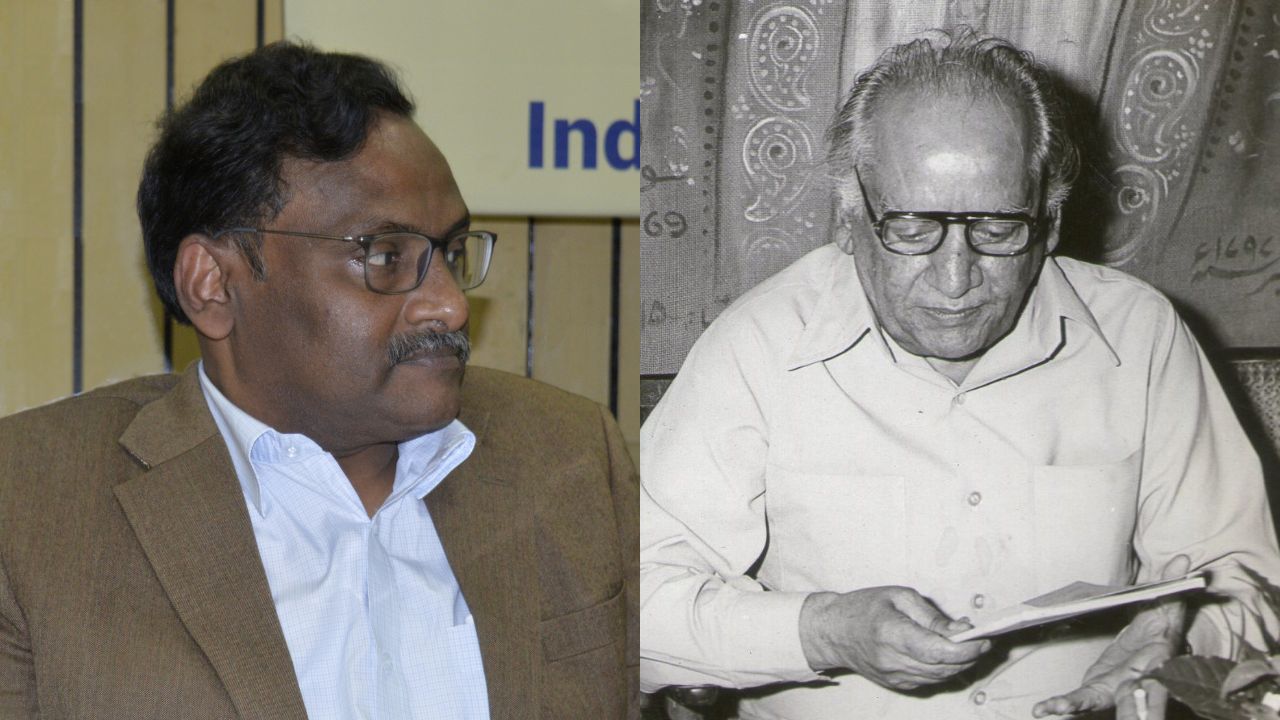
It is not incidental that Saibaba chose to translate Faiz; there are many similarities between their life journeys.
Synopsis: Having lived in different eras, both Faiz and Saibaba are profoundly contemporary. I heard Faiz prominently in university protests against the oppressive state apparatus, when we all sang together ‘Bol ke lab azaad hain tere (speak, for your lips are free)’. ‘Hum Dekhenge’ became an anthem of hope and defiance during the CAA-NRC protests. It is in the same university settings that I learnt about the work of Saibaba, who often repeated that none of us are free until all of us are free.
GN Saibaba’s Telugu translation of Faiz Ahmed Faiz’s poetry was published by Horu Publishers in 2025. While there have been previous translations of Faiz in Telugu, this one sets up an important conversation between two revolutionaries.
The intimate dialogue between Faiz and Saibaba shows a mirror to the oppressive state and voices the cries of the disenfranchised.
It is not incidental that Saibaba chose to translate Faiz; there are many similarities between their life journeys. Both were English professors. Faiz was part of the Progressive Writers’ Association, while Saibaba was part of the Revolutionary Writers’ Movement (Virasam – Viplava Rachayitala Sangham).
Both were tormented ruthlessly by the state. Faiz was named in the false Rawalpindi conspiracy case against then Prime Minister Liaqat Ali Khan in 1951 and was hounded and imprisoned many times throughout his life for his beliefs. Saibaba was arrested for the first time in 2014 for alleged Maoist links and spent many years in prison, which led to the deterioration of his health and eventual death.
Faiz belonged to the people. Faiz’s biographer Ali Madeeh Hashmi recalls that he was ‘humara Faiz (our Faiz)’ even to his foes. Saibaba lived for the people and continues to be an inspiration to them. The thousands who gathered to pay their last respects to him are a testament to the lives he touched.
Having lived in different eras, both Faiz and Saibaba are profoundly contemporary. I heard Faiz prominently in university protests against the oppressive state apparatus, when we all sang together ‘Bol ke lab azaad hain tere (speak, for your lips are free)’. ‘Hum Dekhenge’ became an anthem of hope and defiance during the CAA-NRC protests. It is in the same university settings that I learnt about the work of Saibaba, who often repeated that none of us are free until all of us are free.
When I first heard Saibaba at a public meeting in Hyderabad in 2016, he narrated with a beaming smile the humiliation his 90 percent disabled body was subjected to in the infamous Anda Cell by the inhuman state.
He told us we should worry about the many nameless, faceless Adivasi and Dalit youth who are unlawfully imprisoned in jails across India, who do not get representation in courts, and whose lives are spent in confinement for no fault of theirs. He was perhaps translating Faiz at that time.
Karl Marx, in his theses on Ludwig Feuerbach, noted: ‘The philosophers have only interpreted the world, in various ways; the point, however, is to change it.’ Poets like Faiz and Saibaba reoriented poetry towards changing the world.
It is this spirit that is reflected in Faiz’s poetry when he wrote ‘Mujhse pehli si mohabbat mere mehboob na maang,’ suggesting that there are many other worries and sorrows beyond that of the beloved. It is this spirit of love towards the world that Saibaba translates delicately into Telugu. This is perhaps possible because of the ideological synergy between the poet and the translator.
This synergy is also visible in their immersion in Sufi love. Faiz’s poetry is known for its use of Sufi metaphors, now oriented towards socialism. This is perhaps why some scholars have called him a socialist Sufi.
Sufism brought the language of universal principles of love, equality and justice to the Indian subcontinent, deeply divided by oppressive caste, class and religious structures. It is in this spirit that Sufism is close to socialism; it brings in the language of love in place of ritual and dogma.
Saibaba’s earlier translation was of Kabir. In his own poetry, he often refers to Kabir’s expansive idea of love. In Saibaba’s poem ‘My heart is coloured with the colour of love,’ he writes:
Kabir says,
I’ve shed all the inherited
dogmas and frailties, and
my heart is coloured with
the colour of love.
Saibaba’s introduces the readers to Faiz through a careful curation of poems which reflect Faiz’s life and his many preoccupations. Through the translation Saibaba was also responding to both Faiz, his life, and poetry, and his own contemporary social conditions. Saibaba’s earlier work indicates that he was always in conversation with Faiz, even before he translated him. Few lines from his poem ‘The Ocean of His Voice…’
The feisty poet walks up and down
Measuring the adjacent yard of gallows
As Faiz did five decades ago.
Faiz was thus a fellow traveller, an inspiration and a metaphor for Saibaba. In order to meet Faiz in his own language, Saibaba learnt Urdu from a fellow prisoner. His translation is generously sprinkled with notes in which he provides the context of each poem and explains his choice of words.
Both Faiz and Saibaba’s understanding of love was not limited by restrictive definitions. They were universal citizens; their hearts responded to oppressed people across the world. It was love that was revolutionary, love not chained by caste, class and gender. The true mark of revolution was the ability to love freely.
Faiz wrote on Palestine:
‘Teri ada ne kiya ek filistin barbaad
Mere zakhmo ne kiye kitne filistin abaad
(Your oppression destroyed on Palestine
My wounds prospered how many Palestines)’
Saibaba writes in his poem ‘Bombs go astray’
The child may be from Palestine or Pakistan
The warzone child has no luxury
to weep and wail unlike you and I who are
armed with Gandhian peace and nonviolence
or with Martin Luther King’s kind words.
Air strikes
strike in hundreds or thousands
even as you and I sip from our cups
of peace sitting across
the coffee table or sleep
in our restless cosy pillows
It is perhaps this love that the state feared the most, and sought desperately to suppress. But Saibaba anticipated this and wrote:
The sad thing is that
They don’t know how to make me die
Because, I love so much
The sounds of growing grass.
With the rise of fascism, as innocent people are being torn down by jingoism and war, both at home and abroad, it is perhaps a good time to listen to Faiz and Saibaba, and to stand against power, towards a universal idea of love.


