


Published Dec 04, 2025 | 9:00 AM ⚊ Updated Dec 04, 2025 | 9:00 AM

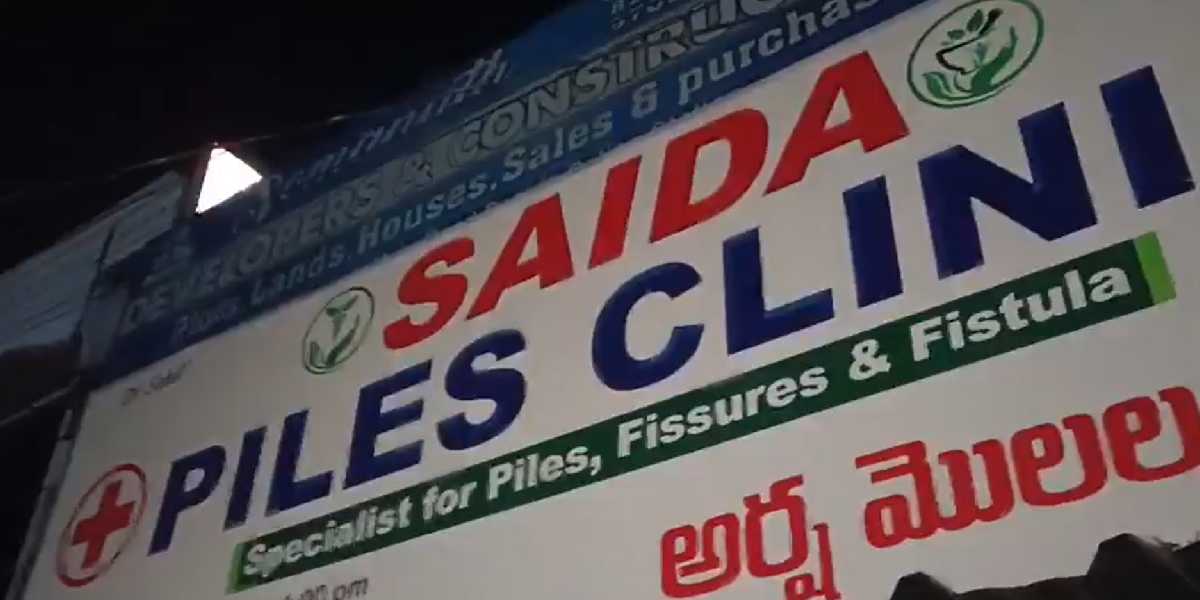
The 'clinic' where Chemma Ravi Teja underwent the procedure, which led to his death.
Synopsis: India has one of the highest rates of piles globally. Around 11% of the population suffers from the condition nationally, with even higher rates in some urban areas. However, people don’t understand the problem, and they don’t understand the complications.
Those travelling by train wouldn’t have missed the graffiti. As the train pulls into a town, long stretches of dusty, sun-kissed walls running along the railway tracks bear announcements of ‘sure cures’ for certain specific ailments.
One such painted announcement is, “PILES • FISTULA • FISSURE — TREATMENT WITHOUT SURGERY.”
The wall-painter has ensured that the announcement is noticed. The ailment is mentioned in red paint, once bright, but now fading after a futile struggle with the elements of nature.
The contact phone number — or numbers — are repeated, at least three times, so that at least one number will be visible even when it rains.
On such walls, treatment for piles, fistula and fissure, jostle for space with others offering cure for kidney stone, sexual problems, back pain cure, and many more.
Chemma Ravi Teja noticed those promises. He was 17, preparing for his intermediate exams. His mother, Padma, sold fruit in Mallapur, on the outskirts of Hyderabad, to earn a living.
On 11 November, she counted ₹7,000 and handed it over to a man who introduced himself as Dr Sahil at Saida Piles Clinic in Hayathnagar. The man’s wife stood beside him. Together, they performed surgery on the boy.
The family stayed overnight in the clinic. The next morning, they returned home.
The following day, Ravi Teja began bleeding heavily. Padma brought him back to the clinic. She continued bringing him there every morning for treatment.
Padma recalled that the bleeding started immediately. “Since my son was bleeding heavily, I took him to the hospital again the next day,” she stated in her complaint filed on 23 November at Hayathnagar police station.
Police investigation later revealed that wounds from the surgery remained open, leading to heavy bleeding. The boy went into shock due to blood loss.
On 21 November, a fever set in. The clinic referred him to Sri Multi Speciality Hospital in Chaitanyapuri. That night, the staff transferred him to Rush Care Hospital in LB Nagar.
At 5 pm on 22 November, doctors informed the family that his condition had turned critical. They advised shifting him to a larger facility. The family took him to Nizam’s Institute of Medical Sciences.
It was too late. Doctors declared him dead on arrival.
“When we took him to the hospital, the doctor there examined my son and confirmed that he had already died,” she wrote.
Duty doctors attributed the death to excessive external bleeding and related complications.
Police registered a case under Section 106 (causing death by negligence) of the Bharatiya Nyaya Sanhita, based on Padma’s complaint against Sahil and his wife. Both are absconding.
This marks the second such incident in Telangana this month. In Narsampet, Warangal, a 29-year-old man’s condition turned critical after undergoing piles surgery at a private facility.
Police investigation revealed that two unqualified individuals performed the procedure. The man, however, was fortunate. He survived after immediate transfer to MGM Hospital.
India has one of the highest rates of piles globally. Around 11% of the population suffers from the condition nationally, with even higher rates in some urban areas.
The condition affects both men and women, but men seek treatment more commonly, often because social stigma prevents women from seeking care openly.
Most people use one word for any anal region problem. “Any problem in the anal region — pain, swelling, bleeding — people commonly refer to it with one word: ‘piles’,” Dr KS Somasekhar Rao, Senior Consultant Gastroenterologist at Yashoda Hospitals, Hitec City, told South First.
But multiple conditions exist in the perianal region, and not everything is piles, he explained.
Haemorrhoids and piles mean the same thing. Haemorrhoids is the medical term, while piles is what people say in everyday language, Dr Somasekhar said.
However, an anal fissure is a tear that causes severe pain. A fistula is an abnormal tract that forms from the rectum, through the buttock muscles, to the skin around the anus.
“It can cause pus discharge and intense pain,” he said. Patients mistake all of these for piles because the symptoms occur in the same area.
Piles are swollen blood vessels in the anal region. Everyone has blood vessels that form a cushion inside the anal canal. “When people strain excessively while passing stool, these vessels swell,” Dr Somasekhar explained. These swollen vessels are called piles or haemorrhoids.
The swelling can gradually increase depending on how long a person strains and genetic factors. Doctors grade haemorrhoids from 1 to 4 when they examine patients. Grade 1 and grade 2 can be treated medically, Dr Somasekhar said.
Doctors advise patients not to strain while passing stool. When the pressure reduces, the swollen vessels can return to normal.
Dr V Naresh Kumar, General Surgeon and member of the Telangana Medical Council, explained the treatment approach. Patients first go to qualified doctors who are MS general surgeons or MBBS doctors.
After examination, doctors conclude whether it is haemorrhoids, a fissure, or a fistula. “Depending on that, we decide treatment,” Dr Naresh told South First. Not all haemorrhoids need surgery.
External haemorrhoids often need surgery. Internal haemorrhoids have four grades. Grade 1 and grade 2 usually don’t require surgery, Dr Naresh explained.
“Around 75% of patients improve with medication alone. Only about 25% need surgery, and even that is usually a laser procedure,” he said. Grade 3 and grade 4 definitely require surgery.
Haemorrhoids progress to grade 3 or grade 4 when they cause symptoms like frequent bleeding. That is when surgical treatment may be required, Dr Somasekhar said.
Internal haemorrhoids can also prolapse, meaning they become large and come out of the anal opening. External haemorrhoids can be felt as a swelling. “Repeated prolapse can lead to clotting inside the vessel, which is called thrombosis,” he said.
Haemorrhoids are normally painless, and even the bleeding does not hurt. “Pain occurs only when they prolapse or undergo thrombosis,” Dr Somasekhar said.
Posters claiming treatment without surgery appear everywhere.
“Most people — anyone, really — prefer to avoid surgery on their body,” Dr Naresh said. Even if someone had a small pus discharge, their first instinct would be to try conservative treatment before taking an injection. That is the general human mindset, he explained.
People don’t want injections, and they certainly want to avoid surgery. These piles ‘specialists’ exploit that belief to attract people’s attention.
People approach these unqualified practitioners to avoid surgery. They claim they can treat piles without surgery or without blades.
“But what they actually do is inject or pull the pile mass and tie a knot around it,” Dr Naresh said. If the knot is perfectly tied, the mass may shrink. If not, it will bleed. It is a painful, unscientific method, and the condition often recurs, he explained.
The Telangana Medical Council took suo motu action and sent a vigilance team to investigate. The council plans to file charges under the National Medical Commission Act, the Telangana Medical Practitioners Registration Act, and sections 318 and 319 of the BNS.
These practitioners are completely untrained. In earlier days, villages had nai-brahmins or manthrakaranis who used to conduct deliveries behind a curtain. Some of them even continued this in small towns and cities.
“These current ‘piles practitioners’ learn in a similar way — not from doctors, but by watching someone else do it,” Dr Naresh said. They just observe and then start doing the procedures themselves. They have no qualifications.
A few BAMS doctors also do these procedures. But if they are scientifically trained, they at least follow proper methods, Dr Naresh explained.
In other cases, they don’t have any setup or permissions. They don’t have qualified staff. “It’s usually just a room in a house. No operation theatre, no sterilisation techniques,” Dr Naresh said.
They charge ₹2,000, ₹5,000, and even ₹6,000 because their overheads are zero. They advertise on local boards and walls, at street corners. That is how they attract people.
The vigilance team has already gone to the centre twice. It was closed both times.
“We are filing a case once the centre is reopened and we get full information about who was running it and their background,” Dr Naresh said. According to the Ayurvedic council norms, only MS (Ayurveda Shalya Tantra) surgeons are allowed to perform such procedures.
TGMC vice chairman Dr G Srinivas said that piles surgery must only be performed by a general surgeon. Unqualified practitioners use unapproved chemicals or herbal concoctions to burn or shrink piles. These agents can cause severe chemical burns, excessive bleeding, infection and complications such as fistula or abscess formation.
Burning piles without proper medical knowledge or aseptic conditions is a reported practice. It results in open wounds, heavy bleeding and life-threatening blood loss, Dr Srinivas said.
Quacks usually fall into two types: some give injections like diclofenac, gentamicin, and steroids like dexamethasone. And then, some perform surgeries for piles, fissure, and fistula.
In piles and fistula cases, they use completely unscientific methods. They apply jellies, give random injections, or insert threads inside fistulas and haemorrhoids.
“Because of these methods, patients often develop anal incontinence, severe bleeding, and serious infections in the perianal region,” Dr Naresh said. Sometimes it even leads to sepsis and kidney failure.
The council has seen two major cases recently, one in Khammam and another in Warangal. Many cases don’t reach the medical council. When complications happen, people quietly go to a local private hospital. Because it involves a private part, they don’t tell anyone. “Not even their spouse or parents. They suffer silently,” Dr Naresh said.
Some develop severe infections. Some develop anal canal stenosis because tissue is removed in an unscientific way. The opening narrows, and even passing stool becomes difficult. “Many patients go into depression. A few even end their lives because they feel unable to share their condition with anyone,” Dr Naresh said.
This is quite prevalent. “When we go on quackery inspections, we often find such places operating,” he said.
The answer is simple: lack of awareness. People don’t understand the problem, and they don’t understand the complications, Dr Somasekhar said. Even today, in so-called developed countries where medical knowledge is high, more patients with jaundice go to quacks than to a gastroenterologist or hepatologist.
“Jaundice is a liver disease, but people don’t know that. That is pure lack of awareness,” he said.
India does not have awareness about health. There is also no awareness about the complications that can happen when people go to quacks. And then, there is fear, Dr Somasekhar explained.
“Fear that going to a hospital will be expensive. In reality, consultation charges are not high. But people assume hospital care equals high cost. They think, ‘this guy has been doing it for years, so I can manage with him,'” he said.
The most important and dangerous complication is infection. Doctors are dealing with blood vessels. If there is an infection in that region, it can directly enter the bloodstream.
“All the blood vessels in the body are connected,” Dr Somasekhar said. So if an untrained person tampers with these vessels and infection sets in, it can spread rapidly. For someone with weak immunity, it can become a life-threatening infection. Some may even die.
Not everyone will experience severe complications, but the risk is real. Another problem is excessive bleeding after their procedures.
“A qualified doctor knows how to manage such bleeding. A quack cannot answer even basic questions about what to do next — because they are not trained,” Dr Somasekhar said.
People feel embarrassed and ignore the condition. But grade 1 and grade 2 can be managed medically. Grade 3 and grade 4 are progressive problems. They require surgical management. “So it is not okay to leave it untreated at an early stage,” Dr Somasekhar said.
People must understand that this is a common condition. It is medically manageable if they see a doctor. “The problem is that everyone around them dismisses it as ‘normal,’ and everyone behaves like a doctor,” Dr Somasekhar said. The same thing is happening with fatty liver as well.
Advertisements for piles treatments displayed on walls violate advertising regulations in India when done without authorisation.
Such wall advertisements often make exaggerated health claims and may breach the Drugs & Magic Remedies (DMR) Act and the Drugs & Cosmetics Rules, which regulate medical advertisements. Several piles treatment ads claiming permanent cure through injection or surgery have been flagged by the Advertising Standards Council of India (ASCI) as misleading and illegal.
Local municipal laws prohibit unauthorised posters or advertisements on public walls and properties to prevent defacement and maintain public order. Unauthorised pasting of such ads can result in fines and removal drives by municipal authorities.
The walls still scream their promises. The train still slows down. People still count their money and hand it over. And somewhere, another family waits in a room, named a clinic, hoping the bleeding stops.
(Edited by Majnu Babu).


