


As per the policy, a company will get three years to set up manufacturing facilities in India, and start commercial production of e-vehicles.

Published May 17, 2024 | 9:36 PM ⚊ Updated May 17, 2024 | 9:36 PM

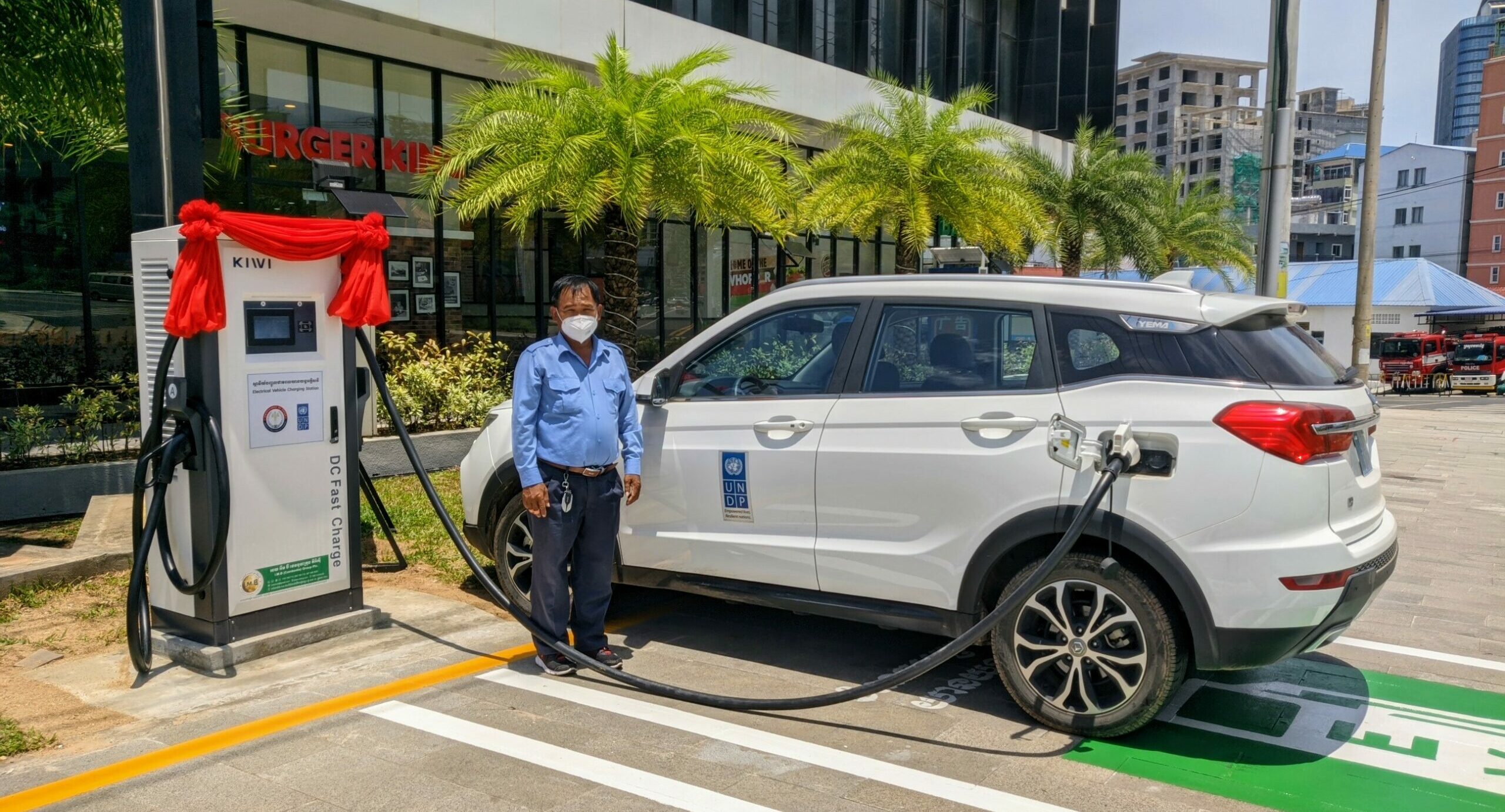
An electric vehicle being charged. (UNDP)
The Union government is working on detailed guidelines for companies looking at investments under the electric-vehicle (EV) policy, and a second round of consultation with stakeholders is expected soon, an official said on Friday.
The Ministry of Heavy Industries has already held the first round of consultation last month.
The guidelines will include information about applications, portal links and the project monitoring agency (PMA), the official added.
The official also clarified that auto firms in India can apply under the policy to seek incentives by committing to the required investments.
“They can apply under the new policy for an import licence for a certain number of EVs, and in order to qualify, they will have to commit to us the investments,” the official said.
Companies already present in India need not register a new subsidiary to apply under the policy.
On 15 March, the government approved an electric-vehicle policy, under which duty concessions will be given to companies setting up manufacturing units in the country with a minimum investment of $500 million, a move aimed at attracting major global players like US-based Tesla.
As per the policy, a company will get three years to set up manufacturing facilities in India, and start commercial production of e-vehicles, and reach 50 percent domestic value addition (DVA) within five years at the maximum.
The companies that would set up manufacturing facilities for EV passenger cars will be allowed to import a limited number of cars at lower customs/import duty of 15 percent on vehicles costing $35,000 and above for five years from the date of issuance of the approval letter by the government.
Further, applications of auto companies from countries that are sharing a land border with India “will have to go through the much more onerous scrutiny”.
Under foreign direct investment norms, applications from China, Bangladesh, Pakistan, Bhutan, Nepal, Myanmar, and Afghanistan require mandatory government approval for investments in any sector within India.
At present, cars imported as completely built units (CBUs) attract customs duty ranging from 70 percent to 100 percent, depending on engine size and cost, insurance and freight (CIF) value less or above $40,000.
The policy seeks to promote India as a manufacturing destination for EVs and attract investment from reputed global EV manufacturers.
According to the scheme, the company will be allowed to import CBUs of e-4W manufactured by them at a reduced customs duty of 15 percent, subject to the conditions.
Under this scheme, EV passenger cars can initially be imported with a minimum CIF (cost, insurance, freight) value of $35,000 at a duty rate of 15 percent for five years from the date of issuance of the approval letter by the Ministry of Heavy Industries (MHI).
The maximum number of e-4W allowed to be imported at the reduced duty rate will be capped at 8,000 per year. The carryover of unutilised annual import limits would be permitted.
(Disclaimer: The headline, subheads, and intro of this report along with the photos may have been reworked by South First. The rest of the content is from a syndicated feed, and has been edited for style.)


