

Published Jan 18, 2026 | 7:00 AM ⚊ Updated Jan 18, 2026 | 7:00 AM

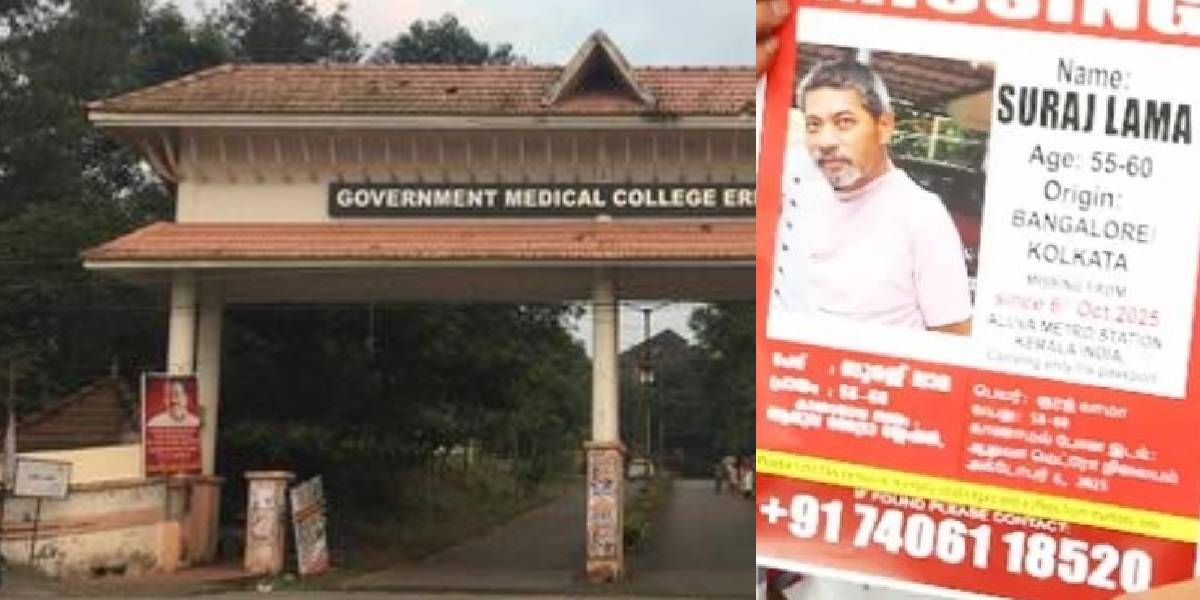
Suraj Lama was last seen on 10 October 2025, before he went missing from the Ernakulam Medical College Hospital at Kalamassery.
Synopsis: Suraj Lama’s case points to multiple failures at several levels. Deported from Kuwait, the Bengaluru man landed in Kochi and was allowed to leave the airport. The man, who suffered memory loss, was later found wandering in Kochi. The police admitted him to the Medical College Hospital, from where he disappeared two days later. Adding to the mystery is the discovery of a decomposing body, which awaits forensic identification.
It is still not clear whether Suraj Lama is alive or not, even as his family’s long wait continues.
The 58-year-old man from Bengaluru was last seen alive on 10 October 2025, according to reports. His disappearance caused a flurry of activities in Kerala, including the intervention of the High Court. A decomposed body, suspected to be of the missing man, was found.
The body has not yet been identified forensically. In a letter dated 9 January, the Director of the Forensic Science Laboratory in Thiruvananthapuram requested two more weeks to complete the examination of the body. On 12 January, the High Court granted the lab’s request.
Along with the wait for the forensic test result, questions, too, remain unanswered. However, if the dead man is Suraj, he certainly have had an undignified end.
Despite the High Court’s intervention and the constitution of a Special Investigating Team headed by the Additional Superintendent of Police, Ernakulam Rural, in October 2025, no tangible headway has been made in the case.
The court later suo motu impleaded the Anti-Human Trafficking Unit under the DIG, Thiruvananthapuram Range, Police Headquarters, but investigations have so far failed to yield results.
Adding a disturbing dimension are reports that Suraj had been failed by multiple agencies, a cascade of institutional lapses that may have pushed him toward an inescapable and tragic end.
Suraj, who had been working in Kuwait for several years, was deported, and he landed at the Cochin International Airport on 5 October.
It is not known why he was forced to land in Kochi instead of Bengaluru, his hometown.
The deportation reportedly followed his hospitalisation in Kuwait for acute toxic leukoencephalopathy, a rare condition characterised by progressive damage to white matter in the brain, caused by exposure to substance use, environmental toxins, or chemotherapeutic drugs. In Suraj’s case, hooch reportedly played the villain.
By the time he reached India, Suraj was said to be suffering from severe memory loss and disorientation.
Instead of being sent to Bengaluru, where his family lives, Suraj, it is alleged, was deported to Kochi without informing his relatives.
Despite his apparent medical condition, airport authorities — including emigration and security — allowed him to leave the terminal unattended.
In the days that followed, Suraj was reported seen wandering across various locations in and around Kochi, reportedly confused and unable to care for himself.
On 8 October, the Thrikkakara police allegedly took him into custody and shifted him by ambulance to the Government Medical College Hospital, Ernakulam, at Kalamassery in Kochi.
Two days later, he disappeared from the hospital.
Alarmed by his father’s disappearance, Suraj’s son, Santon Lama, approached the Kerala High Court on 22 October and filed a habeas corpus petition.
A report later submitted by the Deputy Superintendent of Police, Aluva — who is heading a Special Investigation Team — painted a grim picture of Suraj’s ordeal after deportation.
Filed in December 2025, the report recorded that he was deported by the Government of Kuwait on formal orders and inexplicably cleared by Indian authorities, despite being in a vulnerable mental and physical condition.
The report described, in disturbing detail, how Suraj wandered from place to place, frequently rebuked, forced to endure unhygienic and inhuman conditions, including sleeping on the roadside, and reduced to a life far removed from dignity.
While some good Samaritans reportedly offered him food or temporary relief, they mistook him for a vagrant, unaware of his identity or medical condition.
Hearing the case, a Division Bench of the Kerala High Court comprising Justices Devan Ramachandran and MB Snehalatha expressed deep concern over the circumstances.
The court pointed out that Suraj had once led a dignified life, with a family in Bengaluru, but was left without any institutional or familial support in Kerala, despite clear signs of cognitive impairment following deportation.
The Bench noted that Suraj, an Indian citizen, was taken into custody and deported by a foreign government, only to be abandoned in his own country. The court further remarked that the fate he appears to have been left to endure was “horrible and unspeakable,” underscoring serious lapses in humanitarian care and accountability.
Then came the discovery of a decomposed body in a forested patch near the Hindustan Machine Tools (HMT) premises at Kalamassery in Ernakulam on 30 November.
But the discovery only prolonged the anguish of a family waiting for answers.
The body, suspected to be that of Suraj, was recovered by the SIT.
Acting on CCTV footage that helped trace Suraj’s last known movements, the SIT searched the area with the assistance of Fire and Rescue Services personnel.
Police sources said the clothes and other belongings found on the body matched the description provided by Suraj’s family.
Aluva Deputy Superintendent of Police R Rajesh had then told the media that the identity of the deceased would be officially confirmed only after visual identification by relatives and completion of scientific examinations.
The Kalamassery police have since registered a case related to the recovery. But the wait for closure has stretched on.
When the matter came up before the court on 1 December—after it was informed about the body—the judges raised pointed questions.
The court sought clarity on how Suraj was admitted to a Medical College, how he was discharged, and under what circumstances.
These details, the court noted, were crucial, especially since the petitioner’s case was that his father suffered cognitive impairment following an accident abroad and was sent back to India because of his condition.
The Bench also expressed serious concern over the possibility that a body could lie unnoticed for over a month in a marshy area within a municipal or corporation limit.
If police suspicions were correct, the judges said, authorities would have to explain why such areas were left unsupervised.
At a subsequent hearing on 6 January, the Division Bench struck a sombre note, observing that the situation was deeply distressing.
While the family of the “alleged detenu” continued to live in pain and uncertainty, the court noted that the police appeared to have scaled down their efforts to trace him, seemingly on the assumption that the recovered body was Suraj.
For a family caught between hope and despair, the unanswered questions—and the long wait for forensic confirmation—have only compounded their suffering.
Even weeks after the case came to light, some of the most crucial questions surrounding Suraj remain unanswered—foremost among them, how a deported Indian citizen was allowed to walk free upon arrival at Cochin International Airport.
The Division Bench itself flagged the anomaly, bluntly asking how a person who had been deported could be let go without being handed over to any responsible authority.
“We do not understand how a person who was deported could have been let free like this, without him being given in charge to a person who could have been trusted,” the court observed.
In an order dated 4 December, the Bench said the case raised “very difficult questions” for multiple authorities.
Deportation, the court noted, is never without cause—ranging from health issues to far more serious concerns.
“It is shocking that a person who is so deported is then left free through emigration, without any evaluation or surveillance,” the judges said.
The court further noted that it was now “virtually admitted” that the alleged detenu was not in a proper mental state and suffered from cognitive issues.
Police had reportedly taken him to a Medical College Hospital, after which he was never seen again.
The confusion deepened in the days that followed.
On 17 December, the court was informed that when Suraj was sent back from Kuwait, the airport manager had been alerted by Central Intelligence that the individual did not possess proper cognitive capacity.
Yet a day later, CIAL told the court that it had received no such information from the Central Government or its intelligence agencies.
On 19 December, CIAL maintained that it had merely followed standard protocols in permitting the individual to leave the airport.
Faced with these contradictory claims, the Bench expressed anguish.
“We cannot fathom how the official systems could have failed a citizen of this nation in this manner,” it said, adding that the episode suggested a disturbing lapse in the basic principle that every citizen is equal before the state.
The unanswered question lingers: where, exactly, did the system break down—and who bears responsibility for failing Suraj Lama?
Will the answers ever come? It is another question.
(Edited by Majnu Babu).


