

Published Jan 22, 2026 | 12:15 PM ⚊ Updated Jan 22, 2026 | 12:15 PM

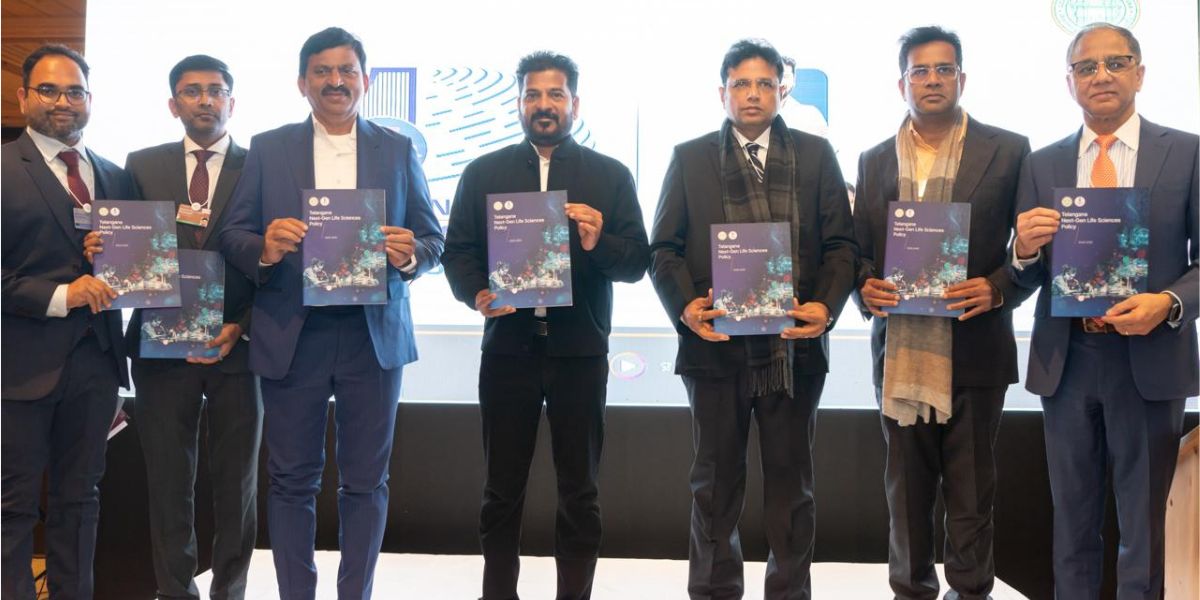
Telangana unveiled next-gen Life Sciences Policy at Davos.
Synopsis: The Telangana government unveiled its Next-Gen Life Sciences Policy 2026–30 at the World Economic Forum Annual Meeting in Davos. Chief Minister A Revanth Reddy said Telangana was building “one of the world’s most trusted and transformational biosciences ecosystems,” with a clear focus on global collaboration and shared innovation agendas.
Focusing on an ambitious transformation from scale-driven manufacturing to innovation-led growth, the Telangana government unveiled its Next-Gen Life Sciences Policy 2026–30 at the World Economic Forum (WEF) Annual Meeting in Davos, Switzerland, on Tuesday, 20 January, outlining a bold roadmap to position the state among the top five global life sciences clusters by 2030.
The policy sets out sweeping targets, including attracting $25 billion in investments, creating nearly 5,00,000 high-quality jobs, and deepening Telangana’s integration into global value chains across healthcare, advanced therapeutics, and sustainable bio-manufacturing.
The global launch at Davos underscores Telangana’s intent to compete not merely as a manufacturing hub, but as a leading originator of cutting-edge life sciences innovation.
Unveiling the policy, Chief Minister A Revanth Reddy said Telangana was building “one of the world’s most trusted and transformational biosciences ecosystems,” with a clear focus on global collaboration and shared innovation agendas. “The policy’s global unveiling at Davos reflects our conviction that the next phase of growth in life sciences will be driven by cross-border collaboration, global capital, and collective innovation,” he said.
The chief minister unveiled the policy in the presence of Information Technology and Industries Minister D Sridhar Babu, Special Chief Secretary (Industries & Commerce) Sanjay Kumar (IAS), and CEO of Telangana Life Sciences Shakthi M Nagappan.
The new policy is designed as a deliberate scale-up of this trajectory, seeking to elevate Telangana from being indispensable to global supply chains to becoming a global innovation originator.
Focusing on recent gains, Sridhar Babu said Telangana had attracted investments worth ₹73,000 crore in the last two years alone. “With the launch of this policy, we are now aiming higher — to attract ₹2 lakh crore over the next five years,” he said.
Nagappan said the policy focuses on frontier R&D (research and development), sustainable manufacturing, talent creation and a strong startup-to-scale-up pipeline. A key proposal is the establishment of a dedicated Life Sciences Innovation Fund, with an initial corpus of ₹100 crore, scalable up to ₹1,000 crore, to catalyse early- and growth-stage innovation, particularly in deep-tech biotherapeutics.
The policy also envisages a Telangana School of Life Sciences, a university of global excellence aimed at research-led education and future-ready talent development.
Policy implementation will be anchored by globally benchmarked infrastructure, including the much-anticipated Green Pharma City, a sustainable industrial cluster designed around zero liquid discharge, centralised waste management, energy-efficient systems and net-zero practices.
To promote decentralised and inclusive growth, the government plans to develop 10 Pharma Villages, each spanning 1,000 to 3,000 acres along the Outer Ring Road in Hyderabad. The policy also calls for the expansion of Genome Valley, the creation of a Bio-Innovation and Bio-Manufacturing Cluster in collaboration with the Government of India, and the further strengthening of the Medical Devices Park with plug-and-play facilities.
The policy identifies multiple focus areas, including frontier R&D and advanced manufacturing, promotion of biologics, biosimilars, mRNA platforms, CRISPR technologies, antibody-drug conjugates and precision fermentation. It also seeks to strengthen the clinical research ecosystem through faster approvals, disease-specific clinical registries and initiatives such as a Clinical Innovation Sandbox.
In pharma services, the state aims to scale the sector from an estimated $2 billion to $10 billion, while also building strong capabilities in diagnostics, medical electronics, precision medicine and personalised therapies. Telangana will actively attract Global Capability Centres (GCCs) and Global Innovation Centres focused on advanced analytics, AI, digital health and high-end R&D.
A future-ready talent ecosystem forms a core pillar of the policy, with emphasis on industry-aligned curricula, internships, lifelong learning and certification programmes across biologics, AI, bioinformatics and health economics. Regulatory streamlining will be driven through TG-iPASS, offering time-bound, single-window approvals and permitting 24×7 operations in designated life sciences parks.
(Edited by Muhammed Fazil.)


