


Published Dec 22, 2025 | 7:00 AM ⚊ Updated Dec 22, 2025 | 7:00 AM

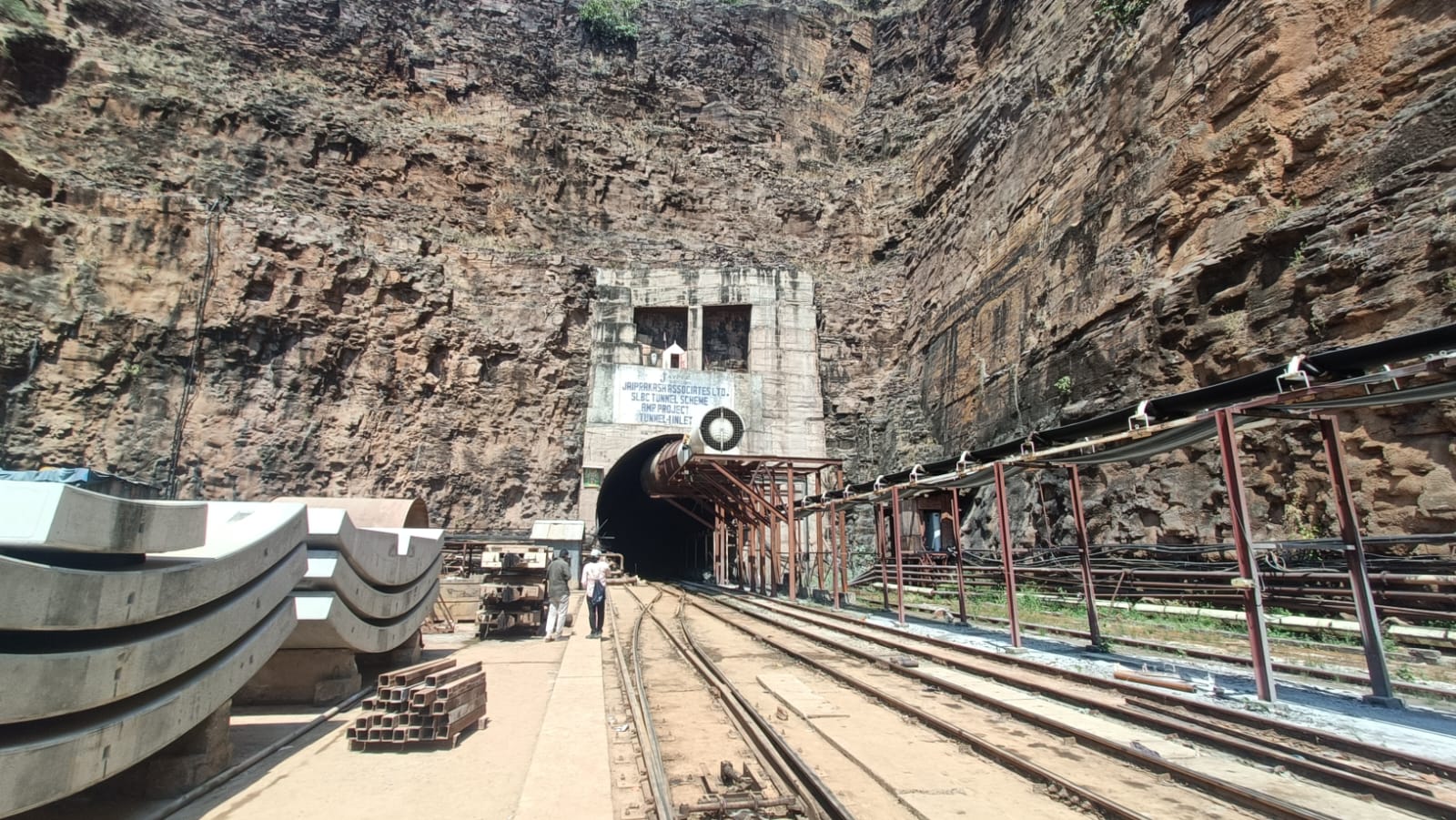
SLBC tunnel
Synopsis: The Telangana government is preparing to resume work on the Srisailam Left Bank Canal tunnel months after a section collapsed, claiming eight lives. The State aims to complete the 43.93 km-long project, designed to divert 30 TMCFT of Krishna river water, by the end of 2027 through scientific surveys, enhanced engineering oversight and administrative reforms.
Months after a section of the under-construction Srisailam Left Bank Canal (SLBC) tunnel collapsed, claiming eight lives, the Telangana government is preparing to resume work on the project.
Located in Nagarkurnool district and touted as the world’s longest irrigation tunnel at 43.93 km, the project is designed to divert 30 TMCFT of Krishna river water. It aims to provide irrigation to around three lakh acres and supply drinking water to nearly 30 lakh people in fluoride-affected and drought-prone areas of Nalgonda and Nagarkurnool districts.
However, the resumption of work is facing a major hurdle due to the continuous inflow of water into the tunnel, estimated at about 4,000 cusecs. The water is being pumped out round the clock.
Even as efforts are under way to address this issue, the State government has begun preparations to restart construction of the remaining portion of the tunnel.
At a recent review meeting, Irrigation Minister N Uttam Kumar Reddy asked officials to expedite the adoption of modern technology by opening an escrow account with the company that will provide the technical know-how and carry out the tunnelling work.
The project, which began in 2019 with an initial completion target of 2024, has faced multiple setbacks. The estimated cost has more than doubled since work began, rising from ₹2,000 crore to ₹4,600 crore.
So far, around 35 km of the tunnel has been excavated, leaving about nine km unfinished. Nearly 80 percent of the allocated funds have already been utilised. Once completed, the tunnel is expected to provide crucial irrigation to districts such as Nalgonda and Nagarkurnool, which have long struggled with water scarcity.
A major setback occurred on 22 February 2025, when a portion of the tunnel collapsed, trapping eight workers and engineers inside. While two bodies were recovered, six remain unrecovered due to unstable geological conditions and persistent water seepage.
In the aftermath, the Telangana government committed to completing the project by 9 December 2027, stressing strict safety standards and the use of what it described as “world-class” technical expertise.
“The SLBC tunnel must be completed under all circumstances,” Chief Minister A Revanth Reddy told irrigation officials and contractors at a recent review meeting. He announced that the project would be formally inaugurated on 9 December 2027 and dedicated to the people of Telangana. He asserted that “not a single day’s delay will be tolerated” and described it as a “vital project of Telangana people”.
Work is expected to resume within a month, with excavation planned from both the inlet and outlet ends at a targeted rate of 178 metres per month. Officials have set a daily excavation target of seven metres, with operations running in three regulated shifts to maintain pace while ensuring safety.
Among the key recent developments is the adoption of innovative methods aimed at preventing future incidents. In November 2025, a heli-borne Versatile Time Domain Electromagnetic (VTEM) Plus magnetic geophysical survey was launched to map underground shear zones, water bodies and potential hazards up to a depth of 1,000 metres.
The aerial survey, conducted using a 24-metre transmitter loop suspended from a helicopter, covers around 200 km of flight paths. It is being carried out in collaboration with the National Geophysical Research Institute (NGRI), Army officers including Lieutenant General Harpal Singh, who has been appointed Special Advisor, and Colonel Parikshit Mehra, deputed for one year as a tunnel specialist, along with experts from Singareni Collieries.
Launching the survey at Mannevaripalli in Nagarkurnool district on 3 November 2025, Chief Minister A Revanth Reddy said, “The people of Nalgonda and Mahabubnagar will not forgive us if we don’t complete the tunnel.”
Speaking at the same event, Irrigation Minister N Uttam Kumar Reddy described the survey as “the starting point of a renewed scientific approach,” adding, “With accurate geological mapping, we will ensure safe and timely completion of the pending work within two years.”
Data from the survey will be used to determine the strategy for the remaining tunnel-boring work, with a shift away from conventional tunnel-boring machines to more adaptive drilling technologies, without imposing any additional financial burden.
The approach includes the deployment of modern machinery recommended by a high-level technical sub-committee, along with enhanced ventilation systems, redundant safety backups and real-time monitoring to address geological risks such as weak rock formations and fault lines.
Junior engineers will be deployed in every shift to monitor progress, with mandatory written records of daily advancements. Third-party quality assurance mechanisms will be put in place to verify compliance. In addition, a dedicated team of young engineers will be formed, trained and incentivised to build long-term expertise in tunnel construction within Telangana.
Expert tunnel and safety engineers will be stationed inside the tunnel across all three shifts. Where required, bolt supports will be installed 15 to 20 metres behind the excavation face, based on favourable geological conditions identified in preliminary assessments.
The project has also received administrative reinforcement, with Lieutenant General Harpal Singh drawing on his experience from projects such as the Atal Tunnel to stress the importance of meticulous documentation and crisis preparedness. Officials said all work would adhere to the revised financial estimates to avoid further cost overruns.
The government has also committed to completing rehabilitation and resettlement (R&R) payments for affected families in areas such as Marlapadu Thanda, Keshi Thanda and Nakkalagandi Thanda by 31 December 2025. The payments will be routed through a green channel to ensure expedited release of funds.
Once completed, the SLBC project is expected to significantly transform agriculture in Nalgonda and surrounding districts by ensuring reliable irrigation and mitigating fluoride contamination in drinking water sources. It is also projected to eliminate the annual electricity expenditure of ₹500 to ₹550 crore currently incurred for pumping water under the lift irrigation system, as the tunnel will enable gravity-based flow.
However, challenges such as geological instability persist, and stakeholders say progress will be closely monitored to ensure the project meets the 2027 deadline.
(Edited by Dese Gowda)


