


Published Apr 03, 2026 | 5:47 PM ⚊ Updated Apr 03, 2026 | 5:49 PM

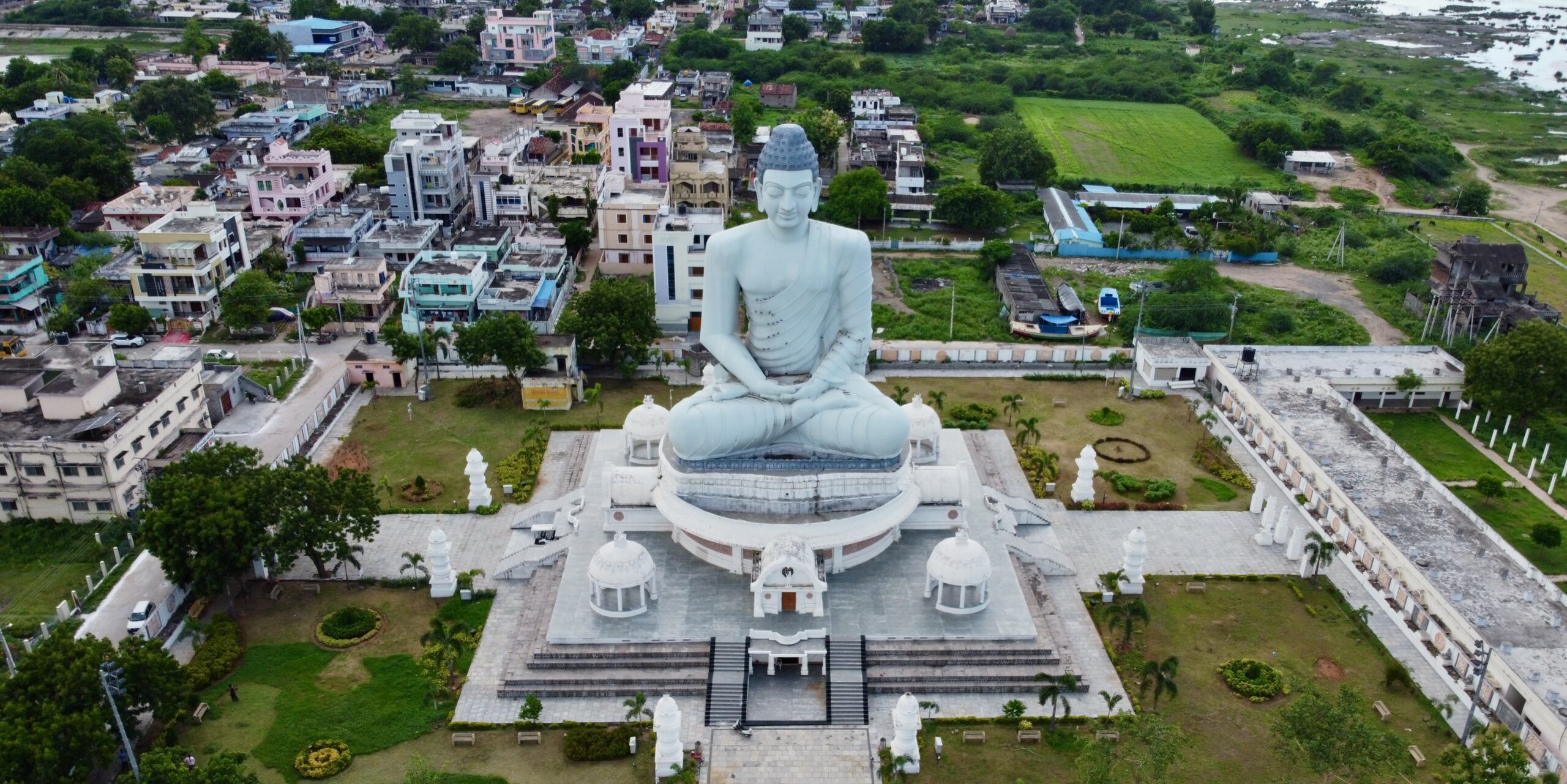
Dhyana Buddha Statue in Amaravati. (Creative Commons)
Synopsis: Amaravati is being developed as a futuristic, world-class city with the help of global expertise. The master plan was prepared with assistance from Singapore, which Chief Minister Naidu said provided the design without charging any fee.
Andhra Pradesh Chief Minister N. Chandrababu Naidu on Friday, 3 April, described the passage of the Andhra Pradesh Reorganisation (Amendment) Bill, 2026, in both Houses of Parliament as the “victory of the people,” and declared that his government is firmly on track to complete major works in Amaravati by 2028 with an investment of ₹56,000 crore.
Addressing a media conference in Amaravati, Naidu said the legislation grants full legal sanctity to Amaravati as the capital of Andhra Pradesh, marking a decisive moment in the state’s post-bifurcation journey.
“With the passage of the bill in Parliament, the aspirations of five crore people of Andhra Pradesh have been fulfilled. No one can alter Amaravati’s status hereafter,” he asserted, adding that Amaravati’s development is irreversible.
“Amaravati is self-sustaining, future-ready, and unstoppable. Any attempts to obstruct Amaravati will remain a daydream for those who are against it,” he said.
He warned that the government would take stringent legal action against those attempting to disrupt development or intimidate investors. “History will not forgive those who act against the state’s interests,” he added.
Naidu said that all political parties in Parliament, barring the YSR Congress Party, supported the move. “If there are 50 parties in Parliament, all except one extended support for granting legal status to Amaravati. Unfortunately, some elected representatives from this state acted against its interests,” he remarked, in a sharp attack on the opposition.
Naidu thanked Prime Minister Narendra Modi and Union Home Minister Amit Shah for their support, along with leaders across party lines, the Lok Sabha Speaker, and the Rajya Sabha Chairman. He noted that despite political differences, parties came together in the interest of the state.
The Chief Minister said the Bill would acquire complete legal force after receiving the President’s assent, but emphasised that the parliamentary approval itself was a historic milestone. He described it as a reaffirmation of democratic values and cooperative federalism.
Naidu reflected on the circumstances surrounding the bifurcation of Andhra Pradesh in 2014, noting that the state began its journey under severe constraints. “We had no capital, limited resources, and immense financial challenges. We started from scratch,” he said.
He recalled setting up the administration in Vijayawada under modest conditions, even operating from temporary offices and makeshift arrangements. “Those were clear examples of how a state was rebuilt from nothing,” he said.
Referring to the recommendations of the Sivaramakrishnan Committee, Naidu said a significant number of people favoured the Vijayawada-Guntur region for the capital. Based on considerations such as central location, connectivity, geography, and historical significance, Amaravati was chosen.
“We wanted a capital that is accessible to all regions and acts as a unifying force. Amaravati represents that vision,” he said.
Naidu recalled the innovative land pooling scheme implemented for Amaravati, calling it a model of participatory development. Around 29,000 farmers voluntarily contributed nearly 34,000 acres of land, while additional government land brought the total to about 54,000 acres.
“These are fertile and valuable lands. Farmers trusted us and became stakeholders in the capital’s development,” he said.
Under the scheme, farmers were offered developed residential and commercial plots in return, along with annual annuities. Landless agricultural workers were also provided pensions. “Our goal was to ensure that every farmer who contributed land benefits from development,” Naidu said.
Naidu reiterated that Amaravati is being developed as a futuristic, world-class city with the help of global expertise. The master plan was prepared with assistance from Singapore, which he said provided the design without charging any fee.
Internationally renowned architects, including those associated with Norman Foster, were engaged to design the city as a “blue-green” urban centre with sustainable infrastructure. “We are not building just a few government buildings. Amaravati is envisioned as a long-term capital that future generations will use,” he said.
He outlined key features of the city, including nine thematic urban clusters, a financial district, extensive road networks, underground utility ducts, and environmentally sustainable planning. The design incorporates concepts such as “walk-to-work” and emergency response times within 5–15 minutes.
Naidu also recalled that Prime Minister Modi had laid the foundation stone for Amaravati, bringing soil from Parliament and water from the Yamuna to symbolise national support.
The Chief Minister accused the YSR Congress Party of attempting to derail the Amaravati project at multiple stages. He alleged that efforts were made to create obstacles by raising objections with international agencies such as the World Bank and by spreading misinformation about the region.
“They called it a desert, a burial ground, even predicted earthquakes. Every attempt was made to stall the capital,” he said.
Naidu criticised the opposition’s stance on decentralisation, questioning the idea of multiple capitals. “How can a state function without a clear capital? Governance cannot be based on whims,” he said.
Providing an update on ongoing works, Naidu said projects worth ₹56,000 crore are currently underway in Amaravati. These include major infrastructure initiatives such as the Inner Ring Road, Outer Ring Road, and a proposed sports city.
He emphasised that capital development is a phased process and cannot be completed overnight. “As infrastructure develops, economic activity will increase, generating revenue for the state,” he said.
Naidu expressed confidence that by 2028, key components of the capital city would reach an advanced stage of completion. He also pointed to financial tie-ups with institutions such as the World Bank, HUDCO, and the Asian Development Bank.
The Chief Minister said Amaravati would serve as the growth engine for Andhra Pradesh’s long-term economic ambitions. He outlined a vision to transform the state into a US $2.4 trillion economy by 2047, with Amaravati playing a central role.
“Amaravati will be a knowledge hub and a driver of innovation, employment, and investment,” he said.
At the same time, he stressed that development would not be limited to the capital region. Cities like Visakhapatnam and Tirupati are also being developed as regional growth centres, with sector-specific industries getting priority. Naidu cited investments from global firms such as Google and ArcelorMittal as indicators of growing investor confidence.
Drawing from his experience in developing Hyderabad into a global IT hub, Naidu said long-term planning and infrastructure investment were key to urban success. He credited initiatives like Cyberabad for transforming Hyderabad into a leading knowledge economy.
“If Hyderabad is among the most livable cities today, it is because of the foundations I laid decades ago. Amaravati will follow a similar trajectory,” he said.
(Edited by Majnu Babu).


