


Published Jan 08, 2026 | 5:51 PM ⚊ Updated Jan 08, 2026 | 5:51 PM


Congress leaders during the Lakshya 2026 camp that concluded in Wayanad
Synopsis: The Congress-led UDF in Kerala shifted into campaign mode months before the formal poll schedule was announced. From early candidate identification and leadership camps to sharpening slogans and expanding the front’s political base, the Congress intends to not repeat the mistakes of the last two Assembly elections.
As Kerala slowly inches towards Assembly elections — expected in April — one political formation appears significantly ahead of the curve in terms of preparation, messaging and organisational mobilisation.
The Congress-led UDF, riding high on a strong showing in the recent local body elections, has already shifted into campaign mode — months before the formal poll schedule is announced.
From early candidate identification and leadership camps to sharpening slogans and expanding the front’s political base, the Congress has sent out a clear signal: It does not intend to repeat the mistakes of the last two Assembly elections.
This time, the party wants to define the narrative early and keep the LDF on the defensive.
Adding an unmistakable political twist, the Congress is also said to be contemplating launching its campaign with the slogan “Kadakku Purathu” (Get Out) — a phrase that has long been associated with Chief Minister Pinarayi Vijayan himself.
The remark, made in 2017 when the chief minister curtly asked journalists to leave a conference, has since become symbolic of what the Opposition describes as Pinarayi Vijayan’s authoritarian style of governance.
By reclaiming the phrase and turning it into a rallying cry, the Congress hopes to weaponise the chief minister’s own words against a government it brands as arrogant, inaccessible and hostile to dissent.
While party leaders say multiple campaign catchphrases are under discussion, senior Congress functionaries believe “Kadakku Purathu” has the potential to capture the public mood.
“Many slogans are being debated within the party. But Kadakku Purathu reflects the sentiment of the people today — that Kerala needs a change and that this government has overstayed its welcome,” a senior Congress leader said, indicating that the phrase could strike a chord beyond conventional party supporters.
However, the leader said, a final call is yet to be made.
This is not the first time the UDF has deployed the phrase politically.
During the just-concluded local body elections, the Congress had anchored parts of its campaign around “Ambalakallanmar Kadakku Purathu” (temple looters get out), targeting the CPI(M) over the Sabarimala gold theft controversy.
The phrase found resonance at the grassroots, reinforcing the party’s belief that sharp, emotive slogans can cut through voter fatigue and anti-incumbency complacency.
Still, a senior leader warned that the phrase needs careful handling.
“The challenge is to turn it into an anti-incumbency message. ‘Kadakku Purathu’ immediately connects with the public mood, but slogans alone cannot win elections. If we lead with it, we must back it with a clear alternative vision of governance. Otherwise, the risk is that the debate gets reduced to rhetoric rather than change,” said the leader.
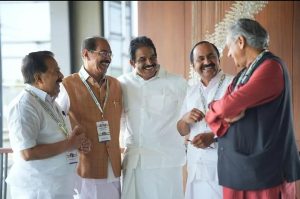
Senior Congress leaders sharing a light moment at the Lakshya 2026
The renewed assertiveness of Congress is rooted firmly in electoral arithmetic.
The UDF emerged as the single largest force in the recent local body elections, securing what its leaders describe as the front’s most decisive mandate since the introduction of the Panchayat Raj system in 1995.
Across grama panchayats, block panchayats, district panchayats, municipalities, and corporations, the UDF registered sharp gains, while the LDF suffered visible erosion.
Senior Congress leaders argued that these results were not a routine mid-cycle fluctuation but an unmistakable reflection of public anger against the Pinarayi Vijayan government — anger they believe will surface more strongly in Assembly polls.
Leader of Opposition in Kerala Assembly VD Satheesan has repeatedly asserted that the “public hatred” against the government did not fully reflect in local body polls, and that Assembly elections will amplify it.
“There will definitely be no third Pinarayi government,” he has said, projecting a UDF tally approaching 100 seats.
What marks this election cycle apart is the Congress’s unusually early start.
While Kerala’s Assembly elections are still months away, the party has already begun internal discussions on candidate selection, campaign architecture and alliance expansion.
A two-day ‘Lakshya Leadership Summit’, held on 4 and 5 January in Wayanad, symbolised this urgency.
Inaugurated by All India Congress Committee (AICC) General Secretary KC Venugopal and chaired by Kerala Pradesh Congress Committee (KPCC) President Sunny Joseph, the camp brought together senior state and national leaders, former KPCC presidents and key organisational heads.
The summit focused on election preparedness, issue-based agitations, organisational accountability and messaging against both the state and central governments.
According to party leaders, detailed discussions were held on price rise, governance paralysis, corruption allegations, gold smuggling and what they describe as the CPI(M)’s “communal double standards”.
Venugopal made it clear that excuses would not be tolerated in the next four months and that party unity would be enforced strictly.
“Only when everyone rows in the same rhythm can the boat reach its destination,” he remarked, underlining the leadership’s determination to avoid internal sabotage.
Another strategic shift is the Congress’s decision to finalise candidates early — a sharp departure from its traditional tendency to delay decisions until the last minute.
Venugopal announced that the screening committee, chaired by Madhusudhan Mistry, would visit Kerala shortly and that the first phase of candidates could be announced by the end of January itself.
Probability of victory, youth representation, and women candidates will be key criteria.
Venugopal reminded that in the 2021 elections, over 50 percent of Congress candidates were below the age of 50 — a statistic the party continues to highlight to counter the LDF’s claim of being more youth-centric.
Joseph echoed the sentiment, stating that a systematic procedure was in place and that senior leaders’ candidature would be decided after internal consultations.
He also dismissed speculation about surveys and premature seat-sharing talks, asserting that the party was moving step-by-step.
Perhaps the most notable change in Congress’s strategy is its attempt to redefine the UDF not merely as a coalition but as a broad political platform.
The front has decided to induct PV Anvar-led Trinamool Congress (Kerala chapter) and CK Janu’s Janadhipathiya Rashtriya Sabha as associate members — even though the latter was previously aligned with the NDA.
UDF leaders argue that this expansion reflects a churn within Kerala politics, with disillusioned Left-leaning activists, opinion-makers and influencers seeking an alternative platform.
Satheesan has openly claimed that many who worked alongside the Left for decades have realised that the CPI(M) “is no longer the Left, but an extreme right force in practice”.
The front is also planning a Kasaragod-to-Thiruvananthapuram march in February to popularise its manifesto, which leaders claim will be radically different from traditional documents, backed by research-like studies across sectors.
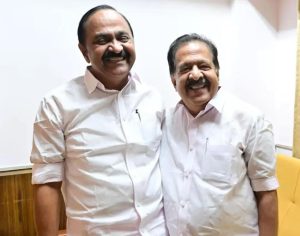
V D Satheesan and Ramesh Chennithala
Despite the early start and upbeat messaging, not everything in the Congress-led UDF camp appears glossy.
As the front moves from preparation to the hard arithmetic of seat-sharing, long-standing alliance pressures are expected to resurface — potentially testing the very unity the party is keen to project.
The most immediate challenge will come from the UDF’s constituents, particularly the Indian Union Muslim League (IUML), which has already made it clear that it believes it has a legitimate claim to more seats in the upcoming Assembly elections.
IUML leaders argue that their consistent vote base, organisational strength and decisive role in recent victories entitle the party to a higher share this time around.
Similar assertions are expected from other allies — the Revolutionary Socialist Party (RSP), Kerala Congress factions, including Kerala Congress (Jacob), the Revolutionary Marxist Party of India (RMPI) and smaller partners — each of whom sees the 2026 election as an opportunity to renegotiate space within a front that believes it is on the upswing.
Beyond inter-party negotiations, the Congress will also have to navigate internal dissent — a perennial feature of Kerala’s grand old party.
The process of accommodating allies inevitably means painful decisions within the Congress itself: which sitting MLAs will be denied a ticket, who among aspirants will be accommodated, and which power centres will feel marginalised.
While open factional warfare is no longer as visible as it once was, senior leaders privately concede that factional loyalties have not disappeared. They now operate in quieter, more tactical ways — through organisational influence, candidate lobbying and subtle alignment with alliance partners.
The “invisible presence” of factions, as many describe it, could still complicate candidate selection once names begin to crystallise. Yet, there is one more sensitive question that will hover over the campaign without ever being articulated publicly — the choice of chief minister.
Officially, the Congress will insist that no chief minister’s face will be projected before the polls and that the legislature party will take a call after the verdict. In practice, however, senior leaders concede that an internal understanding will exist well before election day.
That unspoken consensus — who is acceptable to alliance partners, who balances caste and religious balances, and who does not upset the UDF’s delicate social balance — will itself be a source of tension.
The informal process of narrowing down names is already expected to ruffle feathers, even as the party projects unity outward.
Senior leader Ramesh Chennithala has said the ‘Lakshya’ camp has energised workers but acknowledged that “we have to work harder to reach the desired numbers”.
Yet, the underlying message is unmistakable. With early preparation, sharper messaging, expanding alliances and the confidence of recent electoral gains, the Congress believes it has finally broken the cycle of hesitation that cost it the last two Assembly elections.
Whether this early start translates into votes will only be known when Kerala goes to the polls. For now, however, the Congress has ensured one thing: the battle for the 2026 Assembly election has begun on its terms, not the Left’s.
(Edited by Muhammed Fazil.)


