

Published Dec 22, 2025 | 4:38 PM ⚊ Updated Dec 22, 2025 | 4:38 PM

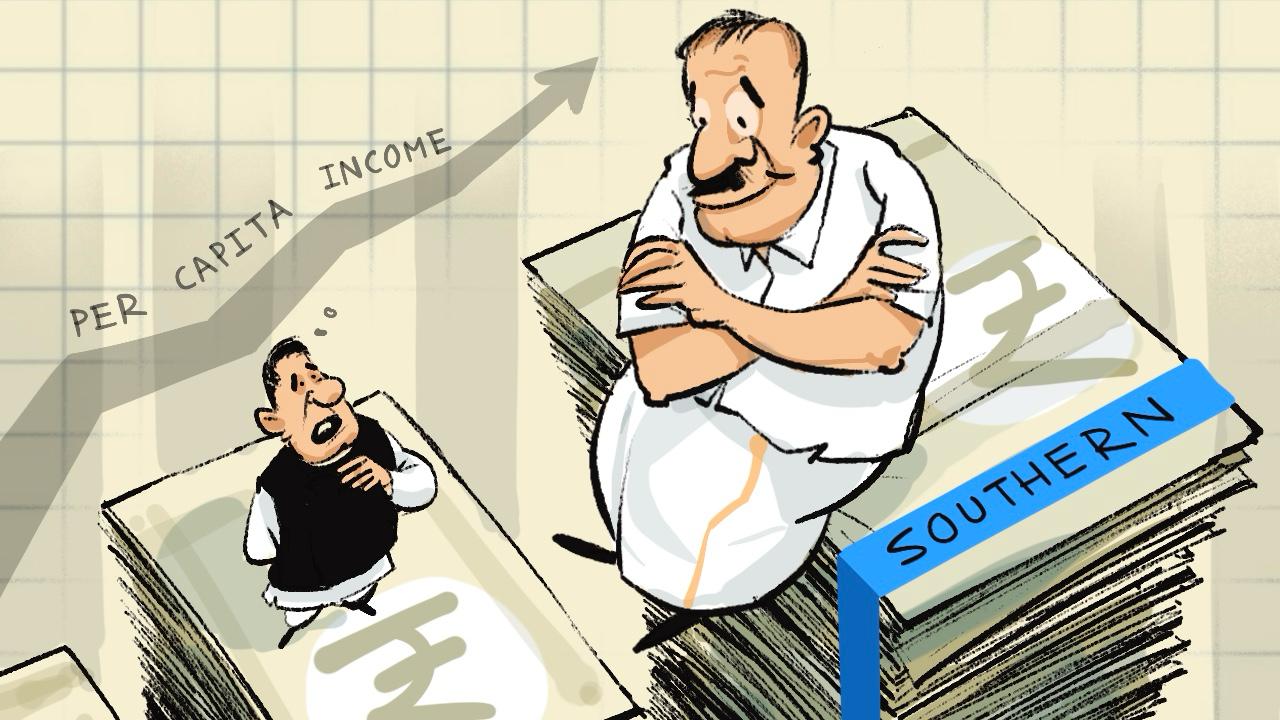
Synopsis: All five southern States have placed within the top 10 in per capita income for FY 2024–25, outpacing most northern States, according to the latest data from the RBI. Telangana ranks second only to Delhi, followed closely by Karnataka and Tamil Nadu. Beyond incomes, the divide extends to inflation and poverty, where southern States generally perform better.
Southern States continue to lead India in per capita income, occupying most of the top positions in the national ranking and remaining well ahead of the large northern States, according to figures from the Reserve Bank of India’s Handbook of Statistics on Indian States 2024–25.
Five southern States feature among the top 10 nationally. Telangana ranks second in the country after Delhi, with a per capita Net State Domestic Product (NSDP) of ₹3,87,623 in current prices.
Karnataka follows at ₹3,80,906, Tamil Nadu at ₹3,61,619, Kerala at ₹3,08,338 and Andhra Pradesh at ₹2,66,240.
By contrast, the large northern States are placed much lower. Maharashtra, India’s largest State economy by output, ranks sixth with a per capita NSDP of ₹3,09,340.
Madhya Pradesh is placed 22nd at ₹1,52,615, Uttar Pradesh 24th at ₹1,08,572 and Bihar last among all States at ₹69,321. The gap between the highest-ranked southern State and Bihar is more than fivefold.
Economic output and per capita income together point to a consistent southern advantage in FY 2024–25.
Tamil Nadu and Karnataka form the economic core of the South. Tamil Nadu’s Net State Domestic Product (NSDP) stood at ₹27,92,49,598 lakh in current prices, with Karnataka close behind at ₹26,03,94,756 lakh.
Telangana and Andhra Pradesh occupy the next tier, with NSDPs of ₹14,87,03,908 lakh and ₹14,22,99,773 lakh, respectively. Kerala follows at ₹11,11,22,940 lakh.
In contrast, Maharashtra, the country’s largest State economy with an NSDP of ₹39,57,31,855 lakh, has a per capita NSDP of ₹3,09,340, placing it only slightly above Kerala.
Uttar Pradesh, with an NSDP of ₹26,00,00,416 lakh, comparable to Tamil Nadu and Karnataka, records a per capita income of just ₹1,08,572, among the lowest in the country.
Madhya Pradesh’s NSDP stood at ₹13,46,24,492 lakh, broadly similar to Andhra Pradesh and Telangana, but its per capita income was significantly lower at ₹1,52,615.
Bihar’s economy was smaller at ₹8,99,02,050 lakh and translated into the lowest per capita NSDP nationwide at ₹69,321.
Among the southern States, Tamil Nadu and Karnataka’s own tax collections stood at ₹1,95,173 crore and ₹1,89,893 crore, respectively, in FY 2024–25. Telangana followed with ₹1,38,181 crore, Andhra Pradesh with ₹1,09,789 crore and Kerala with ₹84,884 crore.
Tamil Nadu’s fiscal deficit for the year stood at ₹1,08,690 crore, the largest among the five southern States. Karnataka’s deficit was ₹82,981 crore, Andhra Pradesh’s ₹68,743 crore, Telangana’s ₹49,255 crore and Kerala’s ₹44,529 crore.
To fill some of these gaps, Tamil Nadu raised ₹50,000 crore from the market during the period, Andhra Pradesh ₹44,000 crore, Telangana ₹31,500 crore and Kerala ₹24,253 crore. Karnataka raised ₹3,000 crore.
In the North, Maharashtra’s tax collections stood far higher than the rest. The State reported own tax revenue of ₹3,42,919 crore and a fiscal deficit of ₹1,10,355 crore. It raised ₹64,000 crore from the market between April and September.
Uttar Pradesh reported own tax revenue of ₹2,70,432 crore and a fiscal deficit of ₹86,531 crore, while reporting no market borrowings during the April–September period.
Madhya Pradesh’s tax collections stood at ₹1,02,097 crore, with a fiscal deficit of ₹62,564 crore and market borrowings of ₹15,000 crore.
Bihar reported own tax revenue of ₹54,300 crore, ran a fiscal deficit of ₹29,095 crore and raised ₹12,000 crore from the market.
Gujarat’s own tax revenue stood at ₹1,48,950 crore, alongside a fiscal deficit of ₹51,917 crore and market borrowings of ₹4,500 crore.
The divide between southern and northern States is most visible in inflation levels, poverty and health spending.
Inflation in FY 2024–25 remained relatively contained across most southern States. Telangana recorded the lowest average inflation among the southern States at 3.7 percent.
Andhra Pradesh and Gujarat both stood at 4.4 percent, Tamil Nadu at 4.7 percent and Karnataka at 4.9 percent. Kerala saw the highest inflation in the South at 5.9 percent.
In the North, Bihar recorded the highest inflation at 6.0 percent, followed by Uttar Pradesh at 5.3 percent, while Maharashtra reported 4.1 percent and Madhya Pradesh 4.7 percent.
Kerala stands apart on poverty. Its multidimensional poverty headcount ratio, based on NFHS-5 (2019–21), is just 0.55 percent, the lowest among all States listed.
Tamil Nadu follows at 2.20 percent. Andhra Pradesh and Telangana record poverty levels of 6.06 percent and 5.88 percent, respectively, while Karnataka stands higher at 7.58 percent. Even so, all five southern States remain well below the levels seen in most large northern States.
In the North, Bihar records the highest poverty rate at 33.76 percent, more than six times that of Andhra Pradesh and over sixty times Kerala’s level.
Uttar Pradesh follows at 22.93 percent, Madhya Pradesh at 20.63 percent and Gujarat at 11.66 percent. Maharashtra, at 7.81 percent, performs better than most northern peers but still lags Kerala and Tamil Nadu.
Public expenditure on health, using the latest available data for FY 2019–20, shows less of a clear regional divide. Tamil Nadu spent ₹13,012 crore on health, the highest among the southern States, followed by Karnataka at ₹9,474 crore, Andhra Pradesh at ₹7,941 crore, Kerala at ₹7,539 crore and Telangana at ₹7,304 crore.
In the North, Uttar Pradesh reported health expenditure of ₹20,250 crore, the highest among all 10 States, reflecting its population size. Maharashtra spent ₹14,756 crore, Gujarat ₹10,396 crore, Madhya Pradesh ₹9,673 crore and Bihar ₹8,079 crore.


