

Published Dec 04, 2025 | 6:06 PM ⚊ Updated Dec 04, 2025 | 6:06 PM

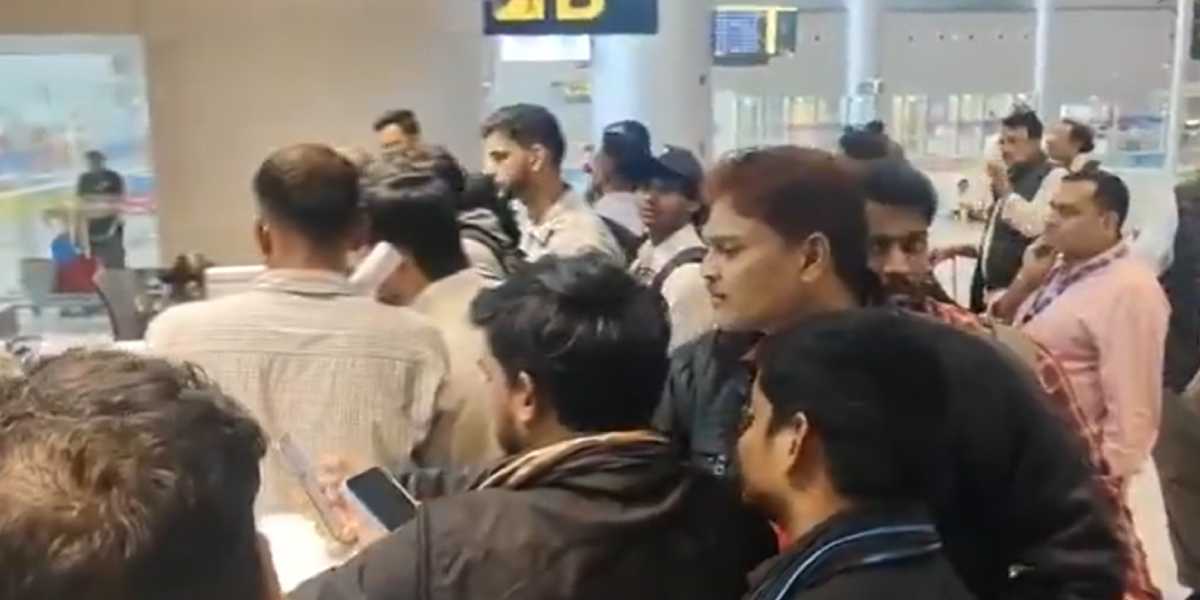
Passengers stuck at Hyderabad airport.(Supplied)
Synopsis: A two-day Hyderabad-Mumbai business trip turned into a never-ending ordeal for Uday Kiran Mantha as IndiGo’s crew shortage crisis struck. Flights delayed by 7–14 hours, no announcements, no water or hotel, and two full planeloads of passengers competing for one aircraft left thousands stranded. IndiGo cancelled 170+ flights on 4 December amid carrier’s plummeting on-time performance.
What was meant to be a routine, two-day work-trip to Mumbai became a very unproductive and stressful ordeal for Uday Kiran Mantha.
His journey began in Hyderabad on 2 December, with an IndiGo flight to Mumbai scheduled at 8:15 am. “The flight was delayed without any reason which went on for hours,” says Mantha.
He spent many anxious hours at the Rajiv Gandhi International Airport, clock ticking away and taking his tightly scheduled meetings out of question. The morning flight eventually became an early evening one, taking off at only around 3:00 pm.
“Even when it was finally time, there was no announcement that boarding had started. I recognised a lady from my flight on her way to board and asked her what was happening,” he recalls. “I was the last one to board.”
IndiGo cancelled over 170 flights on Thursday, 4 December, the third straight day of chaos triggered by acute crew shortages after stricter pilot rest norms took effect on Monday, 1 November.
Delhi, Mumbai, Hyderabad, and Bengaluru were the worst hit, with thousands of passengers stranded, some for over 12 hours. The DGCA has summoned IndiGo officials as the carrier’s November on-time performance plunged to 67.7 percent.
Similar situations were mirrored at the Jaipur airport. Stranded there on 3 December was a pilot himself, on his way home to Hyderabad from a family trip. He addresses the problem at hand – shortage of pilots.
Requesting to be anonymous, he said, “If I had my uniform, I would’ve flown the plane myself!”
In a later conversation with South First, he sums up the problem. “Everything here has a cascading effect. If any crew, be it a pilot, cabin crew or any staff involved, has been mandated to work a certain number of hours only owing to flight safety reasons, they cannot willingly or forcefully be made to exceed that,” he explains.
“When delays occur, no matter the reason, we need to understand that a major portion of the so-called productive time of the crew also is spent doing nothing useful. Simply eating into the permissible working hours. So at the end of the day, they have been working for the maximum stipulated duty hours. And suddenly when there is a need for them to do something, they would have exceeded the duty hours and then we have to wait for the next lot of fresh hands and minds to replace them.”
He also relays that it is, hence, a very difficult situation to jump back from. “A delay in one location results in a greater delay elsewhere and further delay in the next location.”
Also Read: Crew crunch grounds IndiGo: 70+ cancellations; Hyderabad, Bengaluru airports among worst hit
Mantha’s return to Hyderabad, a day later, is testament to the pilot’s words. Mumbai airport was comparable to the city’s local trains. There were hundreds of passengers crowded at the gates, many completely giving up on their flights and leaving the airport.
Inside, there was more commotion. There was very limited staff, and none of the passengers knew what was going on. Mantha’s return flight, also IndiGo, was scheduled for 9:45 pm on the night of 3 December. This too, kept getting pushed, initially to 12:00 am, then 2:00, and 2:30. The journey stretched well into the early hour of 4 December.
When an aircraft finally arrived at the airport at around 12:30 am, ready to board passengers going to Hyderabad, Mantha expressed his hopes to board that flight, but there was another problem. It wasn’t just the 9:45 pm passengers who were waiting, but also people from the 10:00 am flight. Yes, those passengers had been waiting over 12 hours.
Eventually, the airline began boarding passengers from the original 10:00 am flight. What followed was a rush from travellers from Mantha’s flight; everybody wanted to make it on-board.
“There were essentially two full flights of passengers, but only one plane,” Uday recalls.
The pilot at Jaipur later reflects that the problem may never have been a shortage. “At times I do feel that it is more of a planning issue rather than a shortage or difficulty in implementation of the norms.”
Throughout Mantha’s ordeal at both Hyderabad and Mumbai airports, there was no basic assistance whatsoever. “Not a single bottle of water was provided. There were no refunds, no cancellations, no accommodation, no help of any kind,” he said.
For the passengers waiting since the morning, stress levels had been on the rise all day long. Though there were still about 20 seats vacant, according to Mantha, the crew gave up.
“The people who had been waiting since 10 am had lost all patience. There were arguments and people almost came to blows with the crew,” he noted.
The flight departed Mumbai at around 2:00am, landing in Hyderabad by approximately 3.30 am, ending Mantha’s travel that had stretched through nearly two days of uncertainty and exhaustion.
Meanwhile, most passengers continued searching for alternatives that were just out of reach. Though Air India had planes taking off, there were no vacant seats. Airlines began charging exorbitant fares as high as Rs 47,000.
“It was a scramble for everyone,” says Mantha. “They were trying any and all alternative ways, but nothing was working.”
(Diya Mantha is an intern with South First. Edited by Amit Vasudev)


