


The Tamil Nadu Minister for School Education presents 14 essays that dissect the controversial National Education Policy and its implications.

Published Jun 13, 2025 | 4:45 PM ⚊ Updated Jun 13, 2025 | 7:51 PM

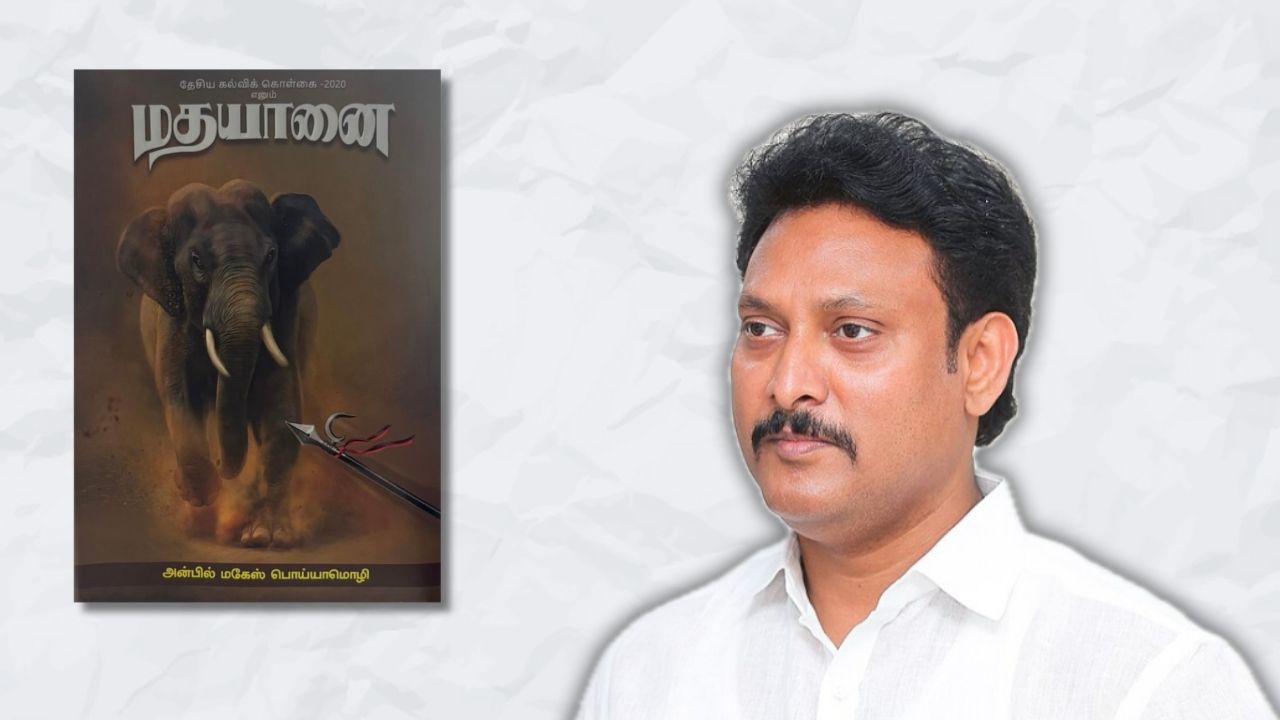
Political parties across the spectrum have criticised NEP 2020 as a political project.
Synopsis: Tamil Nadu Education Minister Anbil Mahesh Poyyamozhi’s recently-released book NEP 2020 Ennum Madhayaanai presents a detailed critique of the National Education Policy 2020, framing it as a threat to the state’s long-standing commitment to social justice and equitable education.
The National Education Policy (NEP) 2020 was brought into effect by the Union government in July 2020 after being drafted and debated for several years, beginning with the submission of the first draft in 2016.
However, not all Indian states have embraced the policy even today. Southern states, including Kerala and Tamil Nadu, continue to oppose it, arguing that NEP 2020 serves as a veiled attempt to impose Hindutva ideology through education.
From the very beginning, the Tamil Nadu government and political parties across the spectrum have criticised NEP 2020 as a political project aimed at embedding RSS-BJP ideology into the educational framework.
Core objections include the three-language formula, mandatory examinations from Class 3, dilution of the Right to Education Act, and attempts to consolidate India’s inherently diverse education systems under a centralised, singular identity.
These concerns have been consistently raised by the Dravida Munnetra Kazhagam (DMK) and several other political parties in the state.
The issue reached a flashpoint when Union Education Minister Dharmendra Pradhan recently stated that the pending SSA (Samagra Shiksha Abhiyan) funds of ₹2,152 crore for Tamil Nadu would be released only if the state implemented the NEP. This statement triggered outrage.
Further, in court proceedings related to reimbursement delays under the 25 percent quota mandated by the Right to Education Act in private schools, the Union government once again cited the same period to justify withholding its share of the funds – strengthening the perception that funds are being used as leverage to coerce policy adoption.
Against this backdrop, Tamil Nadu School Education Minister Anbil Mahesh Poyyamozhi recently released a collection of essays titled NEP 2020 Ennum Madhayaanai, explaining in detail why Tamil Nadu continues to resist the policy.
The book opens with a 2016 tweet by former Chief Minister and DMK leader M Karunanidhi, who had warned:
“The new education policy, this Madhayaanai (Captive elephant), must not be allowed to enter Tamil Nadu. We must not permit it to destroy our state’s legacy of educational excellence or undermine the social justice and equity we have long protected. Wisdom lies in prevention!”
Building on this message, Anbil Mahesh presents 14 essays that dissect the policy and its implications. In his preface, he notes that he has studied the NEP document thoroughly and places his critique from the standpoint of protecting the educational future of Tamil Nadu’s students.
The book, he says, is a “clarion call” to three key stakeholders: students, teachers, and parents.
He directly references Chief Minister MK Stalin’s 2025–26 Budget speech, where the CM emphatically stated that Tamil Nadu would refuse Union government funds if they came with the condition of implementing NEP:
“If adopting NEP is the condition to receive ₹2,152 crore, then we don’t want that money. Even if we are offered ₹10,000 crore, we will not sign on to any policy that works against the interests of the people of Tamil Nadu. We will allocate funds ourselves.”
Anbil Mahesh criticises NEP 2020 as a regressive policy that seeks to dismantle decades of progress achieved by state governments – rights and schemes that were hard-won through legislative and social efforts. According to him, NEP threatens to crush the educational aspirations of future generations.
While the NEP document often speaks of inclusivity, global benchmarks, and evidence-based education, Mahesh argues that these are mere rhetorical flourishes. In practice, he contends, the BJP government is attempting to implement the RSS’s ideological programme through NEP.
He points to the Global Education Monitoring Report (2021–22), which observed that non-governmental organisations play a significant role in influencing education policy in India – including policy design and public discourse. The report also noted that certain experts who advocate privatisation were invited to shape the NEP, and that some media outlets helped frame the narration.
Citing this, Mahesh alleges that NEP was shaped by elites with vested interests, leading to the exclusion of marginalised communities from the mainstream education system.
Mahesh also traces the ideological roots of NEP, from the TSR Subramanian Committee to the Kasturirangan Committee, highlighting how many members had ties to the RSS or other Hindutva-aligned organisations.
By documenting these affiliations, he asserts that NEP is being used as an instrument to implement a specific ideological agenda.
In a society like India’s – deeply stratified along lines of caste, language, and class – the difference in educational opportunity between dominant and marginalised communities is vast. Mahesh argues that Dalit and backward caste students have far fewer opportunities compared to their socially privileged counterparts.
In this context, provisions like mandatory public exams from Class 3, multiple entry/exit, and early vocational training can derail the academic trajectory of marginalised students. These measures, he suggests, push them back into caste-based occupations, essentially forcing them out of the mainstream academic system.
He also criticises NEP’s plan to consolidate primary and middle schools into a single complex model, warning that it would lead to the closure of many well-functioning public schools and pave the way for privatisation of education.
Further, Mahesh points out that Tamil Nadu already surpassed NEP 2030’s target of a 50 percent Gross Enrolment Ratio (GER) in higher education nearly 15 years ago.
“If we’ve already achieved what NEP aims for, why should Tamil Nadu adopt it?” he asks. “On the contrary, India should be adopting the Tamil Nadu model.”
He accuses the NEP of erasing diversity, centralising authority, and disrespecting federal principles. By linking education funds to policy adoption, the Union government, he claims, is coercing states and dragging the education system backward by decades.
In contrast, Mahesh presents the Tamil Nadu model as one that is inclusive, data-driven, globally relevant, and built on social justice. The state’s education policy, he argues, equips students with skills for a fast-changing global landscape without abandoning equity.
Mahesh concludes the book by declaring unwavering support for Chief Minister MK Stalin’s opposition to NEP. He reiterates that Tamil Nadu will never let the Madhayaanai, NEP 2020, enter its borders.
By turning years of political speeches and debates into a published work, Anbil Mahesh underscores the DMK and the Tamil Nadu government’s central message:
“No matter the cost, Tamil, Tamils, and the welfare of our students come first. Any policy that contradicts this will not be accepted.”


