


Published Jul 01, 2025 | 9:00 AM ⚊ Updated Jul 01, 2025 | 9:00 AM

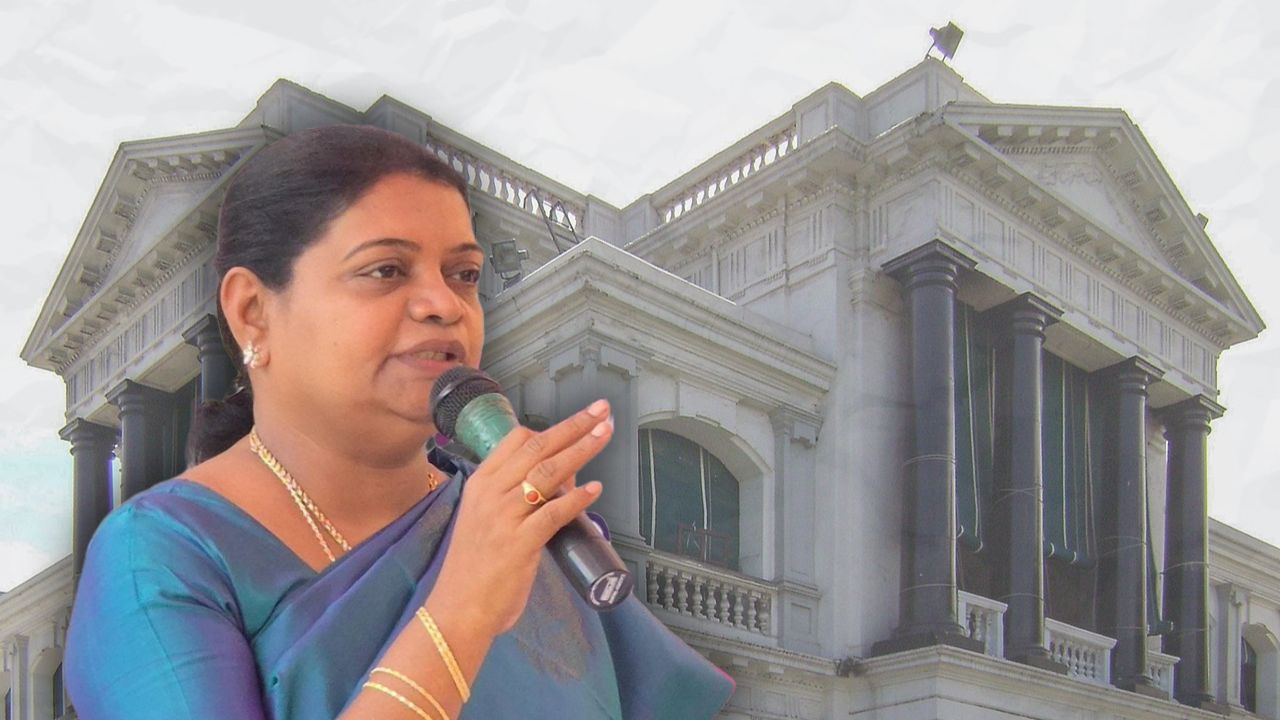
P Geetha Jeevan, Minister of Social Welfare and Women Empowerment of Tamil Nadu
Synopsis: In a wide-ranging conversation with The South First, Tamil Nadu’s Minister for Social Welfare and Women Empowerment, Geetha Jeevan speaks candidly about her political journey, the challenges of balancing ministerial responsibilities with district-level leadership, her views on the ‘flawed’ AIADMK-BJP alliance and Vijay’s Tamilaga Vettri Kazhagam.
Tamil Nadu’s Minister for Social Welfare and Women Empowerment, Geetha Jeevan, is one of the most influential women leaders from southern Tamil Nadu.
She also serves as the Dravida Munnetra Kazhagam’s (DMK) district secretary for North Thoothukudi.
In a wide-ranging conversation with The South First, she speaks candidly about both personal and political matters – her journey from the era of M. Karunanidhi to her current role under Chief Minister MK Stalin, the challenges of balancing ministerial responsibilities with district-level leadership, her views on the AIADMK-BJP alliance and Vijay’s Tamilaga Vettri Kazhagam, and her vision for the empowerment of women and children across the state.
Q: Why DMK? You’ve been in the same party for 30 years. Today we see leaders switch parties if they don’t get posts within a month of joining.
Because I believe in DMK’s ideology. It’s that ideological commitment that keeps us going. Our party, our leader – we’ve driven real social change. I want to keep contributing to that. So, this is a decision rooted in ideology. Our party is firmly committed to that ideology – that’s why I remain with the DMK.
Of course, I was introduced to the party through my father. He was a district secretary for the DMK, and I grew up reading party papers like Murasoli alongside him.
Nowadays, many youngsters join parties with personal gain in mind. If they don’t get what they want, they leave. That’s not right. Only when we stay rooted can we earn respect and truly feel connected. That continuity is important.
Q: You’re both a DMK district secretary and a state minister. How do you balance these two responsibilities? What are the challenges?
There are many challenges. Both roles are important. So, I plan out each separately and keep clear strategies for both. As a minister, all the files are in Chennai. But for field visits, I travel to places like Thoothukudi and other districts. Even during those trips, departmental work continues.
As for party work, meetings, planning, and discussions on party growth happen in the district headquarters, well scheduled. We plan those activities along with union- and city-level party leaders.
Over time, I’ve learned to balance both. It is definitely challenging – and time is the biggest challenge. There’s never enough of it.
Q: As the state’s Social Welfare Minister, what does your day look like?
If I leave home at 9.30 in the morning, the public is already waiting. Hearing their grievances and resolving them can take until 11 am. Only then can I go for field visits. Sometimes if there’s urgency, I head straight out to meet people.
When you speak to them directly, solutions come more easily – that’s why I go in person.
People in the constituency know me. When they say, “Please come, ma’am,” they know the issue will be resolved. After addressing those problems, I meet visitors from other constituencies. Only after that do I get time for lunch.
I’ve learned that afternoon rest is absolutely essential. There are days when I don’t get that break, but I make sure to take it whenever possible. Then, after 5 pm, we go for spot visits. If there’s an emergency call, I might head to places like Vilathikulam or Kovilpatti for public meetings or other events.
My mother-in-law is at home, my children are married, and we live in a joint family – so they manage the household. My entire focus is on political work.
Q: Even today, several people believe politics is not for women. But historically, women have held powerful positions in Tamil Nadu – even during the Sangam era. Now, leaders like you are in important posts. What do you think of these outdated criticisms?
Such comments are made to discourage women. But women can learn, grow, and succeed in this field too. You have to observe everything, understand it, and train yourself for this line of work. Some get elected as union councillors for a five year term, but say “I can’t do it.”
That won’t work. You need to get used to it and prepare yourself.
Earlier, just traveling from one place to another by car would tire me. When I was district panchayat chairperson, I also felt exhausted. But now, I’ve gotten used to it. It’s something you can train your body and mind for, as long as you’re willing to work hard.
When we work for the people, time doesn’t matter. Sundays are actually the busiest – everyone is off, so more people come to meet us. Party events also happen on Sundays.
There’s no time for entertainment like going to the movies. But when you work that hard, any woman can succeed in this field.
So, when people say “Can women really do this?” – that’s just a way of discouraging them.
Q: You’ve likely heard this often: “Even if women succeed, some people will say you have achieved it like a man” I’m sure people have said this to both you and the women around you. What role do men play in women’s progress?
We can’t grow alone. My father was an MLA. Later, it was Kalaignar who said, “Give this girl a chance” – and I got the opportunity to contest. That opportunity came from men. Even when I became a minister, it was Kalaignar who made that call. So, we can’t say we’ll do it all without men’s support.
It’s only with men’s cooperation that we can move forward. Many support their daughters, many support their wives – not just push them forward, but encourage them to take leadership roles.
But there are others who say their wife is the official leader, then send her to the kitchen and act as the real leader themselves. We call out such behavior, even in the party when we see it.
Whether our leader or Kanimozhi akka or me – we all speak out against such practices.
In my home, I have complete support. Since 1996, my husband has always been a steady guide, helping me figure out what works best. Even if there’s not much time, we make it a point to discuss important things.
That’s how we learn from mistakes and avoid repeating them. Without support, it’s not possible to move forward.
Q: When it comes to the cabinet, any ministry can be led by a woman. But do you think the Social Welfare and Women’s Rights Department, in particular, can only be best handled by a woman?
In my view, women can manage any department. But the Women Welfare Department shouldn’t be led by a man – it must be led by a woman. That’s what my experience tells me.
Some issues can only be truly understood by women. That’s why women are appointed to lead the Social Welfare and Women’s Rights departments. Otherwise, women are capable of managing any department.
Q: Over the last four years, how do you assess the progress made by women in Tamil Nadu?
Women have made remarkable progress. Our Chief Minister has centered his schemes around empowering women – ensuring they rise, that their human potential is utilised, and that they participate in the economy.
Schemes like the Magalir Urimai Thogai, Vidiyal Payanam, and the Women Entrepreneur programme, giving women Pattas and house sites, promoting education and skill development – all of these prioritise women. Even in Naan Mudhalvan scheme, preference is given to women.
This year alone, the goal for self-help groups is to disburse ₹37,000 crore in loans. A typical group of 12–15 women receives ₹30 lakh. As their businesses grow, the state’s economy strengthens.
That’s why the Chief Minister gives women top priority. He has even launched an educational support scheme for boys, but when it comes to girls, he brings in more targeted policies. These past four years have seen an unprecedented number of women-centric schemes in Tamil Nadu.
Q: You mentioned the new educational aid scheme for boys. The Pudhumai Penn scheme was once a marriage assistance programme, but its real aim has always been to promote education. But how did the idea to include boys come about? Do other states or countries do this?
I’m not sure about other countries, but when the chief minister travels, people often ask, “You gave it to my daughter – please give it to my son too.” Even boys say, “We’re struggling too, why only for girls?” That demand is what led the chief minister to launch this scheme.
Boys need to study too. Many face economic hardships and are forced to take up jobs to look after their family. That’s why the Chief Minister responded immediately with a scheme for them too. It’s been well received – last year alone, 3.4 lakh students benefited.
Q: You also served as a minister during former chief minister Karunanidhi’s tenure. Is there a piece of advice or a moment from him that you’ll never forget?
There are many, especially from his writings and actions. I used to read Murasoli regularly since childhood, which created a personal connection to him. There were many moments. One stands out from after the 2011 election loss. Many party members visited him, including me. He was visibly upset and talking to everyone.
A month later, when we visited again, he asked, “Still feeling down? It’s been a month. You need to pack up that sorrow and throw it away. There’s a lot of party work to do.”
That line stayed with me. It showed his experience – he was a great leader. It taught me that defeat should not break you. I’ve learned a lot from him.
Q: What do you think of the current Chief Minister? What’s the difference between working in Karunanidhi’s cabinet and Stalin’s?
Honestly, I see no difference. Just as we looked up to Kalaignar as our leader, we now look to Stalin the same way. We follow his guidance and the responsibilities he assigns.
My own goal is to work beyond expectations. That’s how I approach my role. Otherwise, I see both leaders equally.
When we speak about our constituencies, he supports us and helps make it happen.
For example, many people here(Thoothukudi) were asking for land titles(Patta). When the chief minister visited, he asked, “What other issues are there?” We told him about the rule that land titles couldn’t be given within 16 km of the district HQ.
He immediately issued a special order. Based on that, surveys were done, and a new government order was issued allowing patta for people living there for over 40 years, even 5 years. When we present issues, he calls the officers and acts quickly.
Q: Prof Anbazhagan once praised you publicly – saying that even though we all are very close to the leader when he was planning a new scheme and still less remember that, but you can recite all its details from memory. Let’s talk about two schemes: the Moovalur Ramamirtham Marriage Assistance Scheme and the now-expanded Pudhumai Penn. How did M Karunanidhi launch it, and how has it evolved?
It started in 1989 to support girls’ education. Back then, girls were pulled out of school after puberty. So if a girl completed Class 10, the government gave ₹5,000 as marriage aid – encouraging families to keep girls in school.
In his next term, Kalaignar upgraded it – raising the eligibility to Class 12 and the aid to ₹10,000. That pushed families to educate girls through higher secondary, after which girls often chose to attend college on their own.
In 2011, the amount was raised to ₹25,000. The next government didn’t scrap the scheme – they even increased the amount. But they made one mistake: they announced it, but didn’t allocate enough funds. So, 90,000 applications piled up every year.
From 2017, it stagnated. After our government came back, we cleared all pending applications from 2017. In 2021, ₹790 crore was allocated and nearly 95,000 beneficiaries received aid. Still, 3.75 lakh applications were left pending.
The goal of the scheme was to ensure girls pursue education. It was also meant to help with wedding expenses – like buying basic jewellery or household needs. But because of that backlog, many missed the benefit. Some came to collect it years later – with two kids.
When a review was done, we found many girls received aid claiming to be STs with only a Class 5 education – but had no certificates to prove it. A review team found several irregularities: beneficiaries without income proof, and many not even from poor families.
The report said the scheme was not being implemented properly. That’s when the chief minister decided, after discussions with officials, to convert it into an education-based scheme – renaming it the Moovalur Ramamirtham Higher Education Assistance Scheme.
He launched this scheme allowing students to avail it no matter which year they were in. The only requirement was that they had to be pursuing an undergraduate degree – even if they were in their fourth year.
In the very first year, 12,000 students enrolled in the scheme – fourth-year, third-year students, even married women and those who had taken a break from studies at home.
They said, “The government is paying for my education. I’ll study – you don’t have to spend money from home.”
For girls who truly wanted to study, this became a real opportunity. Now, all girls pursuing higher education are receiving this assistance. No matter which college or what year they are in, we provide financial support.
It’s a timely shift – from prioritising marriage to prioritising education – and our Chief Ministers have implemented it with that vision.
Q: As Minister for Social Welfare and Women’s Rights, which scheme do you think stands out the most? And why?
I’d say the breakfast scheme. It’s a great necessity in rural areas – it addresses a real gap.
Most women leave for farm work by 5:30 am while the children are still asleep. Then they rush back around 7.30 or 8 am just to send them to school. For such mothers, the breakfast scheme relieves the burden of preparing a morning meal. Usually, the parents eat leftover food soaked in water.
But that can’t be given to children. So kids often leave home having just coffee and biscuits – or at best, coffee and a piece of jaggery.
Because they don’t eat breakfast, by 11 am children start feeling weak. Their concentration drops. They lack nutrition and energy. A child who last ate dinner at 8 pm and only had coffee in the morning can’t be expected to focus after 11 am. That’s why the Chief Minister introduced this scheme.
He saw this issue firsthand and launched the scheme accordingly. Since then, it’s been running successfully. Now, parents just send their child to school; teachers make sure they eat a full meal. That way, children receive the necessary nutrition.
A study conducted by the state planning commission showed that during the rainy season, parents usually had to take their children to hospitals for injections or admissions.
But now, one mother said, “Not even a single injection this year.” Children are healthier and more active. Teachers are saying the same.
That’s why we introduced the scheme – to provide quality education, improve nutrition, ensure school attendance, and reduce the burden on mothers. Poor children are getting healthy breakfasts.
Q: One of Tamil Nadu government’s biggest strengths is identifying even the most subtle issues. For instance, in families where the man, considered the “head of the household,” abandons the family and takes the ration card with him, the woman struggles to run the household.
The state now recognises such women as household heads and allows them to receive ration cards and benefits. How do you identify such nuanced issues?
Just by listening to the people. One woman once told the Chief Minister that her husband had left and taken the ration card, and she couldn’t remove his name without the cardholder’s consent.
Based on such requests, the Chief Minister issued an order to allow abandoned or single women to be recognised as household heads for ration card eligibility.
So yes, by listening closely to people’s requests, even problems affecting only 5% of the population come to our attention. That’s how a government that listens can pick up even the smallest issues.
Take industries, for example – we want progress in all regions. Every district should get opportunities. That’s the philosophy: inclusive benefits for everyone.
Q: Former Chief Minister Kalaignar was called the “first student,” because he would learn about something and then implement it here. For example, when he saw the rise of tech in the 2000s, he set up IT parks. Among his schemes, which one do you think remains a pillar of Tamil Nadu even today?
In 1996, he introduced computer education in government schools – a visionary move, foreseeing its importance. Today, many of our students are in IT jobs abroad because of that foundation.
At that time, there weren’t even teachers trained in computers. So they immediately appointed temporary teachers with computer knowledge. And every school introduced it as a subject. That’s a landmark scheme.
Another one I admire is the abolition of hand-pulled rickshaws. It’s amazing that he ended the practice of one human pulling another. Even though there was opposition, he replaced them with cycle rickshaws and issued an order: “From now on, use only this.” There are many such examples.
Take the Adi Dravidar housing scheme – Kalaignar was the first to propose building houses for the Adi Dravidar community. Only later did the Union government rename it IAY (Indira Awas Yojana), now known as the PM Housing Scheme. But he was the original architect. There are so many firsts to his credit.
Q: Your department’s primary mandate is to ensure protection for women and children, to enable their progress, and to deliver justice for the marginalised. But crimes against women continue – even in Tamil Nadu. Critics say, “Even under DMK rule, this happens.” But from where you sit as Minister, you’ll know what’s really happening. How do you see this? Why does it still happen under your government?
We are promoting women’s empowerment across all fronts. As women step out and take part in the workforce, their safety becomes crucial – and we must ensure it everywhere.
Women, biologically, are physically less strong. So we must provide them with the right support. We were the first state in India to start “Thozhi” hostels for working women. This year, we’re adding six more. In Chennai alone, there are now multiple hostels, and we’re scaling it based on demand. The scheme is working well.
We’re getting requests from all over asking to start new hostels. The chief minister has said we’ll first cover all districts, then expand in high-demand areas like Chennai and Coimbatore. This year, he’s also announced a hostel for college girls in Chennai. These are emerging needs.
We introduced pink autos for women in Chennai. They have GPS and are linked to police stations. One woman told me she feels very safe now. A volunteer group is developing an app to make it even more accessible.
The chief minister also emphasised awareness – especially around POCSO and crimes against women. We’ve taken this very seriously and launched wide-ranging awareness campaigns.
We’ve reached every child. In school textbooks, we’ve included helpline numbers like 181 and 1098. Everyone now knows them. The education, police, and social welfare departments are working together. And as a result, more complaints are being filed.
In one private school in my district, after an awareness session with the police, a young girl went home and shared her trauma – and that led to an official complaint.
The accused was her father. The child said, “he’s my dad – how would I know this was wrong?” Kids don’t know what’s right or wrong. So it’s our duty to teach them. We explain what safe touch is, what’s wrong, and tell them not to stay silent – come forward. We assure them that it’s confidential. That has encouraged reporting.
We strictly maintain confidentiality. Though helplines 181 and 1098 were Union initiatives, after we came to power, Tamil Nadu ensured these were taken down to the grassroots. That’s why we’re getting more calls. We’re not fighting over whether it’s a state or central initiative – we focus on delivering it to the people.
We even help file complaints ourselves. We have OSCs – One Stop Centres. When we get a call on 181, we connect them to the nearest OSC. The staff meet the woman or child, assess the help they need, and assist in filing the complaint. We guide them on legal aid too. No matter the crime, we take action.
Opposition parties criticise us for rising complaint numbers – but to me, that’s a sign of progress. Awareness is reaching people. In the past, women would stay silent – even in the face of abuse – for the sake of family “honour.” Now, that’s changing. There’s a strong sense that perpetrators should be punished – and this mindset is growing among both women and children. Parents are also stepping forward to support their kids.
Same with child marriages. When underage girls are forced into marriage, it’s often friends or even mothers who alert us. In some cases, the mother calls and says, “My husband is trying to marry off our daughter – please stop it.” And we do – without revealing the whistleblower. That’s the kind of awareness that has emerged. So more complaints? We see it as a good thing.
The chief minister has clearly told the police: take action immediately. If action is delayed or ignored, he holds the police accountable. That’s how swift our government is. So no matter what the opposition says – we stay focused, and we’re seeing the results.
People trust more, and that’s why they come forward. That leads to more complaints, and also to more resolutions.
Absolutely. With penalties getting stricter now, we believe this will eventually act as a strong deterrent.
Q: As a Social Welfare Minister, you deal with many cases daily – like the one you mentioned where a father abused his own daughter. How do these affect you emotionally?
No, they don’t affect me emotionally, but at times I do feel sad that such things happen. I feel sad that these things happened for so long without coming out. But now, people are coming forward to speak out, and that itself is progress. I stay positive, believing that one day this will all come to an end.
Q: You are someone who speaks very highly of your father. We’ve heard that when he entered the house, he’d call out “Geethamma, Geethamma.” Do you miss hearing those words?
Of course, I miss it. On every festival day, we would definitely go and see him. Even if we didn’t go, he would call and ask, “Why didn’t you come?” Whenever his memorial day comes, these memories come flooding back. Initially, when he passed away, I was appointed as district secretary.
For a year, I used to think through every decision, wondering, “What would Appa do?” That helped me move forward. Now I’ve become much more confident – strong, even, I’d say. I keep learning from every incident. If I make a mistake once, I won’t repeat it. I’m extremely careful and aim to be perfect in everything I do. Even a small error becomes a lesson to me. I’ve learned to face and resolve problems without him. I was with Appa for 21 years, so I learned how to handle things from him.
Q: I see that as a reflection of the responsibilities you’ve held as the eldest child in your family. You’ve always been someone who takes charge. But have you ever felt tired of this way of life?
No, I see that as an inborn character. Being the eldest child, everyone always said, “You’re the elder sister.” At home, I was the one who always did things with Appa. Even if it was something like painting the house, he would ask me to choose the colour. I realise now how much freedom he gave me.
He never said anything about religion. My mother is a Christian, and my father a Hindu. He raised us with complete freedom to follow whatever we wanted. My husband is Christian, so I’m Christian too. One of my brothers’ wife is Hindu, and so he also follows Hinduism. Appa gave us that kind of freedom. I see that is because of DMK.
Q: In political families, where the father is a political figure the burden often doubles for mothers. While everyone knows your father, tell us about your mother. What role did she play in raising you?
Many days, we’d be asleep before Appa got home. He would return late after public meetings. Amma took on the extra responsibility – our studies and everything else were taken care of by her.
She cared for her children so much. Now when I think of it, I wonder – can we raise our children the same way? I haven’t done that much myself because I had an extended family – my mother-in-law and others helped. But for our mother, her children were everything.
For all six of us, she would cook four types of breakfast every day. She knew what each of us liked. She worked so hard, and I’d tell her not to strain herself, but for her, children meant everything. She used to say, “My children are my wealth.”
Even my father gave her full freedom. He never told her “Do this, do that.” Everything was her choice – from our studies to what we wore. Even when it came to selecting my groom, he asked Amma what she thought. Appa used to say, “Even if I’m the leader outside, inside the house, my wife is the leader. Everyone should listen to her.”
Q: In 1996, you contested elections for the first time. You were a shy person in college. How did you suddenly get up and speak on a campaign stage? What did you say?
There was no stage initially – I first stood in a campaign jeep. I said, “I am contesting for the district panchayat member. Please give me an opportunity to serve the people. I promise to work for you. Vote for the Udhayasuriyan symbol.” As I went from place to place, I adapted and expanded my speeches.
It was party members who took responsibility. The union secretary and others. I met him just last month. He’s now over 80 years old. He came to meet me, and it made me so happy. He was the one who first helped me up into that jeep.
Q: Let’s talk about Tamil Nadu’s political climate. How do you see the AIADMK-BJP alliance?
After the passing of Jayalalithaa Ammaiyar, support for AIADMK has declined among both the public and their own party workers. BJP and other parties are trying to take advantage of that situation.
This alliance already faced the 2019 parliamentary and 2021 assembly elections together – and they were defeated both times. So there’s nothing new to say. They’ve joined forces again, but that won’t affect us at all.
Q: Some in their party call Edappadi Palaniswami the next MGR or Jayalalithaa. Do you agree?
No, not at all. You can’t compare him to MGR or Jayalalithaa. He is Edappadi – he can remain as that. But he cannot be compared to those leaders.
Q: In Thoothukudi, there have been bitter incidents under previous governments – Sterlite and Sathankulam, for example. DMK came to power promising justice. What plans do you have to fulfil that?
Back then, victims’ families were only given Anganwadi jobs. After we came to power, the Chief Minister gave them posts like Village Assistant and Junior Assistant based on their qualifications.
Also, based on the Aruna Jagadeesan report, additional financial assistance was provided to the affected families. The report recommended action against officers, but action against IAS/IPS officers must be taken by the Union government. We can’t act on that ourselves.
Some have also obtained court stays; trials are still ongoing. So there are many reasons for delays. But we are continuing with what we promised.
Some ask why that police officer hasn’t been removed. But you can’t immediately remove a government official from service, can you? They’re pursuing their own legal proceedings.
Based on the Chief Minister’s promises, we’ve provided jobs suited to everyone’s qualifications. We’re following the Aruna Jagadeesan report and have done everything for those families. Right now, this is being politicised against the DMK.
Q: Actor Vijay has launched a new party – Tamilaga Vettri Kazhagam. They say he has strong support among the fishing community in Thoothukudi. Who do the fisherfolk support?
I don’t accept that claim. People will say anything to grow their party. Thoothukudi remains the same as always. In fact, DMK’s support among fisherfolk has only grown. I’d say I now have more support than I did in 2021. Our work in Thoothukudi speaks for itself – we’ve done things for everyone without seeing caste or religion. Our vote base has grown. I don’t give importance to what they’re saying.
Q: People often wonder – does Geetha Jeevan get angry? But when it comes to ideology, she definitely does. For example, when Seeman or Annamalai criticised party, you responded strongly. When do you get angry?
We must get angry when needed. As an administrator, sometimes people neglect what we say, and then we must react. We must raise our voices when necessary. But otherwise, I’m soft-spoken and friendly. If it’s about ideology or false propaganda against the party, I will get angry.
Q: 2026 is approaching quickly. How is DMK preparing to win?
We are definitely confident of victory. Our leader has put in place a plan of action to win all 234 constituencies. So we are fully confident we’ll win.


