


Kerala's textbooks remain free of communal content, instead promoting scientific thinking and rationalism. The RSS-BJP combine views this as a threat and is attempting to dismantle it.

Published Jul 10, 2025 | 8:00 AM ⚊ Updated Jul 10, 2025 | 8:00 AM

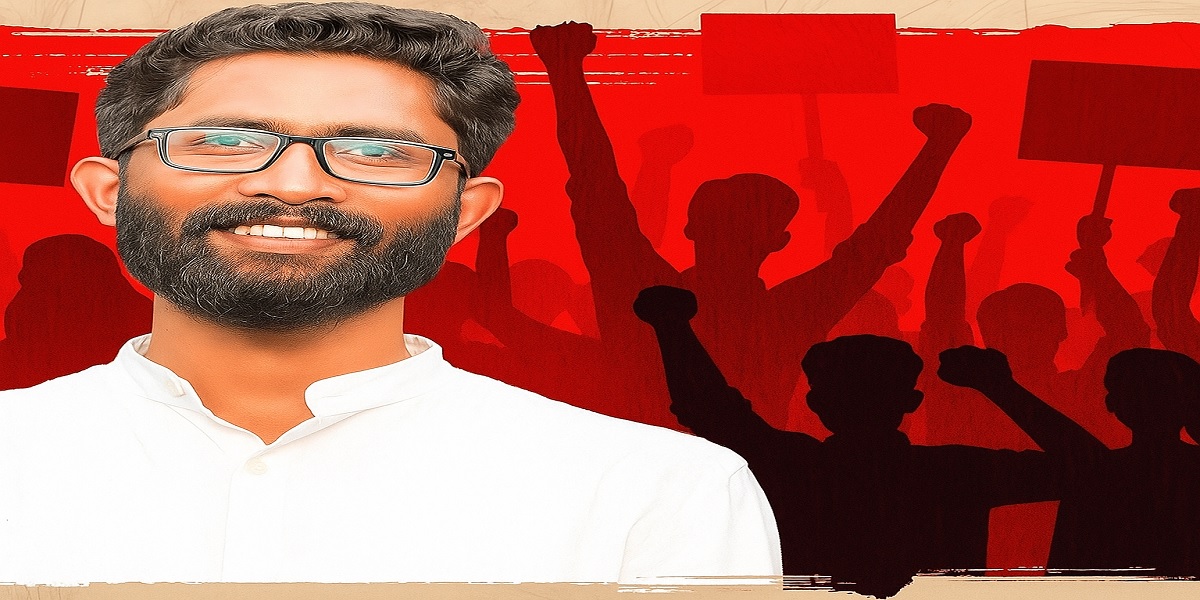
Adarsh M Saji, the newly elected All India President of the Students Federation of India (SFI)
Synopsis: SFI National President Adarsh M Saji feels Kerala has a robust education system, compared to BJP-ruled states that boast of ‘double-engine’ development. The southern state, he says, has now become a destination for foreign students, thanks to its quality higher education institutions.
Adarsh M Saji, the newly elected national President of the Students Federation of India (SFI), is a prominent student leader who rose through the ranks by leading powerful campus struggles and nationwide agitations.
Starting his political journey at SN Polytechnic College, Kottiyam, Adarsh went on to serve as Chathannoor Local Secretary and later became active in Kerala University politics while pursuing his BA at SN College, Kollam.
Currently in his final year of LLB at Janhit College, Delhi, Adarsh has held several leadership roles within SFI, from District Secretary in 2018 to Central Joint Secretary and Editor of Student Struggle. He has led protests across states like Tamil Nadu, UP, MP, and Puducherry, and was a key figure in demonstrations against the Citizenship (Amendment) Act (CAA) and solidarity with Palestine.
In a conversation with South First, Adarsh shared his views on the education system in India, especially highlighting the situation in Kerala.
Q: What is the true state of our national education sector under the Modi government, and how far has it progressed?
A: When we talk about the Modi era and the education sector, certain alarming data must be acknowledged. In the last four years alone, over 67,000 schools were shut down across India. Most recently, a circular in Uttar Pradesh announced the closure of 5,000 more schools, and the process is currently underway.
Despite branding themselves as a “double-engine government,” it is the BJP-ruled states like Madhya Pradesh—which tops the list in school closures—followed by Uttar Pradesh and Gujarat.
Additionally, the condition of existing schools is deeply concerning. 78,854 schools lack even a single functional toilet, 1,99,870 schools have no electricity, 7,81,617 schools do not have computers, and 9,84,126 schools are without internet connectivity. This is the ground reality under Modi’s governance.
Q: How do you view the significant reduction in grants and scholarships, particularly those meant for Muslim students, from a national perspective?
A: The Maulana Abul Kalam Azad Scholarship, particularly the Maulana Azad National Fellowship (MANF) for minority students, has been discontinued by the Modi government.
This move has raised serious concerns about access to education for minority communities. In addition, several fellowships and scholarships intended for SC/ST students have also been slashed, with the government justifying it as a cost-cutting measure.
However, it’s the marginalised and minority communities that are being forced to bear the brunt of these decisions.
In response, the SFI has taken a leading role by forming the United Students of India platform—bringing together 15 student organisations from across the country to raise a collective voice against these injustices.
At a time when many remain unaware of the crisis unfolding in the education sector, SFI is committed to continuing protests and spreading awareness to defend the right to equitable education for all.
Q: Which states, in your opinion, need more active student unions? And what is your take on PM SHRI?
A: Modi came to power in 2014, promoting the ‘Gujarat model’. I’ve seen that model firsthand when I visited educational institutions in that state. There were no proper laboratories, poor infrastructure, and a lack of adequate teachers. The same situation exists in BJP-ruled states like UP, Madhya Pradesh, and Bihar, where the so-called ‘double-engine’ governance is failing.
I visited a college in Lucknow three months ago that had a PM SHRI board with Modi’s photo on the gate, but inside, the condition was pathetic. That’s why they come to Kerala and are surprised by our educational infrastructure.
Another serious issue is hidden in the National Education Policy (NEP) merging of schools. When schools are merged, especially in tribal and rural areas, many institutions are shut down, and large clusters of 2000–3000 students are created. But students from remote villages can’t travel 50–60 km to reach these new schools. They drop out.
In Kerala, we’re resisting PM SHRI because it lacks clear criteria and threatens us by blocking funds. We already have advanced digital classrooms, well-trained teachers, and even robotics labs. So why do we need an arch with Modi’s photo? First, let them clarify what changes or regulations PM SHRI brings before asking us to sign up.
Q: Why does SFI so often find itself in conflict with state governors, especially in Kerala?
A: Kerala has long resisted any interference from the Sangh Parivar in its universities and educational institutions. However, the Sangh is now allegedly using governors as a tool to exert influence over the state’s education system.
The appointment of their nominees to key positions, including governors and vice-chancellors, is seen as part of a broader saffronisation agenda aimed at reshaping campuses.
Unlike many central institutions, Kerala’s textbooks remain free of communal content, instead promoting scientific thinking and rationalism. The RSS-BJP combine views this as a threat and is attempting to dismantle it. But SFI vows to resist such attempts across the country, with renewed determination in Kerala.
Q: This year, the SFI state conference extended support to introducing private universities in Kerala, something the organisation had previously opposed. What led to this change in stance?
A: NEP 2020 was introduced to commercialise, saffronise, and centralise the education sector in our country. It was passed without any meaningful discussion in Parliament. The policy makes no mention of reservations or social justice.
But in Kerala, the approach is different. While we support the establishment of private universities, it is done under the framework of the Private University Regulation Bill.
This ensures reservations, a fair fee structure, proper teacher appointments, and space for democratic practices. If these safeguards are not upheld, SFI will strongly oppose and resist them.
Q: When talking about private universities, we can’t forget the incident where SFI members slapped former diplomat TP Sreenivasan. Recently, a former SFI leader even said slapping him wasn’t a big issue and there’s no need to apologise. Don’t you think, even now, an apology is owed to him?
A: He arrived during the protest and provoked the students by calling one of them a “b*****d.” The events that followed were a direct reaction to that remark.
As I mentioned earlier, the government had previously attempted to introduce private universities without any regulatory framework. That’s why we opposed it.
Education is not a favour—it’s a right. Access to it should not depend on money, but on merit and principles of social justice.
Q: Recently, Minister KN Balagopal said student migration from Kerala is a positive sign, noting that students are brilliant and parents can afford the cost. How does SFI view this trend of student migration?
A: Student migration is not a new trend—it happens across the country. The highest student migration is seen in states like Gujarat and Punjab, often driven by the desire to find jobs abroad.
But in Kerala, it’s different. Here, students primarily migrate for higher education, not out of compulsion, but by choice. They are well-equipped to pursue rigorous academic programs anywhere, thanks to the strong foundation they receive through Kerala’s quality school education.
It’s also important to note that Kerala is not just a source of student migration but a destination too. Universities here—like Calicut, MG, and CUSAT—are attracting students from across the world. This year alone, students from 89 countries applied to Kerala University, and the number of international students continues to grow every year.
Q: We can’t conclude the conversation without addressing the increasing cases of student suicides in Kerala schools and the brutal incidents of ragging, some of which reportedly involve even SFI members. How do you respond to these serious concerns?
A: Don’t generalise and blame SFI for ragging cases based on a few isolated incidents. Whenever such cases have emerged, we have taken strict and immediate action against those involved—regardless of their affiliation. Campuses should be democratic spaces that nurture freedom, expression, and accountability.
When it comes to student suicides, it’s important to look into the underlying causes and the environment that led to such tragedies. Often, in campuses where politics is absent, students feel isolated and powerless, creating a vacuum that allows issues like drug abuse, mental health neglect, and authoritarian practices to grow unchecked.
We firmly believe that student activism, whether politically affiliated or not—must exist in schools and colleges. It empowers students to raise their voices, resist injustice, and shape campuses into safer, more inclusive spaces.
A politically aware and active student community is a strong force against all forms of exploitation and abuse.
(Edited by Majnu Babu).


